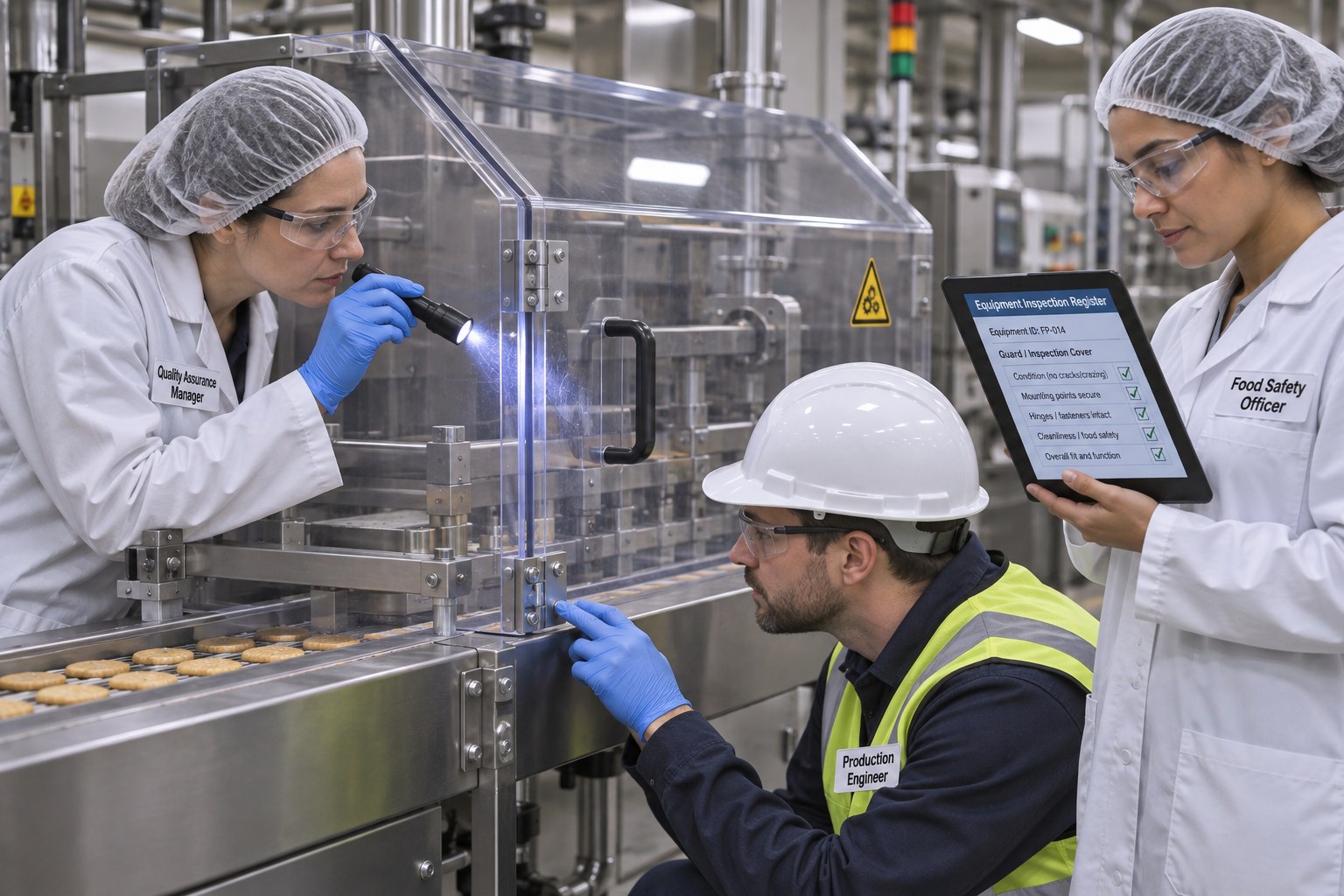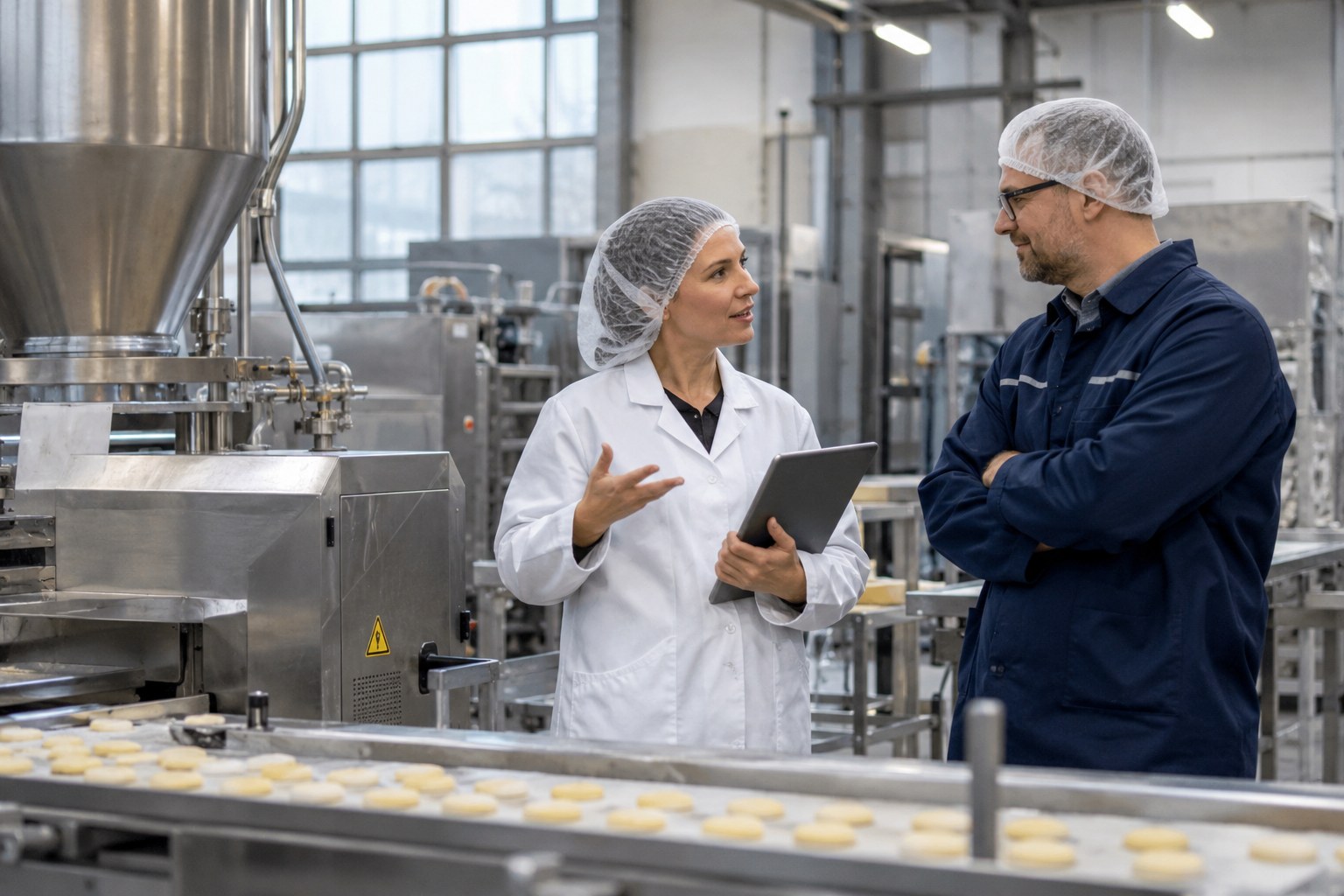
A food manufacturing facility may have carefully approved ingredients, documented suppliers and an established halal management system. Yet a routine sanitation activity can introduce an overlooked risk when a cleaning contractor arrives with an unfamiliar detergent or a production employee replaces an approved cleaning chemical with a commercially available alternative.
The replacement may appear to perform the same function, but its composition, intended application, rinsing requirements and suitability for the manufacturing environment may differ.
For halal food manufacturers, cleaning chemical control should therefore extend beyond maintaining a clean factory. It requires coordination between procurement, sanitation, production, quality assurance and halal management personnel to prevent unsuitable materials or uncontrolled cleaning practices from affecting production.
Why Cleaning Chemicals Deserve Greater Attention in Halal Food Manufacturing
Food manufacturers use a variety of chemical products to maintain processing equipment, production rooms, storage facilities and employee hygiene areas.
These may include detergents, degreasers, disinfectants, descaling products and specialised chemicals used in automated cleaning systems.
Although these substances are generally not intended to become ingredients in finished food products, their application creates potential contamination pathways. Chemical residues may remain on equipment, incorrectly stored products may leak near ingredients, and unsuitable cleaning practices may introduce substances into exposed production areas.
Manufacturers should consider two separate questions:
- Food safety suitability: Is the chemical appropriate for its intended application, and can its use be controlled without creating unacceptable contamination risks?
- Halal assurance suitability: Has the manufacturer assessed relevant material information, exposure pathways and applicable halal requirements?
Evidence addressing one question does not automatically resolve the other. A product marketed as suitable for food-processing environments should not automatically be described as halal-certified.
Understanding the Malaysian Halal Assurance Context
In Malaysia, food manufacturers operating under Malaysian halal certification should consult the applicable certification framework administered by the Department of Islamic Development Malaysia (JAKIM) and relevant state halal authorities.
The official Halal Malaysia portal provides access to reference materials, including the Malaysian Halal Management System 2020 and Malaysia Halal Certification Manual Procedure 2020. Businesses should also check applicable amendments, circulars and current authority guidance.
Cleaning chemical management should be considered within the manufacturer’s wider assessment of manufacturing practices, contamination prevention and halal assurance.
This does not mean that every detergent, disinfectant or cleaning product is subject to identical halal documentation requirements. Manufacturers should establish what evidence is appropriate for the particular substance, its intended application and the applicable certification scheme.
Where uncertainty exists, businesses should obtain clarification from the competent halal authority instead of independently determining the religious status of a chemical formulation.
1. Establish an Approved Cleaning Chemical Register
A central chemical register provides the foundation for effective control. It should cover products purchased directly by the manufacturer and those introduced by external cleaning contractors.
Each chemical should have a specific identity rather than being recorded under a broad description such as detergent or sanitiser.
| Register Field | Purpose |
|---|---|
| Product name and chemical code | Identifies the exact commercial product. |
| Manufacturer and supplier | Establishes the product source. |
| Intended application | Defines where and how the chemical may be used. |
| Safety Data Sheet (SDS) | Supports chemical hazard assessment and safe handling. |
| Technical documentation | Supports assessment of suitability and application conditions. |
| Relevant halal supporting evidence | Provides appropriate documentation where applicable. |
| Application and rinsing instructions | Connects the approved product to sanitation procedures. |
| Approval status and reviewer | Identifies who authorised the product for use. |
A Safety Data Sheet is an important chemical safety document, but it should not be treated as a substitute for halal certification evidence where such evidence is required.
Maintaining an accurate register also helps procurement prevent accidental substitutions when suppliers discontinue products or introduce new formulations.
2. Classify Chemicals According to Their Exposure Pathways
A floor-cleaning detergent used in an administrative office presents a different operational risk from a chemical circulated through equipment that directly contacts food.
Manufacturers can use the following practical classification to determine the appropriate level of assessment and control.
| Application Area | Potential Exposure | Suggested Management Approach |
|---|---|---|
| Administrative areas | Limited production exposure | Maintain basic chemical identification and storage controls. |
| Production floors and walls | Indirect contamination through splashing or dispersal | Control cleaning schedules, application methods and product exposure. |
| Equipment exterior | Possible transfer to nearby food-contact surfaces | Assess equipment layout and cleaning practices. |
| Food-contact surfaces | Potential chemical residue transfer | Apply documented product approval, cleaning and verification controls. |
| Cleaning-in-place systems | Internal exposure through pipes, tanks and processing circuits | Establish validated cleaning conditions and equipment release procedures. |
These are suggested operational categories, not official halal certification classifications. A manufacturer’s actual risk assessment should reflect its products, equipment and production environment.
3. Prevent Unauthorised Chemical Substitutions
Cleaning products are sometimes replaced because an approved chemical is unavailable, a distributor offers a lower price or a sanitation contractor recommends a different formulation.
However, similar commercial descriptions do not establish technical equivalence. A replacement may require different application conditions, affect equipment materials differently or introduce new documentation concerns.
Before introducing a replacement chemical, the responsible personnel should review:
- Whether its exact product identity is already approved.
- Whether its intended application is appropriate.
- Whether additional material information or halal-related evidence is necessary.
- Whether equipment compatibility and sanitation effectiveness have been assessed.
- Whether cleaning instructions and staff training need updating.
- Whether the existing verification methods remain appropriate.
Urgent production requirements should not bypass this review. Manufacturers should prepare approved contingency products where appropriate, particularly when cleaning chemicals have long purchasing lead times.
Factories using external sanitation contractors should also establish contractual controls preventing contractors from introducing unapproved products.
4. Control Chemical Storage and Distribution
Even an appropriately assessed cleaning chemical can become a contamination risk when it is incorrectly stored, transferred or identified.
Factories should establish designated chemical storage locations suited to the hazards of the products involved. Employees should be able to identify each chemical and distinguish it from ingredients, processing aids and other production materials.
Particular attention should be given to secondary containers, mobile cleaning stations and chemical dispensing systems. An unlabelled container makes it difficult to establish what substance was used, investigate an incident or demonstrate that the cleaning procedure was followed.
Access to concentrated chemicals should be controlled according to the manufacturer’s chemical safety arrangements. Storage compatibility, spill containment, personal protective equipment and emergency procedures should follow the relevant safety documentation and occupational safety requirements.
Cleaning chemicals should never be mixed or used outside their authorised instructions merely because an employee believes that doing so will improve cleaning performance.
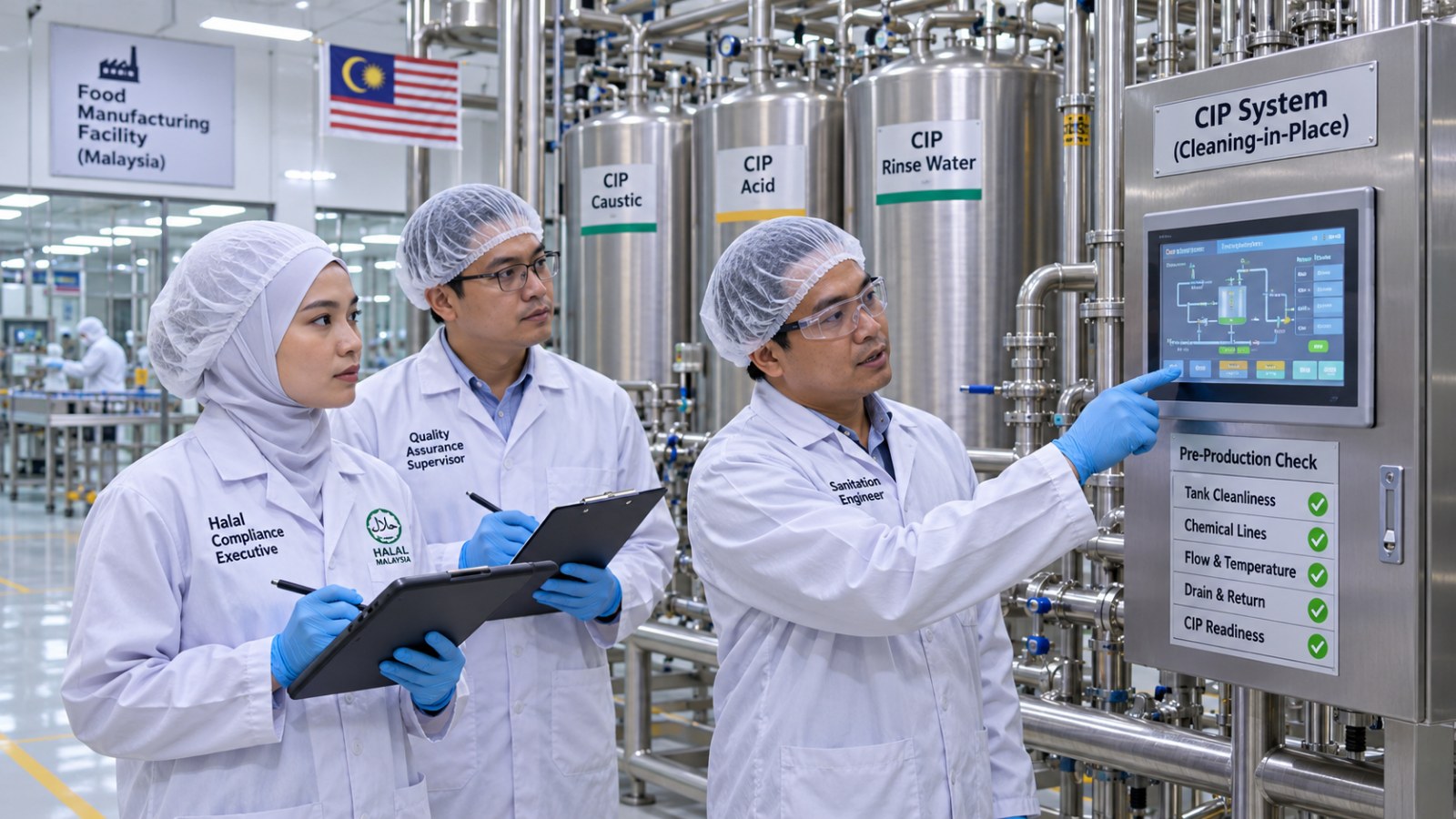
5. Verify Cleaning-in-Place Systems Before Production Restarts
Cleaning-in-place (CIP) systems are used in facilities producing beverages, sauces, dairy products and other foods processed through enclosed equipment.
These systems can reduce manual cleaning requirements, but their enclosed nature makes it difficult for employees to inspect every internal surface directly.
Manufacturers should establish suitable cleaning programmes based on equipment design, product characteristics, chemical instructions and technical validation.
Depending on the process, relevant monitoring parameters may include chemical concentration, temperature, circulation conditions, cleaning duration and final rinse characteristics.
The Codex General Principles of Food Hygiene, revised in 2022, provides a useful international reference for sanitation effectiveness and chemical contamination prevention.
Factories should not assume that the completion of an automated cleaning cycle automatically authorises equipment for production. An interrupted cycle, incorrect chemical connection or unresolved monitoring deviation may require investigation before restart.
Where appropriate, verification should also address chemical residues through suitable methods selected for the particular substance and application. A general hygiene test does not necessarily establish the absence of chemical residues or independently confirm halal compliance.
6. Introduce a Pre-Production Chemical Release Checklist
A practical way to strengthen accountability is to establish a formal equipment release decision after relevant sanitation activities.
Before restarting an affected production line, authorised personnel can use the following checklist:
- The correct approved cleaning chemicals were used.
- The documented sanitation procedure was completed.
- Relevant process monitoring results meet established acceptance criteria.
- Required rinsing or other chemical removal steps were completed.
- Applicable residue verification results are satisfactory.
- Cleaning tools and chemical containers have been removed from exposed production areas.
- Outstanding cleaning deviations have been investigated and resolved.
- The equipment release decision has been recorded by authorised personnel.
The checklist should be adapted to the actual manufacturing process. It is not necessary to impose identical verification methods on every machine or cleaning activity.
The important principle is that production release should depend on appropriate evidence, not simply the time shown on the manufacturing schedule.
7. Respond Properly When a Chemical-Control Failure Occurs
Consider a hypothetical Malaysian sauce manufacturer that discovers an unfamiliar cleaning product was used inside a processing tank before the morning production shift.
The immediate concern is whether the substance could have affected food-contact surfaces or products manufactured after cleaning.
The company should suspend affected operations where necessary, identify the chemical, preserve relevant records and place potentially affected products under appropriate control while authorised personnel investigate the incident.
The investigation should establish which equipment was cleaned, when the chemical was introduced, whether production subsequently occurred and which batches may have been exposed.
Technical personnel should assess the possible chemical contamination risk, while the responsible halal management personnel should evaluate any applicable halal-related concerns and consult the competent authority when necessary.
Repeating the normal cleaning procedure should not automatically close the incident. The manufacturer needs evidence that corrective actions address the identified problem. Products manufactured before the issue was discovered may require a separate disposition decision.
8. Measure Sanitation Efficiency Without Weakening Controls
Effective chemical management can also support operational improvement. Manufacturers may be able to reduce unnecessary chemical consumption, repeated cleaning activities and avoidable production downtime by improving equipment design and sanitation consistency.
Useful performance indicators include:
- Cleaning chemical consumption per comparable completed cleaning cycle.
- Water consumption per validated sanitation cycle.
- Frequency of repeated cleaning caused by unsuccessful verification.
- Number of unauthorised chemical substitutions.
- Production downtime attributable to sanitation deviations.
- Percentage of applicable equipment releases supported by completed verification records.
Efficiency improvements should be assessed alongside hygiene verification, chemical residue controls and relevant halal assurance arrangements. Lower chemical consumption is not a meaningful success if it results from inadequate cleaning.
A manufacturer that achieves an exceptional, objectively measurable sanitation or resource-efficiency milestone may separately consider business achievement recognition. The application guidance on Asia Record’s official website explains how organisations can submit measurable achievements and supporting evidence for assessment.
Such recognition concerns the documented business achievement. It does not establish halal status, replace official halal certification or demonstrate food safety compliance.
Building a More Reliable Sanitation Management System
Cleaning chemical control is most effective when it becomes part of everyday manufacturing management rather than an isolated responsibility assigned to sanitation employees.
Procurement must understand which chemicals are approved. Production supervisors must know when equipment can be released. Quality assurance personnel must establish appropriate verification arrangements, while halal management personnel must address relevant material and compliance considerations.
Manufacturers can begin by reviewing their existing chemical inventory, identifying undocumented products and examining the cleaning activities with the greatest potential for product exposure.
By connecting purchasing decisions, chemical identification, sanitation procedures and equipment release records, halal food manufacturers can develop a more reliable production environment without introducing unnecessary controls for low-risk activities.
The objective is not simply to maintain visibly clean equipment. It is to maintain a controlled manufacturing environment in which the materials used for cleaning and the effectiveness of cleaning activities can be appropriately demonstrated.