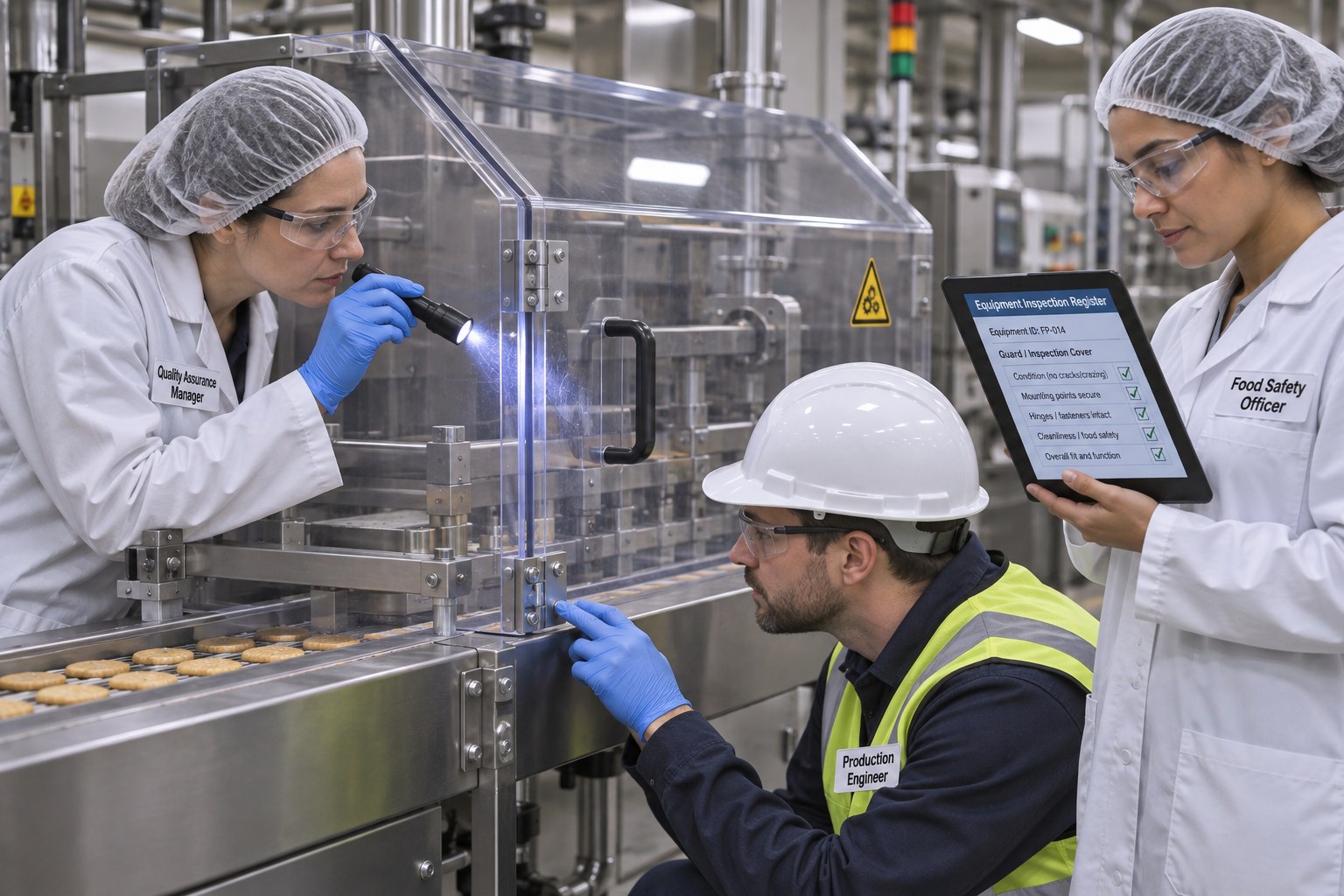
A production operator notices a crack in the transparent inspection cover of a food processing machine during a routine equipment check. The machine has already been operating, several batches have been completed, and finished products are waiting for distribution.
The immediate concern is not simply whether the damaged cover needs replacing. Management must establish when the damage occurred, whether any fragments are missing, which products may have been exposed and whether the affected equipment can safely return to operation.
For halal food manufacturers across Southeast Asia, glass and brittle plastic control is an important component of manufacturing integrity. Although physical contamination prevention is primarily a food safety responsibility, breakage incidents may also expose weaknesses in documentation, equipment maintenance, traceability and wider halal assurance arrangements.
Effective control begins with identifying breakable materials before an incident occurs.
Why Glass and Brittle Plastic Require Dedicated Controls
Glass and rigid, brittle plastics are used throughout modern food processing facilities because of their transparency, durability and suitability for particular equipment applications. However, damaged components can release fragments that may be difficult to identify once they enter production.
The Codex Alimentarius General Principles of Food Hygiene (CXC 1-1969), revised in 2022, identifies physical contamination as a food hygiene concern and provides guidance on preventive maintenance, inspections, appropriate detection methods and breakage response arrangements.
Potential sources of breakable materials include:
- Glass lighting fixtures and protective covers.
- Transparent machine inspection windows.
- Rigid plastic equipment guards.
- Glass measuring instruments and laboratory containers.
- Pressure gauge covers and display panels.
- Transparent ingredient storage containers.
- Glass jars, bottles and other product packaging.
- Windows positioned near exposed production areas.
Manufacturers should assess the likelihood of damage and the potential pathway between each component and exposed food. A damaged item located above an open production line may present a different risk from a similar item inside an enclosed administrative area.
Distinguish Physical Contamination From Halal Status
A glass breakage incident requires a food safety assessment. It should not automatically be treated as a religious determination about the halal status of the affected product.
Additional halal-related concerns may arise if an incident involves uncontrolled cleaning materials, unapproved replacement components, compromised segregation or other circumstances relevant to the manufacturer’s applicable halal requirements.
In Malaysia, businesses should refer to the official Halal Malaysia certification guidance, including the Malaysian Halal Management System documentation, and consult JAKIM or the relevant state halal authority when clarification is necessary.
Manufacturers operating in other countries should follow the requirements applicable to their respective certification jurisdictions. Internal food safety inspections do not replace official halal certification or determine religious acceptability.
Create a Glass and Brittle Plastic Register
A factory cannot consistently inspect breakable materials if it does not know where they are located.
A glass and brittle plastic register should connect each relevant item to its physical location, equipment identification and inspection history. Photographs can help employees recognise the expected condition of individual components, particularly where several machines contain similar inspection covers.
| Register Field | Recommended Information |
|---|---|
| Item identification | Unique reference number and component description |
| Location | Production area, equipment number and installation position |
| Material type | Glass, brittle plastic or other relevant breakable material |
| Exposure assessment | Whether fragments could reach exposed food or packaging |
| Protective measures | Enclosure, protective shielding or suitable containment |
| Inspection frequency | Schedule established according to the assessed risk |
| Condition history | Inspection findings, deterioration and previous damage |
| Responsible personnel | Assigned inspector and corrective action owner |
The register should be updated whenever equipment is installed, modified, relocated or removed. A document prepared during factory commissioning will become unreliable if subsequent engineering changes are not reflected in it.
Prioritise Inspections According to Product Exposure
Inspecting every breakable item at the same frequency can consume resources without directing sufficient attention towards the most significant hazards.
A practical approach is to classify items according to their relationship with exposed products and the effectiveness of existing barriers.
| Suggested Risk Priority | Typical Situation | Management Response |
|---|---|---|
| High | Breakable components above or immediately beside exposed food | Frequent documented inspections and consideration of safer alternatives |
| Medium | Items near production but separated by protective barriers | Scheduled inspections covering component and barrier condition |
| Lower | Items outside processing areas without an identified exposure pathway | Routine facility inspections appropriate to the assessed risk |
These classifications are suggested management tools rather than mandatory regulatory categories. Inspection frequency should reflect equipment design, production conditions, historical incidents and the manufacturer’s documented food safety assessment.
Employees should look for cracks, missing sections, loose fittings, damaged protective covers and signs of deterioration. Reporting early damage can allow planned intervention before a component fails during production.
Establish a Breakage Response Procedure
When glass or brittle plastic damage is discovered, production pressure must not determine whether potentially affected products are released.
A documented response procedure should assign responsibilities for equipment isolation, product containment, investigation and recovery. Employees need to understand who has authority to make each decision.
1. Stop and Contain the Affected Operation
Where a credible contamination risk exists, stop the affected process safely and restrict access. Identify potentially exposed ingredients, work-in-progress, finished products and packaging materials. Prevent their unintended movement by applying physical and inventory-system holds where appropriate.
2. Establish the Potential Exposure Period
Review the last reliable inspection showing that the component was intact. Compare this information with production records, equipment operation history, maintenance activities and material movements.
If the time of damage cannot be established confidently, adopt a conservative containment scope rather than assuming that only the latest batch was affected.
3. Assess Fragment Distribution
Examine the damaged component, surrounding machinery and relevant production pathways. Consider whether fragments could have travelled into connected conveyors, collection containers or adjacent processing areas.
Recovered fragments may support the investigation, but visual reconstruction alone should not be treated as proof that all fragments have been recovered.
4. Complete Controlled Cleaning and Repairs
Use an appropriate incident-specific cleaning method that minimises the risk of spreading fragments. Maintenance personnel should replace damaged components with suitable approved alternatives and record the work performed.
The inspection should include areas that may be overlooked during routine cleaning, such as equipment recesses, conveyor edges and removable machine assemblies.
5. Determine Product Disposition
Qualified food safety personnel should assess potentially affected products using documented procedures. Product release must not depend solely on visual inspection or the absence of further complaints.
Where unsafe products may already have entered distribution, manufacturers should activate applicable withdrawal or recall arrangements and fulfil relevant reporting obligations.
Use Separate Approvals for Equipment Restart and Product Release
Replacing a damaged component and cleaning a production line resolves only part of the incident. It does not establish that products manufactured before the repair are suitable for release.
Manufacturers should therefore distinguish between two operational decisions.
| Decision | Evidence to Consider |
|---|---|
| Equipment restart | Completed repairs, cleaning verification, equipment condition and authorised inspection findings |
| Affected product disposition | Exposure assessment, batch traceability, investigation findings and documented food safety evaluation |
Where an incident raises separate halal compliance concerns, the relevant halal assurance personnel should participate in the assessment and obtain clarification from the competent authority where appropriate.
This separation prevents a common management error: assuming that successful equipment recovery automatically resolves every concern associated with previously manufactured products.
Understand the Limitations of Foreign Material Detection
Foreign material detection systems can support contamination prevention, but their suitability depends on the material, product characteristics and equipment configuration.
A conventional metal detector cannot reliably detect ordinary glass or non-metallic plastic fragments. X-ray inspection may identify certain glass fragments, but detection capability depends on factors including fragment size, density, product composition and equipment performance. Some plastics may be particularly difficult to detect.
Manufacturers should evaluate detection performance for their actual production conditions rather than relying on general equipment capability claims.
Detection technology should complement preventive inspections and incident containment. It should not become a justification for releasing potentially contaminated products without an appropriate food safety assessment.
Prevent New Risks During Equipment Replacement
Maintenance work can introduce additional breakable materials when technicians replace inspection windows, guards or instrument covers.
Purchasing decisions should consider mechanical strength, operating temperatures, cleaning compatibility, food-contact suitability where relevant and any applicable halal documentation requirements.
Replacement activities should be connected to the manufacturer’s existing maintenance material controls, ensuring that accompanying consumables and servicing activities are also appropriately managed.
Engineering and quality assurance personnel should jointly review significant equipment modifications. An alternative material may reduce breakage risk but introduce other operational concerns if it is unsuitable for the intended application.
Measure the Effectiveness of Breakage Prevention
Counting reported breakages alone does not provide a complete picture of control effectiveness. Management should also examine whether inspections are completed, defects are corrected and incident investigations can reliably identify affected batches.
| Performance Indicator | Management Purpose |
|---|---|
| Register coverage | Check whether relevant breakable components have been identified |
| Inspection completion rate | Monitor completion of scheduled inspection activities |
| Unresolved component defects | Identify deterioration requiring corrective action |
| Repeat breakage incidents | Identify recurring equipment or handling problems |
| Containment response time | Evaluate how quickly potentially affected materials are isolated |
| Investigation completeness | Assess the reliability of incident documentation and batch identification |
These indicators should be interpreted together. An increase in recorded minor defects may reflect improving inspection discipline rather than deteriorating equipment performance. Employees should never be discouraged from reporting incidents simply to maintain favourable performance figures.
Manufacturers should preserve original inspection records, maintenance histories, production data and corrective action evidence when evaluating sustained operational improvements.
If these improvements eventually contribute to an exceptional, objectively measurable manufacturing achievement, the business may separately explore the evidence and assessment requirements for business achievement recognition through Asia Record’s official website. Such recognition concerns the measurable achievement itself and does not establish food safety compliance, halal status or certification eligibility.
Build a Practical Implementation Programme
Manufacturers establishing a dedicated breakable material control programme can organise implementation around three stages.
| Implementation Stage | Priority Actions |
|---|---|
| First 30 days | Identify breakable materials, establish the register and address immediate contamination concerns |
| Days 31-60 | Introduce risk-based inspection schedules, assign responsibilities and establish incident procedures |
| Days 61-90 | Conduct response exercises, review recurring defects and evaluate documentation quality |
This suggested schedule should be adapted to the facility’s complexity and available resources. Immediate food safety concerns must be addressed without waiting for scheduled implementation milestones.
Response exercises can be conducted using simulated scenarios without introducing actual glass fragments into operational production areas.
Make Breakage Prevention Part of Everyday Manufacturing
Glass and brittle plastic control becomes more effective when it forms part of normal production and maintenance activities rather than an inspection exercise performed only before an audit.
Operators should understand which defects require escalation. Maintenance teams should know how replacement components are assessed. Quality assurance personnel should be able to reconstruct affected production periods, while halal assurance teams should evaluate any separate concerns arising under the applicable certification framework.
For halal food manufacturers, the objective is to maintain a production environment where potential contamination is identified early, incidents are investigated transparently and decisions are supported by reliable evidence. Protecting product integrity depends not only on preventing equipment failures but also on responding responsibly when those failures occur.