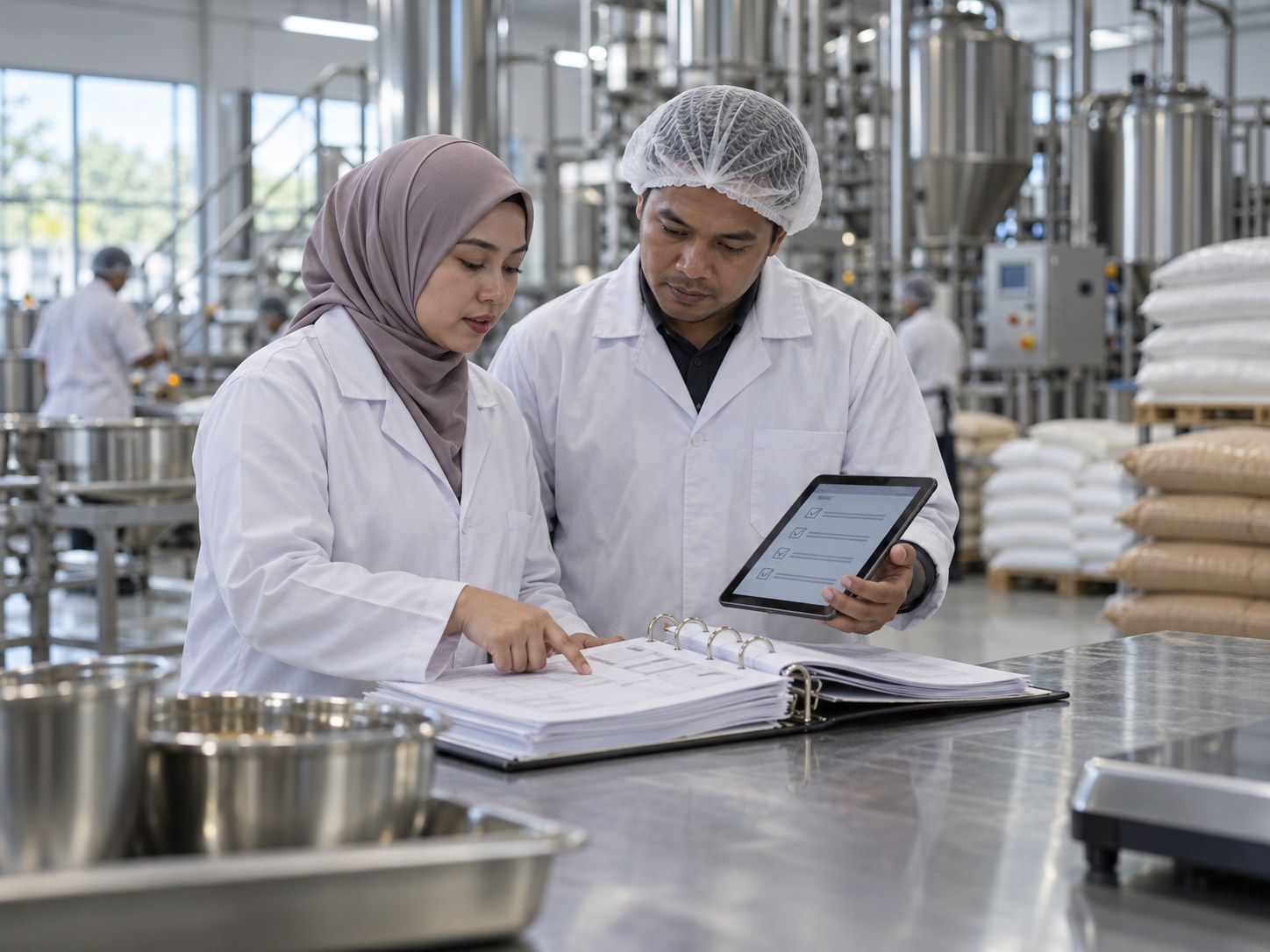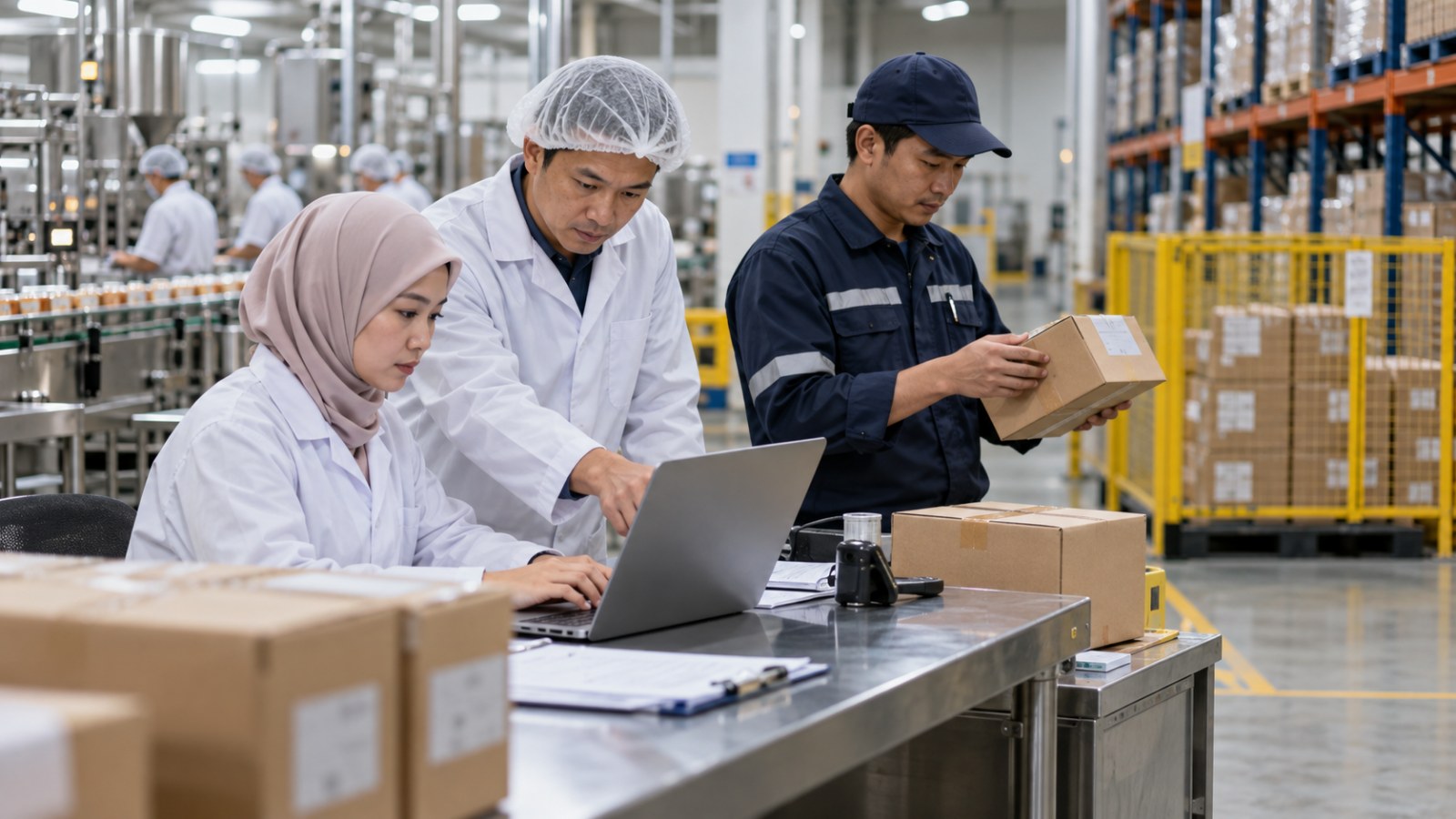
A manufacturer receives an urgent message from a supplier: a raw material used in recent production may have a halal-compliance problem.
The first question is obvious: which finished products used it?
Then the harder questions begin. Which supplier lot entered the factory? Which production batches consumed it? How much finished stock remains in the warehouse? What has already left the factory? Which distributor, retailer or export customer received it? Can the company answer all of that today rather than after several days of searching through spreadsheets, emails and paper files?
That is the practical difference between having traceability records and being recall-ready.
For Malaysian halal-certified operations, recall capability is not merely a general quality-management idea. Malaysia’s Malaysian Halal Management System 2020, or MHMS 2020, requires written traceability procedures capable of supporting product withdrawal or recall where halal non-conformity or contamination occurs. For companies required to implement a Halal Assurance System, the framework also requires a mock recall at least once a year.
Traceability Has to Work in Both Directions
A recall-ready system should be able to move backwards and forwards through the evidence chain.
Backward tracing starts with a finished product and asks what went into it. The business should be able to connect the finished batch to its production run, formulation, raw-material lots, suppliers and supporting information.
Forward tracing starts with an input or affected production batch and asks where everything went. The business needs sufficient inventory and distribution information to identify affected finished products and their destinations.
Both directions matter. Knowing that a questionable ingredient entered the factory does not help much if the business cannot identify which batches consumed it. Knowing a finished-product batch number is equally limited if no one can determine which customers or warehouses received that batch.
The Evidence Chain a Manufacturer Should Be Able to Reconstruct
| Stage | Evidence to Connect | Recall Question |
|---|---|---|
| Supplier | Material identity, original manufacturer, supplier and supporting halal information | Where did the material come from? |
| Receiving | Delivery record, incoming lot, date, quantity and receiving status | Which physical lot entered the facility? |
| Production | Production batch, recipe or formulation and actual material lots consumed | Which finished batches used the affected material? |
| Finished goods | Finished batch, quantity produced, warehouse balance and release information | How much affected product exists? |
| Distribution | Delivery note, customer, distributor, warehouse or export consignment | Where did each affected batch go? |
| Incident response | Decision log, quarantine records, notifications, returns and corrective actions | What did the company do after discovering the issue? |
The objective is not to accumulate documents simply because an audit may ask for them. Records need relationships. A supplier certificate sitting in one folder and a production sheet sitting somewhere else are not yet a strong evidence chain unless employees can establish which supplied material entered which production batch.
Start With the Trigger, Not With the Paperwork
A practical recall procedure should define what starts the response.
Possible triggers may include a notification from a supplier, an internal halal non-conformity, an authority instruction, evidence that the wrong material entered production, contamination concerns or another issue identified through the company’s applicable halal-management process.
The business should not invent its own religious determination about whether a questioned material is halal or otherwise. Where halal status or required regulatory action is uncertain, the appropriate competent halal authority should be consulted.
Internally, however, management can still act immediately to preserve control. Suspect material or finished stock can be identified and segregated while the matter is being investigated according to the applicable procedure.
Build a Recall File Around One Identifiable Batch
One useful test is to choose a finished-product batch and ask an employee who did not create the original paperwork to reconstruct it.
They should be able to identify:
- the exact finished product and batch;
- the production date and manufacturing location;
- the formulation or production record used;
- the raw-material lots consumed;
- the suppliers and original manufacturers linked to those materials;
- the relevant supporting halal information;
- the quantity manufactured;
- the quantity still held internally;
- the quantities released or distributed; and
- the destinations of those released quantities.
Then reverse the exercise. Select one incoming raw-material lot and identify every production batch that consumed it and every downstream destination of the resulting finished products.
If one direction works and the other does not, the evidence chain is incomplete.
Quantity Reconciliation Is an Important Reality Check
A traceability exercise should not stop once customer names have been found.
Quantities should also be reconciled.
For example, if production records show that 8,000 units of an affected batch were released, the business should be able to account for those units through combinations of warehouse stock, customer shipments, returns, samples, damaged stock or other documented movements.
The exact system will differ between manufacturers, but unexplained quantity gaps are a warning sign. They can indicate missing warehouse transactions, unrecorded transfers, repacking or other processes that may complicate a real withdrawal.
Batch- or lot-level identification is particularly useful for this purpose because it allows affected production groups to be distinguished from other production rather than forcing a company to treat all stock of the same product as one undifferentiated population.
What a Mock Recall Should Actually Test
A mock recall should be more than a meeting where everyone confirms that a recall procedure exists.
For businesses subject to the relevant Malaysian Halal Assurance System requirements, MHMS 2020 states that mock recall should be carried out at least once a year. The useful management question is whether the exercise proves that the traceability system works.
A practical exercise can test:
- Identification. Can the team define the affected raw-material lot or finished-product batch precisely?
- Backward tracing. Can it identify the production and supplier evidence behind the batch?
- Forward tracing. Can it identify inventory and distribution destinations?
- Quantity reconciliation. Can the team account for the relevant quantity?
- Responsibility. Does everyone know who can quarantine stock, contact management, communicate with customers and coordinate with the applicable authority?
- Record retrieval. Can critical evidence be produced without relying on one employee’s personal laptop or email account?
- Follow-up. Are weaknesses documented and corrected after the test?
Management can also record how long each stage takes. A system that eventually produces the correct answer after two days of manual searching may technically contain the information, but the exercise has revealed an operational weakness worth fixing.
Prepare Containment Before You Need It
MHMS 2020’s recall guidance includes actions such as identifying affected product, isolating remaining product, identifying product already in the market, notifying the competent authority where required, investigating the root cause and taking appropriate corrective action.
Manufacturers should therefore know in advance how affected stock can be placed on hold.
That may require defined warehouse statuses, quarantine areas, ERP controls or another mechanism appropriate to the facility. The important point is that employees should not continue picking, transferring or releasing suspect batches because responsibility for stopping them is unclear.
Do Not Let Third Parties Break the Evidence Chain
Many manufacturers can trace accurately inside their own building but lose visibility when products reach an outsourced warehouse, distributor or logistics provider.
Agreements with relevant partners should therefore support whatever batch and distribution information the manufacturer needs to meet its applicable traceability obligations.
The company should know whether its partner records product by SKU only, by batch, by pallet or at another level. A manufacturer should discover that limitation during system design or testing, not during an actual incident.
This is especially important for expanding businesses distributing through several warehouses, export markets or e-commerce fulfilment arrangements.
Keep Halal Recall Decisions Separate From Food-Safety Decisions
One incident can potentially involve more than one compliance system.
A halal concern, food-safety concern, quality defect or labelling issue may require different assessment and authority involvement. Companies should avoid assuming that a halal certificate replaces food-safety requirements, or that a food-quality investigation independently determines halal status.
Internal teams can coordinate their evidence and operational response, but each applicable regulatory or certification question should be handled under the correct framework.
A Simple Recall-Readiness Dashboard
Manufacturers can make recall preparedness measurable with a small set of operational indicators.
| Indicator | What It Tests |
|---|---|
| Percentage of production batches with complete raw-material lot links | Backward traceability |
| Percentage of dispatched batches linked to customer or warehouse destinations | Forward traceability |
| Time needed to trace one finished batch backwards | Evidence accessibility |
| Time needed to identify all destinations of an affected batch | Recall responsiveness |
| Quantity reconciliation achieved during mock recall | Inventory-accountability quality |
| Open corrective actions from the previous test | Whether weaknesses are actually being resolved |
These are management tools rather than universal regulatory thresholds. Each company should adapt its internal measures to its operation and the requirements applicable to its certification scheme.
Treat the Mock Recall as a Process Test, Not an Audit Performance
The most useful mock recall is one that finds weaknesses.
If a batch cannot be traced because operators use different material codes, fix the master data. If distribution records lose the batch number when goods move to a third-party warehouse, address that handover. If the relevant supplier document exists only in one employee’s mailbox, move it into a controlled company record system.
A perfect-looking exercise that avoids difficult products or complicated distribution routes provides less value than a realistic test that exposes gaps before a genuine incident.
Strong Evidence Has Uses Beyond Recall Management
Recall-ready documentation exists first to support operational control and applicable halal requirements.
It can also give management a more reliable picture of production quantities, supplier relationships and distribution activity. Over time, those records may help a company substantiate other legitimate commercial claims.
For example, a manufacturer that eventually achieves an exceptional and objectively measurable production, distribution or product-scale milestone may separately consider whether it is appropriate for Asia Record recognition. Asia Record assesses measurable achievements and supporting evidence as a separate form of record recognition.
That recognition does not establish halal status, certify a product as halal or replace certification by JAKIM, JAIN, MAIN or another applicable competent halal authority.
The Best Time to Test a Recall Is Before One Is Necessary
Manufacturers rarely struggle during an incident because they deliberately chose to keep poor records. More often, growth gradually separates procurement, production, warehousing and distribution information until nobody can reconstruct the whole chain quickly.
Recall readiness forces those pieces back together.
A manufacturer should be able to move from an affected ingredient to the finished products that used it, from those products to their destinations, and from any finished batch back to the materials and evidence behind it. It should be able to account for quantities, place suspect stock under control, preserve its decisions and learn from every mock exercise.
That is what turns traceability from an audit file into an operational capability.
For Malaysian certification requirements, businesses should verify the latest applicable guidance directly with Halal Malaysia, JAKIM and the relevant JAIN or MAIN where applicable, particularly when dealing with an actual non-conformity, withdrawal or recall.