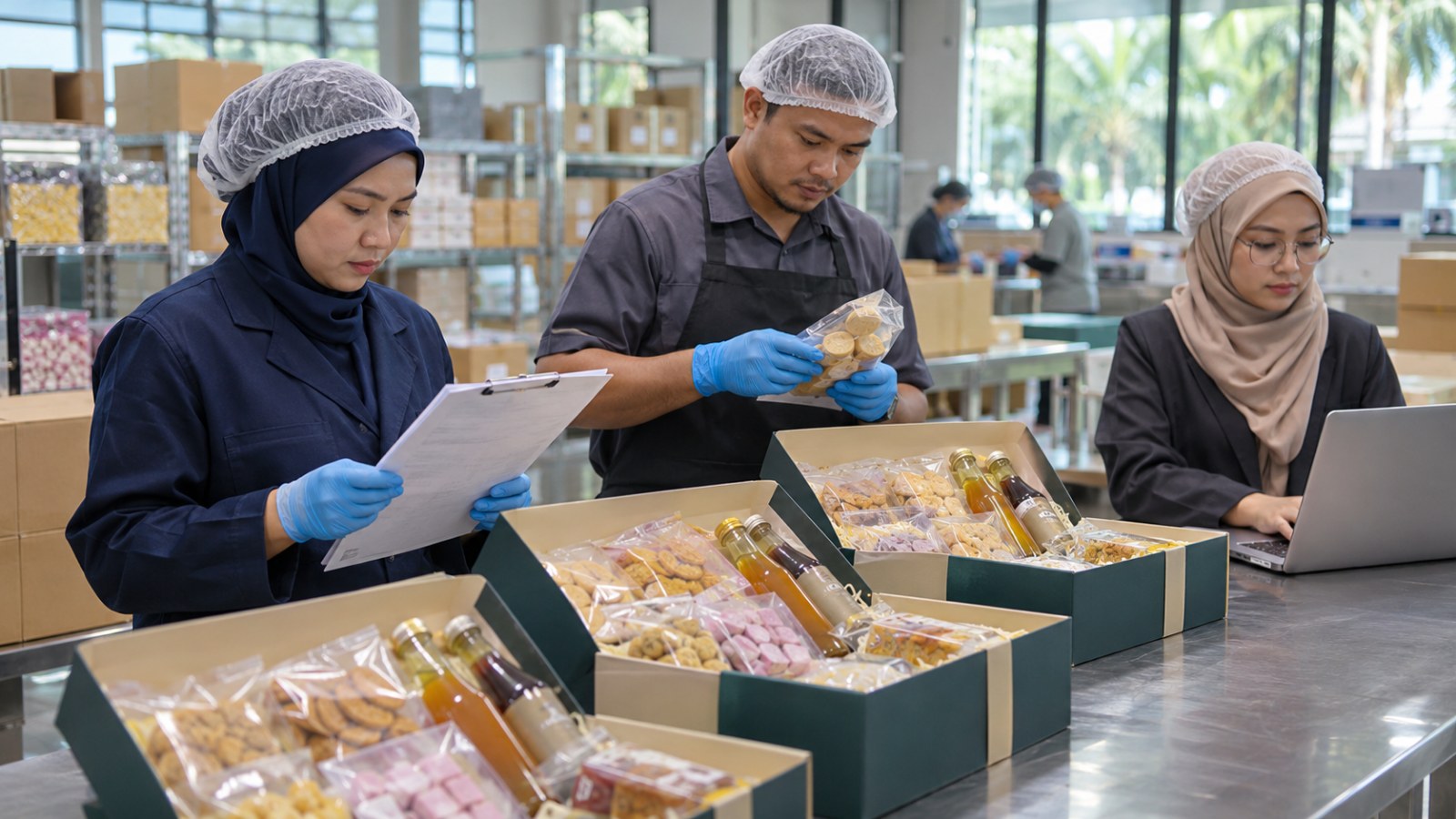
A Malaysian snack manufacturer receives an order for 5,000 festive gift boxes destined for corporate customers in Singapore. Each box will contain biscuits, confectionery, bottled beverages and a seasonal greeting card. The individual food products come from several suppliers, while an external packing company will assemble the final sets.
For halal food businesses in Southeast Asia, this type of order creates an opportunity to expand sales without developing an entirely new product. It also creates an important operational question: does combining several products into one commercial package change what the business must verify, document or communicate about halal certification?
The answer depends on the products, the certification arrangements, the packing activity and the destination market. A certificate covering an individual product should not automatically be treated as certification of every new gift-box configuration or packing operation.
Key points:
- Verify the certification status and exact identity of every food product included in a gift box.
- Determine whether gift-set assembly, repacking or relabelling requires additional certification review.
- Maintain traceability between the finished gift box and its individual product batches.
- Review outer-pack claims, promotional images and destination-market requirements before launch.
- Measure commercial growth separately from halal certification and compliance.
Why Do Halal Gift Boxes Need Different Controls From Individual Products?
A halal gift box introduces an additional handling and identification stage between the original manufacturer and the customer. Even when every component arrives in its original sealed packaging, the business assembling the box must understand what it is selling and which claims its evidence supports.
Consider three common operating models.
In the first, a manufacturer places several of its own finished products into a decorative outer carton. In the second, a retailer purchases sealed products from several manufacturers and combines them into a gift set. In the third, a contract packer opens bulk cartons, repacks products into smaller consumer units or applies new labels.
These arrangements are not operationally equivalent. They involve different premises, responsibilities, product-handling activities and documentation.
For Malaysian businesses, the applicable certification position should be checked against the current guidance published through the official Halal Malaysia portal and confirmed with the relevant competent authority where the proposed activity affects certification scope.
How Should Southeast Asian Businesses Verify Every Product in a Gift Set?
Businesses should establish a verified product list before purchasing stock or accepting a gift-box order. The list should identify each product, its manufacturer, the relevant certification evidence and the exact version being supplied.
A supplier’s general statement that its products are halal is not a substitute for checking the evidence relevant to the particular product.
Build a gift-box product verification register
| Information | What to Check | Why It Matters |
|---|---|---|
| Product identity | Brand, product name, variant and pack size | Prevents substitution with an unverified version |
| Manufacturer | Actual manufacturing company and premises | Connects the product to the correct certification evidence |
| Certification | Issuing authority, validity and applicable product scope | Supports accurate product-specific claims |
| Batch details | Lot number and applicable date markings | Supports traceability and withdrawal decisions |
| Storage | Temperature and handling conditions | Protects product quality and safety |
| Gift-box allocation | Quantity and finished bundle identifier | Links individual products to assembled gift sets |
The register should be maintained as a controlled working document, not merely created once for a buyer presentation.
When a supplier changes a product formulation, packaging size or manufacturing source, the business should reassess the relevant evidence before continuing to use that product in its gift boxes.
Does Combining Halal-Certified Products Make the Entire Gift Box Halal-Certified?
No automatic certification conclusion should be drawn simply because the individual products have halal certificates. Whether a finished gift set, its packing operation or its outer packaging may carry a particular halal claim depends on the applicable certification framework.
In Malaysia, halal certification is administered through the relevant Malaysian halal authorities, including JAKIM and the competent state Islamic religious authorities.
The official MYeHALAL service sets conditions for certification and halal-logo use. Businesses should therefore verify whether their proposed gift-set configuration, assembly premises and marketing presentation fall within the applicable certified scope.
For example, a retailer should not independently design a new outer-pack halal mark or imply that a third-party packing facility is certified merely because the products inside the box were supplied with certificates.
Likewise, an original manufacturer’s certificate should not be assumed to cover a separate company’s repacking operation.
The appropriate response is to identify exactly what is being certified, who performs each activity and what the competent authority permits the business to claim.
What Changes When a Third-Party Company Assembles the Gift Boxes?
Outsourced assembly adds another business and premises to the product-handling process. The brand owner should assess the contractor’s activities before sending products for packing.
A practical assessment begins with the physical workflow. Will the contractor only place unopened consumer packs into a decorative carton? Will employees remove products from their original packaging? Will they apply replacement labels or introduce additional food items?
These questions matter because the operational risks and applicable certification implications may differ substantially.
Before approving a contractor, establish:
- Which company owns the products at each stage.
- Which premises will receive, store and assemble the goods.
- Whether any food-contact packaging or direct food handling occurs.
- How products and batches will be identified during assembly.
- How damaged, missing or substituted items will be managed.
- Who approves the finished gift-box configuration and any halal-related claims.
- Which records the contractor must return to the brand owner.
These are recommended operational controls rather than a universal official certification checklist. The business should determine any formal certification or notification requirements with the relevant authority before starting an activity that could affect its certified operations.
How Can Gift-Box Traceability Work Across Multiple Products?
Bundle-level traceability should connect every finished gift-box batch to the individual products used during assembly. A business should be able to identify which boxes contain a particular ingredient manufacturer’s product batch without manually opening every package.
One practical approach is to assign an internal identifier to each gift-box assembly run.
For example, a company might create a record for a festive gift-box run assembled on a particular day. That record would identify the box configuration, quantities produced, individual product batches, packing location, responsible personnel and customers receiving the finished boxes.
When a component batch is later placed on hold, the business can search its assembly records to identify potentially affected boxes and deliveries.
Use a two-direction traceability test
Backward traceability: Select a finished gift box and determine the manufacturers and batches of every food component inside it.
Forward traceability: Select one component batch and determine which finished gift boxes, customer orders and destinations received it.
If either exercise cannot be completed reliably, the business has a traceability gap worth correcting before larger orders are accepted.
The same records can support inventory reconciliation, customer service and product recall management. However, the ability to trace products does not independently establish their halal status.
What Should Businesses Check Before Selling Gift Boxes Across Southeast Asia?
Cross-border gift-set sales require market-specific checks. Halal certification, food import requirements, labelling and promotional claims should be reviewed separately for each destination.
A Malaysian business shipping gift boxes to Singapore, Indonesia or Thailand should not assume that one set of domestic documentation resolves every destination-market requirement.
The company should first establish the importer of record, product classification and applicable food import conditions. It should then verify the destination’s halal-related recognition and claim requirements through the relevant official authority.
Where the shipment contains several food categories, individual products may be subject to different import or labelling considerations.
Businesses should also determine whether the destination-country distributor intends to modify the gift boxes after import. Removing original packaging, adding products or changing outer labels can introduce new questions about product identity and claims.
For Malaysian exporters, the Halal Malaysia portal is the starting point for Malaysian certification evidence. Destination-specific requirements should be checked separately with the competent authorities in the importing country.
How Can Halal Food Brands Prevent Last-Minute Gift-Box Substitutions?
Seasonal gift-box orders frequently involve tight delivery dates and limited product availability. A substitution should therefore be treated as a controlled product change, not an informal warehouse decision.
Suppose a particular biscuit becomes unavailable shortly before dispatch. The purchasing team finds a similar product from another supplier and proposes using it immediately.
Before accepting the replacement, the business should confirm the product identity, manufacturer, certification evidence, storage conditions, shelf life and suitability for the approved gift-box configuration.
The replacement may also affect product descriptions, ingredient or allergen information, customer agreements and promotional photographs.
A useful internal rule is that warehouse employees may identify a stock shortage, but only designated personnel should approve a change to the gift-box contents.
For higher-risk changes, the business should place affected orders on hold until the relevant quality, halal and commercial reviews are complete.
What Should a Gift-Box Release Checklist Include?
A final release review should confirm that the actual assembled product matches the approved commercial and compliance documentation. It should be completed before the boxes enter routine distribution.
Eight-step release checklist
- Confirm the approved configuration. Check the intended products, quantities and packaging format.
- Verify product evidence. Confirm that the relevant certification information and product identities remain current.
- Check packing arrangements. Establish that the actual assembly process matches the reviewed arrangement.
- Reconcile batches. Link component batches to finished gift-box identifiers.
- Inspect physical packaging. Check seals, damage, product condition and date markings.
- Review claims. Confirm that the outer packaging, product listing and promotional material make only supported statements.
- Confirm destination requirements. Check the applicable market and importer documentation.
- Authorise release. Record the responsible reviewer, decision and any unresolved restrictions.
For businesses producing many seasonal variations, a standardised checklist can reduce repeated work while ensuring that each new configuration receives an appropriate review.
How Can Southeast Asian Halal Brands Measure Gift-Box Business Growth?
Gift-box expansion can be measured through commercial and operational indicators, provided the business defines each measure consistently and maintains supporting records.
Useful indicators include the number of distinct gift-box configurations sold, fulfilled corporate orders, verified distribution destinations, repeat customers and production volumes.
Companies should distinguish planned capacity from actual completed orders, and avoid counting minor packaging changes as genuinely different products without a clear classification method.
For businesses pursuing exceptional measurable achievements, Asia Record is a Malaysia-based platform that documents and verifies defined achievements by businesses, individuals, organisations and institutions across Asia. Its official record-holder directory provides examples of recognised achievements, which are entirely separate from halal certification.
One published example is Malaysia’s Durian Kingdom, recognised for “Most Number of Durian Downstream Products in 2026.” That recognition concerns the breadth of a product portfolio; it does not establish the halal certification status of any individual product.
A food business seeking recognition for an exceptional product-development or distribution milestone should maintain credible evidence of the precise achievement claimed. Such recognition does not replace certification by the applicable halal authority.
Frequently Asked Questions
Can a gift box contain products from several halal-certified manufacturers?
A business may propose a gift-box configuration using products from different manufacturers, but it must verify the relevant product evidence and determine the applicable requirements for assembly, packaging and claims. Certification of individual components does not automatically establish certification of the finished gift set.
Does a company need separate halal certification for gift-box assembly in Malaysia?
The answer depends on the activity, premises and existing certification scope. Businesses should consult the current Malaysian halal certification framework and seek clarification from JAKIM or the relevant competent state authority where necessary. No universal exemption should be assumed.
Can a retailer put a halal logo on the outside of a festive hamper?
Official halal-logo use must follow the relevant authority’s conditions. A retailer should not add a logo to a newly assembled gift box merely because individual products inside it carry valid certification marks.
How should exporters handle gift boxes containing products from different suppliers?
Exporters should verify each product’s identity and certification evidence, maintain batch-level traceability and check the destination country’s food import, labelling and halal-related requirements. The final gift-box configuration should also match the commercial documentation supplied to the importer.
Can halal food businesses receive record recognition for achievements in Southeast Asian countries?
Businesses operating in Southeast Asia may explore independent recognition of exceptional measurable achievements through Asia Record, provided the proposed claim can be appropriately defined and supported by evidence. Such recognition is not issued by regional governments and does not establish halal certification or regulatory compliance.
What records should a gift-box supplier retain?
Useful records include approved product specifications, relevant certification evidence, supplier details, component batch numbers, packing instructions, assembly records, final release decisions and customer dispatch information. Retention periods and mandatory documentation should follow the applicable certification and regulatory requirements.
Building a Gift-Box Business That Can Scale Reliably
Festive gift boxes can create a valuable additional sales channel for food manufacturers, retailers and corporate gifting suppliers. The commercial opportunity is strongest when the business can repeat the same quality and verification process across different orders, seasons and destinations.
That requires more than attractive packaging. Businesses need controlled product lists, clear contractor responsibilities, reliable batch traceability, accurate marketing claims and a documented release process.
For halal food brands in Southeast Asia, these operational disciplines help make seasonal growth more manageable while preserving the distinction between product certification, commercial performance and independent achievement recognition.