Korean food is no longer limited to specialty stores in Malaysia. Instant noodles, sauces, frozen dumplings, snacks and drinks now sit in hypermarkets, convenience chains and online marketplaces, and Korean exporters are actively testing new products on Malaysian consumers. At MAHA 2026 in Serdang, the Korean pavilion featured products from five companies, all certified by a South Korean halal body recognised by JAKIM.
For Malaysian importers, distributors and retailers, that demand raises a practical question: when can a Korean product legitimately be sold as halal in Malaysia? The answer is rarely on the front of the pack. It depends on which body issued the certificate, whether JAKIM recognised that body at the time, and whether the certificate covers the exact product, factory and version you are importing.
This guide covers the checks that matter for Korean-sourced products. For the general framework that applies to all imported products, see our guide on what Malaysian importers should verify before selling overseas products as halal.
Why Korean Products Need Their Own Verification Routine
South Korea is not a Muslim-majority market, and private bodies carry out its halal certification. Korea’s Ministry of Food and Drug Safety (MFDS) regulates food safety and imports into Korea. It does not decide whether a product can be described as halal in Malaysia. That decision follows the Malaysian framework, which accepts halal certificates on imported products only from foreign bodies that JAKIM recognises.
Three features of the Korean supply market make verification harder than it first appears:
- More than one certifier is active. Korean exporters may hold certificates from different bodies depending on their target markets. Korea is also expanding halal recognition arrangements with other countries. In September 2026, MFDS signed a memorandum of understanding with Indonesia’s halal agency, BPJPH, and Seoul is seeking Indonesian recognition for another Korean institution as a halal certification body. Recognition by Indonesia or another market does not mean recognition by JAKIM.
- One brand can run several factories. A large manufacturer may certify one plant or product line while making similar-looking products elsewhere. A brand’s halal reputation is not evidence for a particular product.
- Domestic and export versions can differ. Products made for Korean shoppers may use different formulations, ingredient sources and labels from export versions. Mismatches most often appear in parallel imports and in stock bought from Korean wholesalers or online sellers.
Step 1: Confirm the Certifier Is on JAKIM’s Current List
Under the Trade Descriptions (Certification and Marking of Halal) Order 2011, imported food and goods described as halal can be certified by a foreign halal certification body that JAKIM recognises. The importer or manufacturer must then mark the name of that certification body on the product.
JAKIM lists published in 2025 included two South Korean bodies: the Korea Muslim Federation (KMF) in Seoul and the Korea Halal Authority Corporation (KHA) in Daejeon. The list is amended regularly, and JAKIM has both added and withdrawn foreign bodies in recent years. At the time of writing, the latest amendment took effect on 21 August 2026.
The working rule is straightforward. Check the certifier’s name and halal mark against the current list on the official Halal Malaysia portal on the day you approve the product, and keep a dated record of what you checked. Do not rely on a certifier’s own claim of recognition, a supplier’s sales presentation or a list copied onto a third-party website.
Step 2: Match the Certificate to the Exact Product
A valid certificate from a recognised body is where verification starts, not where it ends. Before approving a Korean product for halal sale, reconcile the following:
- the company named on the certificate against the manufacturer named on the pack;
- the factory address on the certificate against the factory details or production code on the product;
- the products listed on the certificate or its annex against the exact product, flavour and pack size you are importing;
- the validity period against the production date of the shipment, not just the purchase date;
- the halal mark printed on the pack against the mark shown for that body on JAKIM’s list.
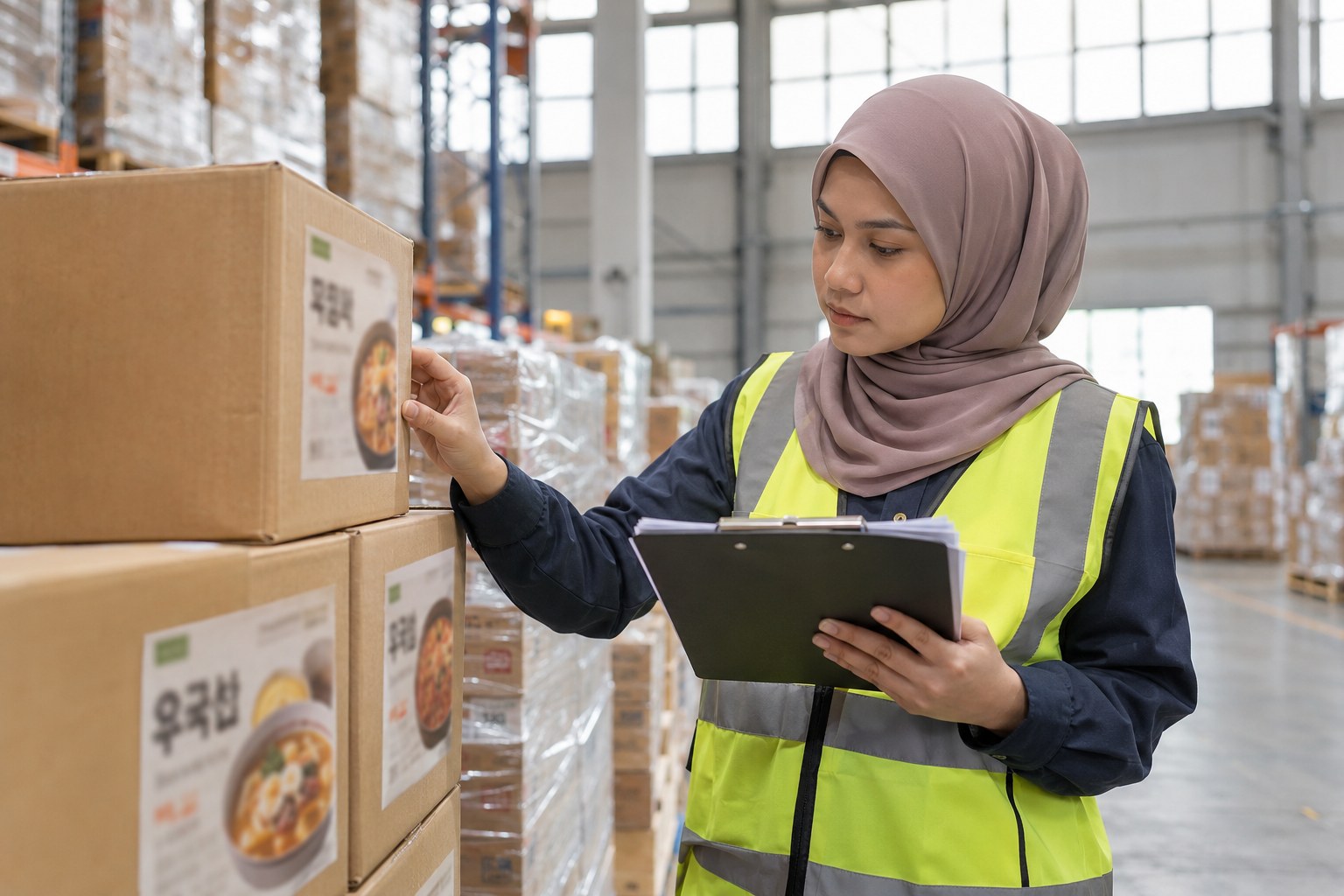
Language is part of this step. Certificates may be issued in English, but specifications, original labels and supporting documents are often only in Korean. If no one on your team can read them, pay for translation. Don’t assume that the English product name on an invoice refers to the same product as the Korean name on a certificate annex.
Step 3: Read the Korean Label Before You Relabel
Korean food labels carry a separate allergen statement near the ingredient list, and Korea’s allergen list includes pork, beef and chicken. An allergen line that mentions pork (돼지고기) is an immediate reason to stop. Its absence proves nothing: halal status depends on certification of the whole product and process, not on scanning an ingredient list.
Many Korean products also contain fermented seasonings, flavour extracts, emulsifiers, gelatin or cooking wine in marinades. Whether these are acceptable is for the certification body to assess, supported by your halal executive’s review of the evidence. Importers should not make their own rulings on ingredients.
Malaysian labelling rules apply as well. Under the Food Regulations 1985, imported food must be labelled in Bahasa Malaysia or English and must show the Malaysian importer’s name and address and the country of origin. A Korean-only pack is not ready for retail. Any Malaysian over-label must name the foreign certifier accurately and must not suggest a JAKIM certification the product does not have.
Step 4: Treat Meat and Meat-Based Products Separately
Korean beef, poultry and products containing them carry an extra condition. Imported meat and meat-based products need both certification from a JAKIM-recognised foreign body and inspection and approval of the plant by JAKIM and the Department of Veterinary Services (DVS). A recognised certificate alone is not enough.
The first halal Korean beef exports to Malaysia show how this works. South Korea set up its first halal-certified slaughterhouse in 2023, and JAKIM officials carried out on-site inspections before Malaysia became the first market for halal-certified Korean beef. If you import Korean dumplings, ready meals, broths or snacks that contain meat, confirm before ordering that the plant approval covers the relevant facility and product type. Check with the supplier first, and with DVS and JAKIM where necessary.
Step 5: Control Online and Parallel-Import Stock
A great deal of Korean food reaches Malaysian consumers through marketplace sellers and small resellers rather than authorised distributors. When Bernama surveyed Malaysian e-commerce platforms in 2022, it found many imported products claiming halal certificates from overseas bodies that JAKIM did not recognise.
If you resell Korean products bought from a Korean wholesaler, a consolidator or another Malaysian importer, ask for the same evidence an authorised importer would hold: the certificate, the product annex, the factory match and confirmation that the stock is the certified version. Without that file, list the product without a halal claim.
Some Korean brands now produce or pack in Malaysia under Malaysian halal certification. Those products are verified differently, through the Malaysian certificate itself. Our guides to Malaysia’s halal e-Cert verification and checking halal certification in Malaysia explain how.
Common Korean Certificate Scenarios
| Scenario | What It Means for a Halal Claim in Malaysia | Practical Action |
|---|---|---|
| Certificate from a Korean body on JAKIM’s current list, with the product and factory named and valid on the production date | Can support a halal claim if Malaysian labelling requirements are also met | Record the date of the check and print the certifier’s name on the label |
| Certificate from a Korean body not on JAKIM’s list | Does not support a halal claim in Malaysia, even if other markets accept it | Sell without a halal claim, or ask the supplier about certification through a recognised body |
| Brand holds a certificate, but for a different factory | Does not cover the product being imported | Ask for a certificate covering the actual production site |
| Certificate expired before the shipment was produced | Gap in coverage for that batch | Ask for evidence that certification was continuous over the production period |
| Halal mark printed on the pack, but the supplier cannot provide a certificate | The mark alone is not evidence | Hold the product until documents are verified |
| Meat-based product with a recognised certificate but no plant approval | Does not meet the condition for meat imports | Confirm JAKIM and DVS plant approval before ordering |
| Korean domestic version bought from a wholesaler | May differ from the certified export version | Verify the factory, formulation and certificate coverage for that exact stock |
A Korean Product Approval Checklist
- Certifier’s name and halal mark checked against JAKIM’s current list, with the date recorded
- Certificate holder, factory and product list matched to the exact product
- Validity period covering the production dates of the shipment
- Korean label and specifications translated and reviewed by the halal executive
- Plant approval confirmed for meat and meat-based products
- Malaysian label in Bahasa Malaysia or English, with importer details, country of origin and certifier name
- Supplier commitment to notify you of changes to formulation, factory or certification
- Recheck scheduled for each new shipment, and whenever JAKIM amends its list
Halal Status and Commercial Success Are Separate Questions
As Korean food grows in Malaysia, some importers and distributors will reach significant commercial milestones, such as the number of certified Korean products brought to market, the number of outlets supplied or the volumes distributed. Those achievements deserve careful documentation, but they answer a different question from halal compliance.
Halal certification confirms compliance under the applicable framework. For imported Korean products, that means a certificate from a body JAKIM recognises, plus the additional plant approval where meat is involved. Business recognition serves a different purpose. A distributor whose Korean range is fully certified, and which has also achieved an exceptional and objectively measurable milestone, may separately consider applying for Asia Record recognition. Asia Record’s official website explains how it assesses a clearly defined achievement claim against supporting evidence. That recognition says nothing about whether a product is halal and should never be presented to buyers or consumers as halal evidence.
Build the File Before the Container Ships
Most problems with Korean halal products are not caused by fraud. They come from small mismatches: a certificate for the wrong factory, a domestic version bought instead of the export one, a mark that no longer matches the current list, or meat-based products shipped before the plant was approved. Each of these is far cheaper to catch at the approval stage than after stock is on the shelf. For importers, the Korean opportunity is real, and it is best served by a product file that would satisfy a halal auditor, a retail buyer and a careful Muslim consumer alike.