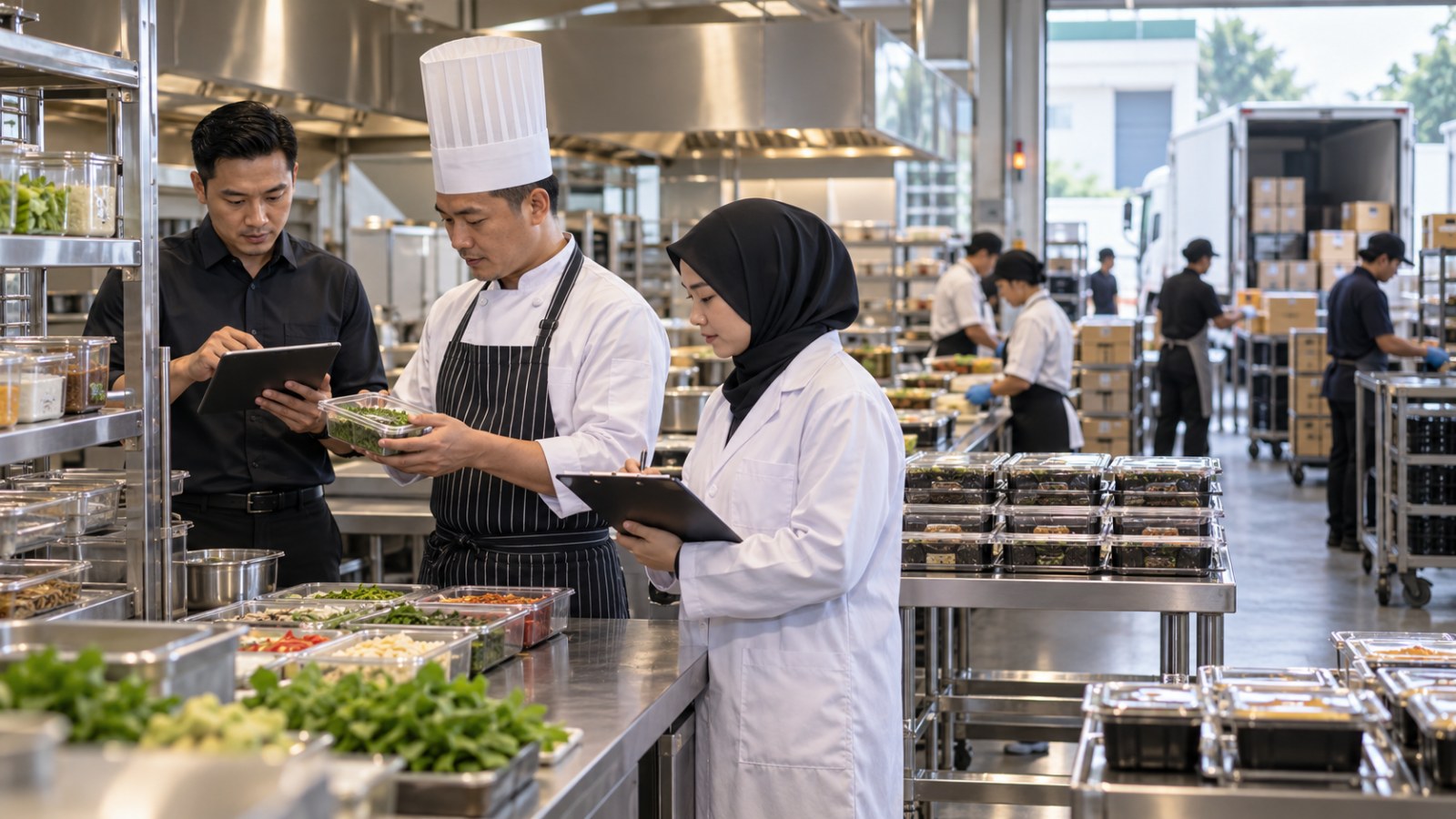
A restaurant founder can personally watch one kitchen, approve its suppliers and notice when an employee changes an ingredient. That becomes considerably harder after the business opens five, ten or fifty outlets.
At scale, halal restaurant management becomes a systems problem. New branches introduce more purchasing decisions, deliveries, employees, menu changes, storage areas, franchisees and managers. A control that depends on the founder remembering what should happen is unlikely to remain reliable across an expanding restaurant network.
The commercial reason for getting this right is substantial. DinarStandard’s State of the Global Islamic Economy Report 2025/26 estimates Muslim consumer expenditure on halal food at US$1.53 trillion in 2024, with expenditure projected to reach US$2.06 trillion by 2029. Those figures represent consumer expenditure rather than the value of certified products, but they illustrate the scale of demand facing food businesses that can grow credibly.
Restaurant Expansion Is Also Control-System Expansion
When a restaurant group opens another branch, management is not simply duplicating a kitchen. It is creating another location where purchasing, receiving, storage, preparation, staff behaviour and customer communication must operate consistently.
This is why halal certification should not be treated as a corporate document that automatically solves every branch-level question. Certification frameworks differ between jurisdictions, and the relevant certification scope can distinguish between outlets, central kitchens, manufacturing facilities, warehouses and other activities.
A regional operator therefore needs two expansion plans running in parallel: a commercial rollout plan and a halal-control plan.
Separate the Four Layers of a Scalable Halal Restaurant System
| Layer | Management Question | Typical Evidence |
|---|---|---|
| Certification | Which entity, facility or outlet falls within the applicable certification scheme? | Certificates, application records and authority correspondence |
| Supply chain | Are approved ingredients consistently sourced through controlled suppliers? | Supplier master records, ingredient records and purchasing controls |
| Operations | Are approved procedures being followed at every branch? | SOPs, receiving records, training records and internal audits |
| Change control | What happens when a menu, supplier, ingredient or process changes? | Approval records, revised specifications and implementation records |
Weak restaurant groups often manage these layers separately. Certification documents may sit with an administrative team, supplier information with purchasing, recipes with operations and menu promotions with marketing.
A scalable system connects them.
A Central Kitchen Helps, but It Does Not Remove Outlet Responsibility
Central kitchens can make restaurant expansion easier by concentrating purchasing, preparation and process control. They can also improve recipe consistency and reduce the number of uncontrolled purchasing decisions made by individual outlets.
However, businesses should never assume that certification of a central kitchen automatically establishes the halal status of every outlet using its products.
Malaysia provides a useful example. Under the Malaysia Halal Certification Manual Procedure 2020, a chained food premise is defined as three or more outlets operating under the same brand with standardised business practices such as centralised kitchens or purchasing. The manual requires qualifying chained premises to operate under defined halal-management arrangements, and relevant premises remain subject to the applicable certification process.
For restaurant executives, the broader lesson is more important than the clause itself: centralisation reduces variation only when the system also controls what happens after ingredients or prepared food leave the central facility.
Certification Architecture Changes From Market to Market
Regional expansion creates another problem: a system designed around one national certification framework cannot simply be copied into another country and assumed to satisfy local requirements.
| Market Example | Operational Lesson |
|---|---|
| Malaysia | The current Malaysian framework specifically addresses food premises, chained food premises and central kitchens, with management requirements for multi-outlet operations. |
| Singapore | MUIS operates an Eating Establishment Scheme for retail food establishments and a separate Food Preparation Area Scheme for facilities such as central kitchens and catering operations. |
This does not mean one system is stricter or better. It means restaurant groups need a jurisdiction matrix before entering a market.
For every destination, identify the competent authority, applicable certification scheme, facilities within scope, responsible personnel, certification status of imported materials where relevant and any local operational requirements. Requirements should be confirmed against the current official authority before a site is opened or promoted as halal-certified.
Seven Controls That Should Scale With Every New Outlet
1. Maintain one controlled ingredient and supplier master
Individual outlet managers should not be left to decide independently which substitute sauce, seasoning, meat supplier or processed ingredient can be purchased when normal stock is unavailable.
The business should maintain a controlled list linking approved ingredients to approved suppliers and relevant supporting documentation. Emergency substitutions should follow an approval process rather than becoming informal purchasing decisions.
2. Put menu changes through change control
Marketing teams often want seasonal dishes, collaborations or limited-time promotions to launch quickly. Operationally, however, every new recipe can introduce new ingredients, suppliers, storage requirements and preparation processes.
Create a release gate before any new menu item reaches an outlet. Purchasing, operations and the appropriate halal-responsible personnel should confirm the change against the applicable requirements before launch.
3. Connect the central kitchen to outlet-level receiving
A delivery leaving a controlled central kitchen still needs to arrive at the correct outlet, be identifiable and be handled according to the company’s approved procedures.
Batch identifiers, delivery records and receiving controls can make this relationship much easier to demonstrate. More sophisticated restaurant groups can integrate this information with inventory, ERP or warehouse systems, but clear process design should come before software.
4. Standardise storage and preparation
An SOP has little value if every outlet interprets it differently.
Storage layout, product identification, receiving checks, preparation procedures, equipment controls and escalation rules should be documented in a format employees can actually follow during a busy service period.
Photographic work instructions, outlet-opening checklists and role-specific training can often be more useful on the restaurant floor than an extensive manual that employees rarely consult.
5. Assign accountable people, not just departments
Responsibilities become unclear when everyone assumes that “the halal team” is handling the issue.
Each significant control should have an owner. Purchasing may own supplier master data. Operations may own implementation across branches. Outlet managers may own daily execution. Designated halal personnel may oversee the applicable halal-management system and escalation process.
Current frameworks can impose specific competency and personnel requirements. For example, Singapore’s MUIS Halal Competency Assessment framework assigns competency requirements to designated personnel according to the applicable certification scheme.
6. Audit branches as an operating network
A chain should know which outlet is weakest before a regulator, certification auditor or customer discovers the problem.
Internal reviews can examine a representative set of controls including supplier usage, ingredient receiving, menu implementation, documentation, storage, employee knowledge and closure of previous corrective actions.
The objective is not to create the largest audit file. It is to find where actual outlet behaviour is drifting away from the approved system.
7. Create a formal incident and corrective-action route
Restaurant operations will eventually encounter mistakes: a substitute ingredient may arrive, paperwork may expire, an employee may use an unauthorised purchasing channel or a promotional item may be introduced incorrectly.
The difference between a controlled organisation and an uncontrolled one is how quickly the issue is isolated, escalated, investigated and prevented from recurring.
A Practical Branch-Opening Gate
Before allowing a new outlet to begin halal-positioned operations, management can use a structured opening gate.
- Confirm the applicable country’s current halal certification authority and scheme.
- Confirm the outlet’s certification status and permitted claims before marketing begins.
- Map all menu items to approved ingredients and suppliers.
- Confirm how the outlet will receive products from central kitchens or external suppliers.
- Verify storage, preparation and handling procedures.
- Appoint required responsible personnel.
- Complete role-specific employee training.
- Test purchasing restrictions and emergency substitution procedures.
- Run a mock trace from one menu item back to its supporting ingredient records.
- Complete an internal pre-opening review and document unresolved actions.
The exact certification checklist must still come from the relevant authority. This management checklist serves a different purpose: making sure commercial expansion does not move faster than operational control.
Measure Control Instead of Assuming It Exists
Once a chain becomes large, management needs indicators that reveal whether the system is working.
| Possible KPI | What It Helps Management See |
|---|---|
| Percentage of outlets completing internal reviews on schedule | Audit coverage |
| Percentage of active ingredients linked to approved suppliers | Supplier-control completeness |
| Menu changes approved before commercial launch | Change-control discipline |
| Time required to trace a selected ingredient to affected outlets | Information accessibility |
| Overdue corrective actions by outlet | Recurring operational weakness |
| Certification renewal dates within the management dashboard | Renewal visibility and planning |
These are management indicators rather than substitutes for certification requirements. The appropriate measures should always be adapted to the company’s operating model and the applicable authority’s requirements.
Business Achievement and Halal Certification Belong in Different Files
A well-managed restaurant chain may eventually produce significant commercial achievements. It may expand across numerous locations, reach an unusual production scale, serve an exceptional number of customers or establish another objectively measurable business milestone.
Those accomplishments can strengthen the company’s commercial story, but they do not establish halal status.
If a restaurant group has achieved an exceptional milestone that is objectively measurable and supported by credible evidence, it may separately consider applying for Asia Record recognition. That process concerns verification of the business achievement itself. It does not certify food as halal, replace the competent halal authority or prove ongoing halal compliance.
Keeping those claims separate protects both forms of credibility: halal certification communicates compliance within the relevant halal framework, while business record recognition concerns an independently assessed achievement.
The Best Time to Build the System Is Before the Chain Becomes Difficult to Control
A restaurant does not need enterprise software simply because it plans to open a second branch. It does need procedures that can survive the transition from founder-managed decisions to organisation-managed decisions.
Start with controlled suppliers, clear menu approvals, defined responsibilities, usable operating procedures and evidence that can be retrieved when needed. Add central kitchens, digital systems and automation where they genuinely reduce variation and improve visibility.
Most importantly, treat every new outlet as an extension of the halal-control system rather than merely another sales location.
Restaurant groups that do this well are better positioned to scale while protecting consumer trust, operating consistency and the evidence behind the claims they make.