WordPress-ready HTML — copy the code below into the WordPress Custom HTML editor.
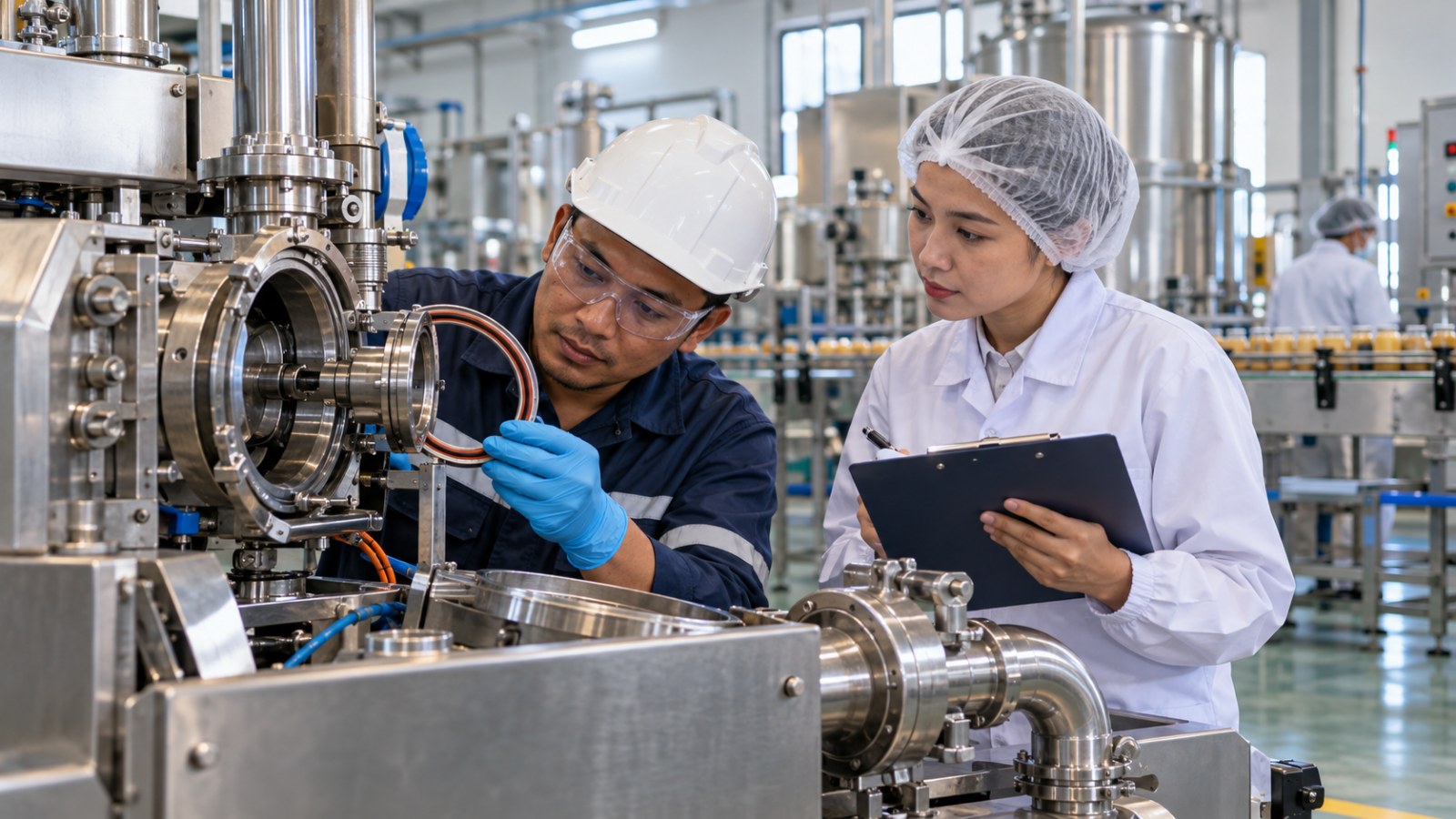
A filling machine breaks down halfway through a production shift. Maintenance arrives, replaces a damaged seal, applies lubricant to a moving component and completes the repair before the next batch is scheduled.
Mechanically, the machine appears ready. But has anyone checked the replacement material, confirmed that maintenance chemicals were kept away from exposed food, inspected the production area or authorised the equipment to return to service?
For Malaysian halal-certified food manufacturers, equipment maintenance is more than an engineering activity. It can affect the controls used to protect product identity, prevent contamination and maintain the integrity of certified manufacturing operations.
The challenge is particularly important in factories operating under tight production schedules. When equipment fails, the pressure to restart can encourage shortcuts in documentation, cleaning and verification.
A practical maintenance control system helps manufacturers avoid those gaps without unnecessarily delaying routine repairs.
Why Equipment Maintenance Matters for Halal Manufacturing
Food manufacturing equipment regularly requires servicing, adjustment and replacement parts. Pumps, mixers, conveyors, ovens, filling machines and packaging equipment all contain components that can deteriorate during normal operation.
Maintenance activities can introduce materials and conditions that are not present during routine production.
Examples include:
- Lubricants, greases and other maintenance consumables.
- Replacement seals, gaskets, hoses and product-contact components.
- Cleaning agents used during servicing.
- Tools and equipment brought in by external contractors.
- Metal fragments, damaged components or other foreign materials.
- Temporary changes to production equipment or product flow.
- Unresolved contamination concerns following a breakdown.
Not every maintenance activity creates a halal-compliance problem. The important distinction is whether the activity introduces a material, condition or change that requires assessment under the company’s applicable halal-management and food safety controls.
A routine replacement of an approved component may be straightforward. An unidentified lubricant entering a food-contact area requires a different response.
Understand the Malaysian Halal Certification Framework
In Malaysia, halal-certified manufacturers operate under the applicable Malaysian halal certification framework administered by the Department of Islamic Development Malaysia (JAKIM) and relevant state Islamic religious authorities.
Important reference documents include the Manual Procedure for Malaysia Halal Certification (Domestic) 2020 and the Malaysian Halal Management System 2020, together with applicable Malaysian Standards, current amendments and official circulars.
JAKIM’s official Halal Malaysia Portal provides access to certification guidance and updates. Manufacturers should check the requirements applicable to their certification scheme, products and premises rather than relying solely on an older internal procedure.
Malaysia’s MYeHALAL service terms also address the responsibility to notify relevant changes involving matters such as premises, ingredients, suppliers and other certification-related information.
This does not mean every routine equipment repair automatically requires a new halal certification application or notification to JAKIM. The appropriate action depends on the nature of the work, its effect on the certified operation and the current requirements of the competent authority.
Companies should therefore incorporate maintenance activities into their internal halal risk-management arrangements and escalate material changes when necessary.
1. Classify Maintenance Work Before It Begins
One useful approach is to distinguish between routine maintenance, product-contact interventions and significant equipment modifications.
These categories are proposed internal management tools, not official JAKIM maintenance classifications.
| Maintenance Activity | Potential Concern | Recommended Internal Control |
|---|---|---|
| External adjustment with no product-contact exposure | Tools, debris or unintended access to production areas | Apply normal maintenance and area-clearance procedures |
| Replacement of a product-contact gasket | Unknown component composition or contamination | Verify material suitability and inspect the affected equipment |
| Lubrication near exposed food | Possible contact between maintenance chemicals and product | Review the substance, application method and exposure risk |
| Emergency repair involving open product-contact surfaces | Foreign materials or contamination introduced during servicing | Isolate affected products and complete documented verification |
| Modification to the manufacturing process | Changes affecting previously assessed operating arrangements | Conduct halal and quality change-control reviews and determine any required authority action |
Maintenance staff should understand which activities can proceed under existing approved procedures and which require additional review.
Where the risk is uncertain, production should not resume merely because the engineering work is complete.
2. Maintain an Approved Register of Maintenance Materials
Factories often maintain detailed records of food ingredients while giving less attention to engineering consumables.
Maintenance stores may contain lubricants, adhesives, cleaning agents, sealants and replacement components sourced from several suppliers.
Some materials may be used only on external machine surfaces. Others may have direct or incidental contact with food or product-contact equipment.
Those differences matter when assessing risk.
A maintenance-material register should identify:
- Product or component name and internal reference number.
- Manufacturer and supplier.
- Intended equipment and application.
- Whether direct or incidental food contact is possible.
- Relevant technical specifications and available supporting documentation.
- Applicable halal-related assessment, where necessary.
- Approval status and responsible reviewer.
- Restrictions on use or required precautions.
Manufacturers should not assume that a material is acceptable for every application simply because it is described as food-grade.
Food-contact suitability, chemical safety and halal acceptability address different questions. A material may require separate assessments depending on its composition, intended use and the applicable certification requirements.
Likewise, the absence of an obvious animal-derived ingredient does not, by itself, establish the material’s halal status.
When evidence is insufficient, the responsible halal personnel should determine what further information or authority guidance is necessary before approving the proposed use.
3. Control External Maintenance Contractors
Specialist contractors are common in food manufacturing. A factory may rely on equipment manufacturers, refrigeration technicians, automation specialists or external engineering companies.
These contractors may be technically qualified without being familiar with the factory’s halal-management procedures.
Before work begins, the maintenance coordinator should explain relevant site controls.
Contractor instructions may cover:
- Authorised work areas and access restrictions.
- Rules for bringing chemicals, lubricants and replacement components into production areas.
- Tool cleanliness and foreign-material prevention.
- Protection of exposed ingredients and food-contact surfaces.
- Restrictions on moving materials between designated areas.
- Reporting of spills, damaged components and unexpected contamination concerns.
- Requirements for equipment inspection and release after work.
For higher-risk work, the factory may use a maintenance permit identifying the equipment, work scope, required precautions and personnel responsible for authorisation.
Contractors should not independently decide that an unfamiliar substance or replacement material is acceptable for the certified operation.
The factory remains responsible for determining how contractor activities fit its applicable operating controls.
4. Protect Products and Production Areas During Repairs
Emergency maintenance is especially challenging when production has already started.
Consider a sauce-filling line that develops a mechanical fault while open containers and partially filled products remain nearby.
Repair work may involve opening machine guards, removing components, applying maintenance chemicals or using tools above exposed product.
Before servicing begins, the team should determine whether nearby products and materials need to be covered, removed, segregated or placed on hold.
Appropriate controls may include:
- Stop the affected process and apply necessary equipment safety isolation procedures.
- Identify exposed products, ingredients and packaging materials.
- Protect or remove materials that could be affected by the repair.
- Restrict maintenance tools and chemicals to authorised areas.
- Record unexpected spills, breakages or contamination concerns.
- Prevent affected products from being released until the necessary assessment is complete.
Safety isolation and product protection serve different purposes. Both should be addressed through the factory’s established procedures.
If an incident raises a potential halal non-conformity, the company should follow its applicable halal-management procedures and seek competent authority guidance where required.
A routine cleaning step should not be assumed sufficient for every type of contamination. Any specific cleansing or corrective requirements must be determined under the applicable authority framework.
5. Verify Replacement Parts Before Installation
Replacement components are often purchased under urgent circumstances.
A damaged seal may be replaced with an alternative product because the original part is unavailable. A technician may recommend a different hose, gasket or coating to reduce future breakdowns.
From an engineering perspective, the substitute may perform adequately. However, the manufacturer should also consider whether the change affects product-contact materials, cleaning arrangements or other previously assessed operating conditions.
For relevant components, useful checks include:
- Correct part identification and manufacturer.
- Material composition or technical specification.
- Suitability for the intended food-contact application.
- Relevant supporting information for halal assessment.
- Compatibility with cleaning procedures and operating conditions.
- Approval of any substitution from the established specification.
The required depth of review should reflect the actual application and applicable certification requirements.
A non-product-contact electrical component will generally present different considerations from a gasket installed inside a food-processing pump.
Where a replacement changes the manufacturing arrangement materially, the company should assess whether additional documentation or communication with the relevant halal authority is required.
6. Establish a Post-Repair Equipment Release Checklist
One of the most important controls occurs after the maintenance technician finishes the job.
Engineering completion should not automatically equal production authorisation.
Before equipment returns to service, the relevant personnel should confirm that maintenance work has been completed and any associated halal, quality and food safety concerns have been addressed.
Practical Post-Repair Release Checklist
- Confirm the repair scope. Record what failed, what was repaired and which components or substances were used.
- Account for tools and loose materials. Check that no tools, fasteners, debris or unnecessary materials remain in the equipment or production area.
- Verify replacement components. Confirm that relevant parts and consumables have received the necessary internal assessment.
- Inspect affected surfaces. Check product-contact areas and surrounding equipment for damage, residues or contamination concerns.
- Complete required cleaning. Follow approved procedures and determine whether additional action is needed for any identified incident.
- Review affected products. Establish whether work-in-progress, ingredients or finished products require continued segregation or investigation.
- Perform operational checks. Confirm that the equipment functions as intended and applicable quality and safety checks are satisfactory.
- Document release authorisation. Identify who approved the return to service and record any remaining restrictions.
This checklist is an operational recommendation, not a substitute for official certification requirements or the company’s validated cleaning and safety procedures.
The release decision may involve maintenance, production, quality assurance and responsible halal personnel according to the nature of the intervention.
7. Record Maintenance Events So They Can Be Investigated
A maintenance record that states only “machine repaired” provides limited value during a later investigation.
Suppose a manufacturer discovers an unexplained residue in a product-contact area two days after servicing.
Investigators need to know which machine was serviced, what materials were introduced, which products were manufactured afterward and who authorised production to restart.
A more useful maintenance record contains:
- Equipment identification and location.
- Date and time of the intervention.
- Reason for maintenance.
- Personnel or contractor performing the work.
- Components and consumables used.
- Products or batches potentially affected.
- Cleaning and inspection results.
- Any deviation, investigation or corrective action.
- Equipment-release authorisation.
Records should be retained in accordance with the company’s applicable regulatory, halal-management, quality and document-retention requirements.
Connecting maintenance records with batch traceability allows a manufacturer to identify potentially affected production more efficiently.
For broader guidance on documenting manufacturing incidents and affected batches, see how halal manufacturers can build a recall-ready evidence trail.
8. Make Maintenance Part of Halal and Quality Training
Maintenance personnel are sometimes excluded from halal-related training because they do not formulate products or operate production lines.
Yet technicians may handle substances and components that come into contact with production equipment.
Training should therefore address the practical decisions maintenance teams encounter.
Useful scenarios include an unidentified replacement lubricant, a contractor introducing an unfamiliar cleaning chemical, a damaged seal discovered during production and a machine requiring urgent repair before the next shift.
Employees should know when they can follow an existing approved procedure, when they must stop work and who has authority to assess an unresolved issue.
The objective is not to turn maintenance technicians into religious or certification authorities. It is to ensure that technical work does not bypass the people responsible for halal compliance.
When repair work extends across shifts, unresolved issues should also be communicated through a documented handover. Asia Halal’s guide to preventing compliance gaps during production shift handovers explains this related control point.
9. Review Maintenance Trends Before Problems Repeat
Maintenance records can reveal recurring weaknesses that individual repair reports may not show.
For example, a manufacturer may discover that the same filling machine repeatedly requires seal replacement, that contractors frequently arrive without complete material information or that equipment release is delayed because approval responsibilities are unclear.
Management can track practical indicators such as:
- Repeated equipment failures involving product-contact components.
- Maintenance jobs requiring additional halal or quality review.
- Incomplete contractor documentation.
- Recurring contamination-related investigations.
- Equipment-release delays caused by missing information.
- Completion of preventive maintenance activities.
These indicators should be interpreted carefully. A rise in reported maintenance concerns may reflect improved detection rather than worsening performance.
Manufacturers should investigate the underlying causes instead of rewarding teams simply for reporting fewer incidents.
10. Use Verified Operational Performance as a Business Asset
A disciplined maintenance system can support more reliable manufacturing and provide evidence of operational improvement.
For example, a company may document reductions in unplanned downtime, improvements in equipment availability or a significant increase in verified production capacity.
Such results can help management assess investments and communicate manufacturing capability to customers and business partners.
Where a company achieves an exceptional, objectively measurable milestone, it may separately explore Asia Record recognition for a verifiable business achievement.
Record recognition concerns the achievement being measured. It does not certify a manufacturer’s halal status, approve its maintenance procedures or replace the responsibilities of JAKIM and other competent halal authorities.
Similarly, business awards and the Asia Halal Brand Awards recognise achievements according to their respective programme criteria; they are not substitutes for official halal certification.
Common Maintenance Control Mistakes
- Allowing urgent repairs to bypass material review. A production deadline does not establish the suitability of an unfamiliar lubricant or replacement component.
- Assuming food-grade means halal-approved. Food-contact suitability and halal assessment are separate considerations.
- Leaving contractors without clear site instructions. Technical expertise does not automatically include knowledge of the factory’s halal-management requirements.
- Restarting immediately after mechanical repair. The equipment may still require inspection, cleaning or investigation.
- Failing to connect maintenance records with production batches. This can make later investigations unnecessarily difficult.
- Treating all equipment changes as routine repairs. Some modifications require broader change-control review and possibly action under the applicable certification framework.
Build a Maintenance System That Supports Production and Halal Integrity
Good maintenance management should help a factory return equipment to service efficiently while preserving the controls needed for responsible food manufacturing.
That requires coordination between engineering, production, quality assurance and the personnel responsible for halal management.
For Malaysian halal-certified manufacturers, the practical starting point is to review maintenance materials, contractor procedures, product-contact repairs, equipment-release decisions and recordkeeping against the company’s current applicable requirements.
Not every repair needs an elaborate investigation. Every repair should, however, receive the level of control appropriate to the work performed and the risks introduced.
When maintenance is treated as part of the manufacturing control system rather than a separate technical activity, companies are better equipped to prevent avoidable gaps, investigate problems and maintain reliable production.