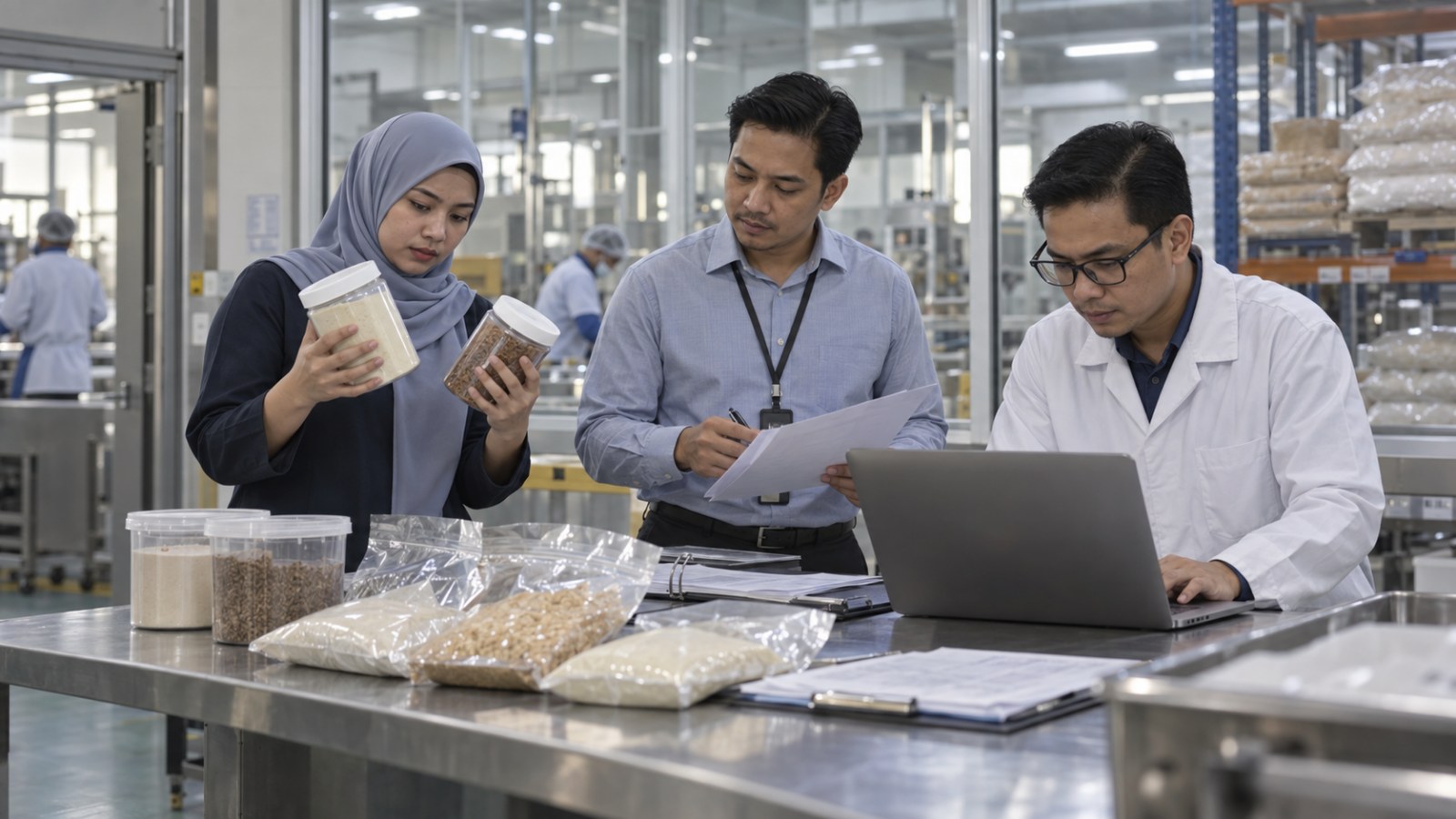
A supplier calls on Monday morning to say an ingredient will not arrive before the next production run. Procurement finds another supplier offering what appears to be the same material, at the same specification, and the factory needs it by Wednesday.
Operationally, the substitution may look simple. From a halal-control perspective, it should not be treated as an ordinary purchasing decision.
For Malaysian halal-certified manufacturers, the important questions include whether only the distributor has changed, whether the original manufacturer is different, whether the ingredient specification has changed, whether the supporting halal documentation remains applicable and whether the company’s certification information needs to be updated before the new source enters normal production.
The distinction matters even more following the 2026 amendment to Malaysia’s domestic halal-certification procedure. Procurement, quality, halal and production teams need one controlled process for handling changes rather than allowing individual buyers to decide that two materials are “basically the same”.
Malaysia’s Current Procedure Makes Raw-Material Identity Important
Malaysia’s current domestic framework is the Manual Procedure for Malaysia Halal Certification (Domestic) 2020 as amended in 2026. The amendment took effect on 1 April 2026.
Under the amended procedure, raw materials used by certificate holders are subject to several controls. Among other requirements, the business needs to establish the status of the raw material, identify its original manufacturer and maintain appropriate supporting documentation. Certain animal-origin materials require valid halal certification from the relevant competent authority or recognised certification body, while materials without the applicable certification may require more detailed supporting information such as composition, process-flow and source information.
The procedure also requires raw-material information declared through MYeHALAL to correspond with the actual material information.
This means a supplier substitution should not begin with the question, “Can we buy this?” It should begin with, “Is this still the same approved material, from the same underlying source, with evidence that supports its use?”
A Supplier Change and an Ingredient Change Are Not the Same
One of the most useful controls is to classify the proposed change before approving it.
| Situation | What Has Actually Changed? | Recommended Internal Response |
|---|---|---|
| New distributor, same ingredient and same original manufacturer | Commercial supplier | Verify the supplier relationship and documentation, then determine the required MYeHALAL information update before routine use. |
| Same ingredient description but different original manufacturer | Material source | Treat as a higher-risk change. Recheck the manufacturer, specification, supporting halal evidence and applicable authority process. |
| Same manufacturer but revised formulation or specification | Ingredient itself | Do not treat the existing approval as automatically covering the revised material. Review the change formally. |
| Completely new ingredient | Formulation | Confirm the applicable certification procedure before introducing it into certified production. |
| Emergency substitute purchased without normal review | Control process | Quarantine the material from certified production until the required verification and approval steps are completed. |
The commercial name printed on an invoice is therefore not enough to establish equivalence.
1. Identify the Original Manufacturer, Not Only the Trader
Procurement records often show the company that issued the quotation. That company may be a distributor, importer or trading intermediary rather than the organisation that actually manufactured the ingredient.
The amended Malaysian procedure specifically makes original-manufacturer identification relevant to raw-material control.
Before changing source, record at least:
- the internal material code;
- the exact ingredient or raw-material name;
- the commercial supplier;
- the original manufacturer;
- the manufacturing location where relevant;
- the specification or grade;
- the applicable supporting halal document;
- the document scope and validity information; and
- the products or formulations in which the material is used.
This prevents a common purchasing error: assuming that identical product names from two suppliers necessarily represent the same underlying material.
2. Verify the Evidence Instead of Reusing an Old Supplier File
A PDF certificate saved two years ago should not become permanent evidence simply because it remains in the procurement folder.
Where certification evidence is applicable, teams should verify current information through the relevant official source and check that the document actually relates to the manufacturer and material under review.
For materials where a halal certificate is not the applicable form of evidence, the Malaysian procedure may require other supporting documents. The appropriate evidence depends on the material and applicable requirements, so businesses should avoid creating their own rule that every raw material merely needs “some halal certificate”.
The objective is to establish a documented evidence chain that can survive a later audit or investigation.
3. Separate Supplier Approval From Ingredient Approval
A useful internal system maintains two connected approvals.
Supplier approval
This answers whether the company is permitted to buy the specified material from a particular supplier.
Material approval
This answers whether the particular ingredient, specification, manufacturer and supporting evidence have been accepted for the intended certified operation.
Keeping these approvals separate matters because several suppliers may sell the same underlying material, while two materials with similar commercial descriptions may come from different manufacturers or processes.
A purchasing system should ideally block an unapproved combination rather than merely checking whether the supplier exists in the vendor database.
4. Do Not Assume MYeHALAL Updates Are Purely Administrative
The amended procedure contains a specific section covering MYeHALAL information updates.
It allows a Malaysian Halal Certification Certificate holder to submit a formal request concerning manufacturer or supplier information for raw materials. Changes, additions or removals of suppliers under this mechanism are tied to existing raw materials or ingredients.
The same procedure places separate limits on adding raw-material or ingredient information. Manufacturers should therefore not assume that introducing a genuinely new ingredient is equivalent to replacing a supplier for an ingredient that is already recorded.
Where the classification is uncertain, the appropriate step is to confirm the current procedure with the authority responsible for the certificate before production uses the substitute.
5. Build a Change-Control Gate Before the Purchase Order
The best time to identify a halal-control problem is before the substitute material arrives at the factory.
A practical approval flow can be kept simple:
- Procurement raises the proposed change. The request identifies the current material and proposed replacement.
- Quality checks specification equivalence. Any difference in composition, grade, manufacturer or processing is highlighted.
- The responsible halal function checks applicable evidence. Current documentation and official verification sources are reviewed.
- The MYeHALAL or authority requirement is determined. The team identifies whether the change can proceed through the applicable update mechanism or requires another certification action.
- Master data is updated. Only approved supplier-material combinations become purchasable.
- Receiving is informed. Warehouse employees know which manufacturer, label and product identification they should expect.
- Production is released only after approval. The substitution is linked to the relevant production batches.
This is more reliable than asking procurement employees to interpret certification rules while trying to prevent a production stoppage.
A Practical Pre-Use Checklist
Before the first delivery of a replacement material is released into certified production, the responsible team should be able to answer these questions:
- Is this an existing material or a genuinely new ingredient?
- Has only the distributor changed, or has the original manufacturer changed?
- Does the specification match the approved material?
- Can the original manufacturer be clearly identified?
- Is the applicable supporting halal documentation current and relevant to this material?
- Are composition, source and process documents available where required?
- Has the current status been checked through the appropriate official source where applicable?
- Has the company completed or initiated the required MYeHALAL or authority process?
- Has the approved supplier-material relationship been updated in purchasing records?
- Can incoming batches be linked to supplier and manufacturer information?
- Can the factory identify which finished batches use the replacement material?
- Has someone with defined authority released the material for production?
If the answer to an essential question is still unknown, production pressure should not turn that uncertainty into an approval.
Emergency Substitutions Need More Control, Not Less
Supplier disruption is inevitable. A manufacturer may face a port delay, failed delivery, sudden shortage or discontinued ingredient.
That is exactly when uncontrolled substitutions are most likely.
Businesses can prepare an emergency-sourcing procedure in advance. It can identify alternative approved suppliers for important materials, define who can approve a temporary source, list the evidence that must be available and require segregation of any unapproved delivery until review is completed.
Companies with larger operations should connect this process to their broader halal traceability controls. A supplier decision is much easier to investigate later when the material can be traced into specific production batches.
Common Mistakes That Make Supplier Changes Hard to Defend
- Approving by ingredient name alone. A generic description may hide a different manufacturer, formulation or process.
- Checking only the distributor. The original manufacturer may be different.
- Keeping certificates without checking scope. A document is useful only when it supports the material being purchased.
- Letting purchasing master data outrun halal master data. An ERP should not allow an operational shortcut to become an uncontrolled approved source.
- Using first and updating later. Administrative delay is not a reason to bypass applicable certification controls.
- Failing to connect the change to production batches. If a later issue arises, the business needs to know which finished products used the substitute.
Supplier changes should also form part of wider post-certification monitoring. Certification is not a static file: suppliers, formulations, production arrangements and supporting documents continue to change while a business operates.
Where manufacturing is outsourced, brand owners should additionally coordinate these controls with their contract manufacturer oversight rather than assuming the factory will automatically manage every brand-level change.
When Operational Evidence Becomes a Separate Business Achievement
Strong supplier control can eventually produce business results beyond day-to-day compliance. A manufacturer may develop an unusually extensive traceability system, achieve a significant measurable production milestone or document another exceptional operational result.
That kind of achievement is separate from halal certification. If the result is objectively measurable, clearly defined and supported by credible evidence, a company may separately explore applying for Asia Record recognition.
Asia Record recognition concerns the measurable achievement. It does not determine the halal status of an ingredient, product, process or company, and it does not replace certification by JAKIM, JAIN, MAIN or another applicable competent halal authority.
Supplier Changes Should Be Managed Before They Reach the Factory Floor
A replacement ingredient can solve a purchasing problem and create a larger compliance problem when the change reaches production before anyone checks what actually changed.
The practical answer is not more paperwork for its own sake. It is a controlled sequence: identify the manufacturer, verify the material, check the evidence, determine the applicable authority process, update controlled information, approve the supplier-material combination and preserve batch traceability.
That sequence gives procurement teams clear boundaries while allowing the business to respond to supply disruptions without turning urgency into guesswork.
Malaysian certificate holders should always check the latest Halal Malaysia and relevant JAKIM, MAIN or JAIN requirements for their particular certification scheme and circumstances before implementing a material or supplier change.