
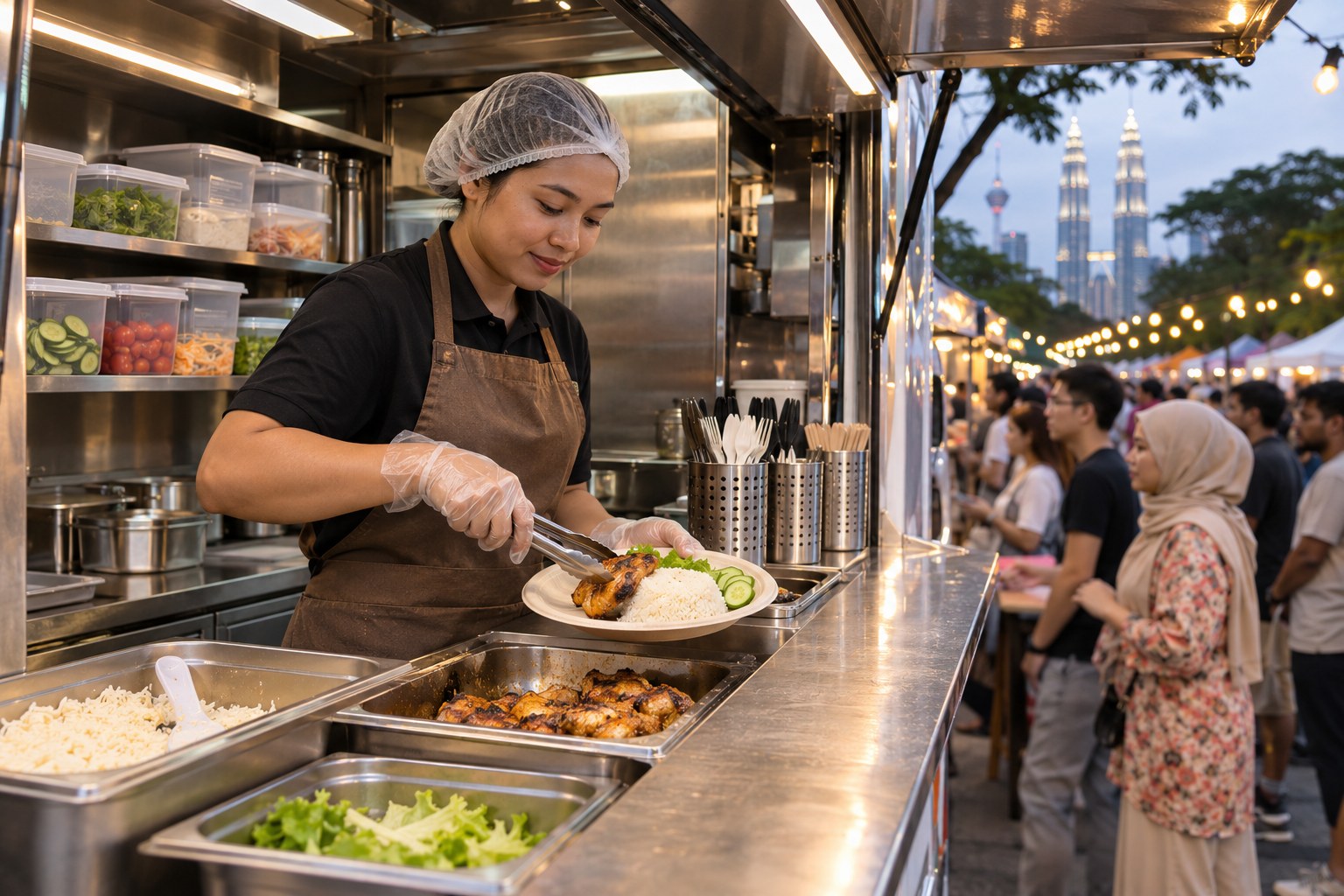
A food truck owner in the Klang Valley can buy every ingredient from halal-certified suppliers, hire a Muslim cook and park outside a mosque on Fridays, and customers will still ask the same question: “Ada sijil halal?” The honest answer is often no. That is not because the food is doubtful. Halal certification for a mobile business follows its own rules, and many operators do not realise where they fall short until an auditor points it out.
This guide explains how halal certification works for food trucks and other mobile food premises in Malaysia, what usually trips operators up, and how to prepare before you submit an application.
Food trucks have their own place in the food premises scheme
In Malaysia, halal certification for food businesses is handled by the Department of Islamic Development Malaysia (JAKIM) and the State Islamic Religious Councils or Departments. Under the Trade Descriptions (Certification and Marking of Halal) Order 2011, only these authorities may issue the Malaysia Halal Certificate (Sijil Pengesahan Halal Malaysia, or SPHM) and authorise use of the Malaysia Halal logo.
The current framework is the Malaysian Halal Certification Procedure Manual (Domestic) 2020, used together with the Malaysian Halal Management System (MHMS) 2020 and the relevant Malaysian Standards. It took effect on 1 January 2021. Under this framework, the Food Premises scheme covers restaurants, cafés, canteens, bakeries, caterers, central kitchens, kiosks, food court operators and mobile premises such as food trucks.
Certification remains voluntary. In September 2024 the Cabinet decided to keep the long-standing policy that applying for the Malaysia Halal Certificate is optional. Not holding a certificate does not, on its own, mean a menu is not halal. But a truck without one cannot present itself as halal-certified or display the Malaysia Halal logo, and it gives up the independent assurance many Muslim customers look for.
What the mobile premises requirements focus on
Public summaries of the 2020 manual describe several conditions specific to mobile operators. Check each one against the current manual and the Halal Malaysia Portal before you apply, because procedures and fees are updated from time to time.
- Where the food is prepared. Processing must happen either entirely on the truck or at a central kitchen. If you rely on a central kitchen, it needs its own halal certificate. If everything happens on board, expect auditors to look for dedicated storage for ingredients and utensils.
- Who is on duty. At least one Malaysian Muslim employee must be present while the truck is operating.
- How halal is managed. A single truck is generally treated as a small operation that runs an Internal Halal Control System (IHCS), with a Halal Supervisor responsible for day-to-day control.
- Where the truck operates. Mobile premises are expected to trade only at approved locations.
- What is on the menu. The certification covers the menu you declare. The menu customers see must match what was submitted.
- Basic food safety. Food handlers are expected to have anti-typhoid vaccination and food handler training from an institution recognised by the Ministry of Health. You still need your local authority licence and any Ministry of Health registration required for your premises. Halal certification sits alongside these, not in place of them.
Applications are made online through the MYeHALAL system on the Halal Malaysia Portal. Once JAKIM issues a charge letter, the fee must be paid within 14 working days, or the application is rejected and you have to start again. Certificates in the Food Premises scheme have generally been issued with a two-year validity.
The first decision: prepare on board, or use a central kitchen?
The choice of preparation model shapes almost everything else in your application. Many operators drift into a hybrid, prepping sauces at home or in a rented kitchen and finishing on the truck, without realising that the off-truck step has to be covered too.
| Question | Everything prepared on the truck | Prep at a central kitchen, finish on the truck |
|---|---|---|
| What needs certification? | The truck as mobile premises | The central kitchen, which needs its own certificate, plus the truck |
| Main audit focus | On-board storage, separation of utensils, cleaning, ingredient records | Kitchen controls, transport between kitchen and truck, and the truck’s own handling |
| Typical risk | Limited space leads to mixed storage of unverified items | Using a kitchen that is not certified, or sharing one with a non-certified tenant |
| Best suited to | Short menus, cooking to order | Larger menus, high event volumes, plans for more trucks |
If you are still working out of a home kitchen and plan to move to commercial premises, our guide on choosing a first commercial kitchen for halal certification covers the questions to ask a landlord or shared-kitchen provider before you sign.
Five gaps that commonly hold mobile operators back
1. Ingredients bought on the move
A truck that runs out of buns at a weekend event may send someone to the nearest shop. If that product is not on your declared ingredient list, or its halal status cannot be shown, your records no longer match what you serve. Keep a short approved-ingredient list in the truck with brand names and certificate details, and make it a rule that substitutes come only from that list.
2. Shifts without a qualified Muslim staff member
Mobile businesses often run with two people. If the Muslim employee is on leave or sick, the truck may operate in breach of a condition of its certificate. Build a backup into your roster before an auditor or customer notices.
3. Trading at unplanned locations
Pop-up events, festival grounds and private functions are part of food truck business. Because mobile premises are expected to trade at approved locations, check with the certifying authority how new or temporary locations should be handled before you commit to them. Do not assume the certificate travels automatically.
4. Menu creep
A limited-time special or a collaboration item with another brand can quietly expand your menu beyond what was certified. Treat every new item as a change that needs its ingredients checked and the authority informed, not just as a marketing idea.
5. Logo use on the truck wrap and social media
The Malaysia Halal logo can be displayed only when its use has been authorised. Operators sometimes design their truck wrap while an application is still pending, or reuse a supplier’s logo artwork in posts. Both create problems. Until your certificate is issued, describe your sourcing accurately and leave the logo off.
A pre-application checklist for food truck owners
- Confirm your business registration, local authority licence and food handler requirements are current.
- Decide your preparation model and, if you use a central kitchen, confirm it holds a valid halal certificate in its own name or the relevant scheme.
- Compile a full ingredient list with supplier names, brands and halal certificate details for each item.
- Write down your final menu and make sure every printed or digital menu matches it.
- Appoint a Halal Supervisor and set out your IHCS: who checks deliveries, who signs off cleaning, and how records are kept.
- Plan your roster so a Malaysian Muslim employee is present on every operating shift, with a named backup.
- List the locations where you trade and clarify how event or temporary locations are handled.
- Photograph your on-board storage and utensil separation so you can see your layout the way an auditor will.
Customers will check your status, and many already do. Our practical guide to checking halal certification in Malaysia shows what they see when they search the Halal Malaysia Portal, which helps when you decide how to display your certificate details on the truck and online.
When one truck becomes a fleet
Growth changes the rules. Under the 2020 framework, three or more premises operating under the same brand are generally treated as chain food premises. That category calls for a Halal Assurance System (HAS) managed centrally, with a Halal Executive and an Internal Halal Committee, rather than an IHCS run truck by truck. If you are planning a second or third vehicle, start preparing the management structure early. Our article on moving from IHCS to a Halal Assurance System explains what that shift involves.
Fleet operators also tend to pick up catering and corporate event work. If you are supplying meals to a client who will check your status before signing, review our guide on what clients verify about halal certification before appointing a caterer. It shows the questions from the buyer’s side.
Certification, growth and recognition are different things
As mobile brands grow, it helps to keep apart three things that are easy to blur in marketing.
Halal certification confirms that your premises and menu meet the requirements of the Malaysian halal certification framework, as assessed by JAKIM or a state religious authority. It is the only basis for calling your truck halal-certified.
Business growth, such as more trucks, more events served or more meals sold, shows commercial success. It says nothing about halal compliance on its own.
Achievement recognition is separate again. Some food truck businesses reach measurable milestones worth documenting. A halal-certified operator with an exceptional, verifiable result, such as a fleet size, event coverage or service volume that can be measured and evidenced, may consider applying for Asia Record recognition through Asia Record’s official website. Asia Record assesses whether a proposed achievement is clear, measurable and verifiable, and asks for evidence of how it was measured. That recognition concerns the business milestone only. It does not certify, confirm or replace halal status, which remains a matter for the halal authorities.
Keeping these separate in your truck signage, social media and pitches to event organisers protects your credibility. Customers trust a brand that says exactly what each badge means.
Getting the basics right before you grow
For most mobile operators, the hardest part of halal certification is not the paperwork. It is discipline in a small, moving space with a small team: staying on the declared ingredient list, keeping the right person on shift, trading where you are approved to trade, and keeping your menu in line with your certificate. Build those habits on your first truck and the jump to a fleet is far easier to manage.
Because procedures, fees and processing commitments are reviewed periodically, confirm the current requirements on the Halal Malaysia Portal or with your state religious authority before you apply.