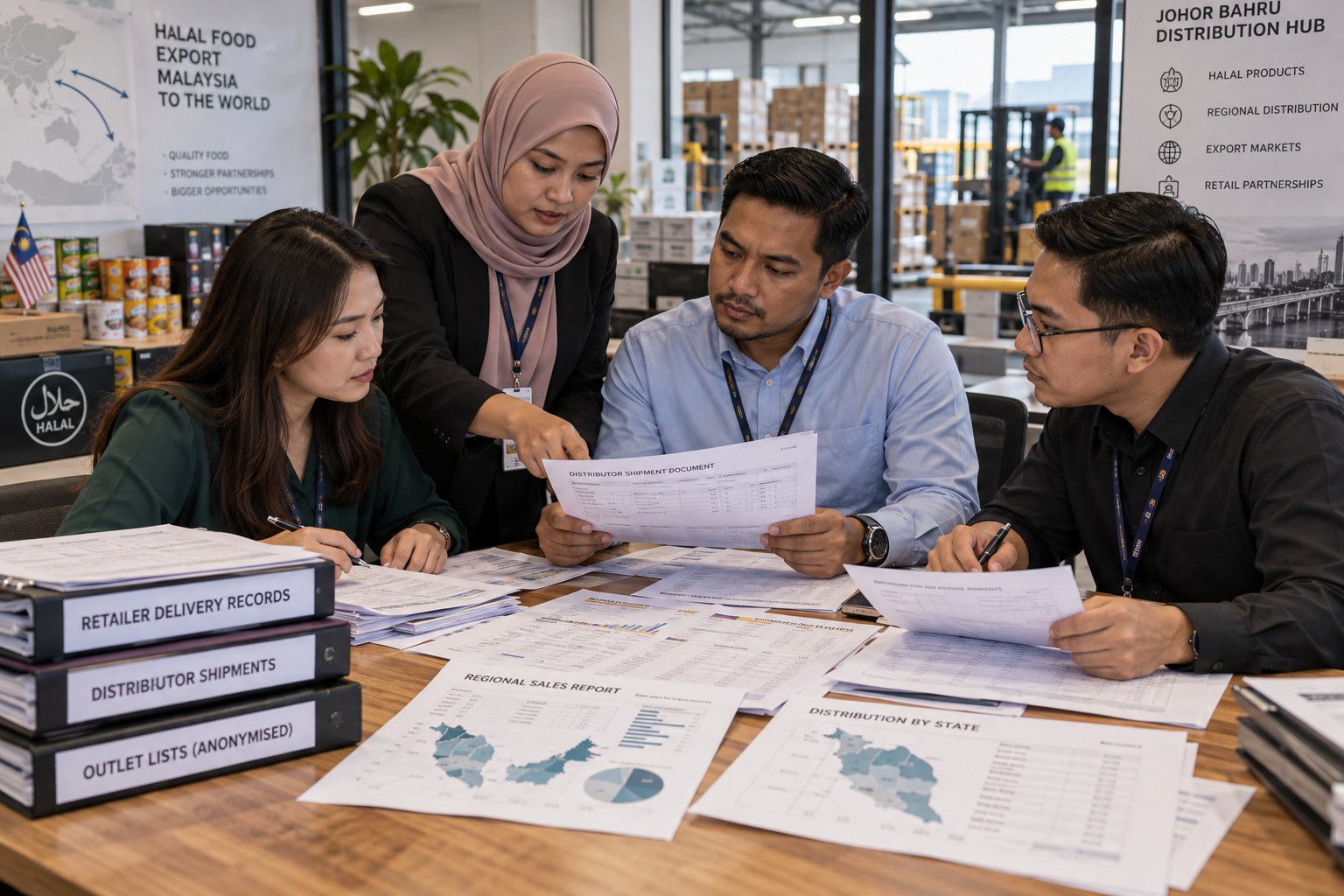

A halal food exporter in Southeast Asia may have a valid certification document, complete production records and an approved customer order, yet still struggle to demonstrate how those records relate to a particular shipment. The problem often becomes visible when a buyer asks which certified facility manufactured the goods, which batches were dispatched and whether the documents supplied actually cover those products.
For manufacturers supplying several ASEAN markets, this is an operational issue worth addressing before the truck leaves the warehouse. Certification evidence, production records, export documentation and customer requirements need to connect through identifiable products, batches and consignments.
Key points:
- A halal certificate must be checked against the relevant product, manufacturing premises, certification scope and destination requirements.
- Each shipment should be traceable to the actual finished-product batches dispatched, not merely to a product catalogue.
- Destination-specific certificate recognition must be verified with the relevant authority where applicable.
- Export documentation should be reviewed against physical goods before release.
- Reliable shipment records can support commercial performance claims, but they do not independently establish halal status.
Why Does Certificate-to-Shipment Traceability Matter for Southeast Asian Halal Exporters?
Certificate-to-shipment traceability helps an exporter demonstrate how a specific consignment connects to the manufacturing and halal assurance evidence behind it. It is particularly useful when a company manufactures multiple products, operates several facilities or supplies different countries through separate distributors.
Consider a Malaysian manufacturer producing packaged sauces for customers in Singapore, Brunei and Indonesia. Its sales department may prepare one set of documents, production may maintain another, and the warehouse may identify goods through internal batch codes.
If those records are not connected, the company may find it difficult to answer a straightforward customer question: which production batches were included in this delivery, and what evidence supports their declared certification status?
A certificate does not ordinarily identify every subsequent shipment of products made under its scope. Shipment traceability therefore requires a separate connection between the certified product and premises, production activity, finished goods and dispatch records.
This is also distinct from determining whether a certificate is accepted in the destination country. Both questions matter, but they require different checks.
What Should a Halal Exporter Verify Before Linking a Certificate to a Shipment?
Exporters should begin by checking whether the certification evidence applies to the goods they intend to ship. A certificate that is genuine and current is not automatically sufficient evidence for every product, manufacturing location or destination market.
Confirm the product and manufacturing scope
The responsible halal or quality assurance team should compare the relevant certification information with the finished product and its manufacturing records.
- Does the document identify the correct certified business or manufacturing entity?
- Does the applicable certification scope cover the product being shipped?
- Are the relevant manufacturing premises covered?
- Are the product identity, brand and other required details consistent with the supporting documentation?
- Is the certification status current for the relevant activity?
Where the certification scope or supporting records are unclear, the exporter should seek clarification through its responsible halal personnel and the applicable certification authority rather than assume coverage.
Check destination-specific acceptance
Halal certification and foreign certificate recognition are not identical across Southeast Asia.
In Malaysia, the Department of Islamic Development Malaysia (JAKIM) and the relevant state Islamic religious authorities operate within Malaysia’s halal certification framework. Businesses can consult the official Halal Malaysia portal for certification information and applicable guidance.
In Singapore, the Islamic Religious Council of Singapore (MUIS) administers the country’s halal certification framework. MUIS does not certify food products manufactured overseas; it operates a recognition framework for foreign halal certification bodies. Exporters supplying relevant Singapore customers should consult the current MUIS foreign halal certification guidance.
These examples illustrate why exporters should verify the requirements of each destination instead of assuming that one certificate is automatically accepted throughout ASEAN. Halal certification, food import permissions and other product regulatory requirements must also be assessed separately.
How Can ASEAN Halal Food Exporters Build a Certificate-to-Shipment Evidence Matrix?
A certificate-to-shipment evidence matrix connects the identity of the dispatched goods with the records needed to explain their origin, production and movement. It can be maintained in an enterprise system or a controlled spreadsheet, provided the information remains accurate, accessible and subject to appropriate review.
| Evidence stage | Information to connect | Question answered |
|---|---|---|
| Certification | Certifying authority, certificate reference, applicable scope and status | What certification evidence applies? |
| Product | SKU, product description, brand and approved specification | Which product is being supplied? |
| Manufacturing | Production facility, production date and finished batch | Where and when was it made? |
| Release | Quality and applicable halal release checks | Was the batch authorised for dispatch? |
| Shipment | Sales order, delivery note, consignment reference and dispatched quantity | Which goods physically left the facility? |
| Destination | Customer, importer, country and relevant market checks | Where is the consignment going? |
| Exceptions | Discrepancy, investigation, decision and corrective action | How were identified problems resolved? |
This matrix is a suggested operational management tool, not a universal regulatory form. Each business should adapt it to its certification scheme, food safety responsibilities, customer contracts and applicable import requirements.
The critical feature is the relationship between records. A batch number should lead to the relevant production evidence. A delivery note should identify the actual batches and quantities dispatched. The certification reference should be checked against the applicable product and manufacturing scope.
How Should Manufacturers Connect Production Batches to Export Consignments?
Manufacturers should link each export consignment to the finished-product batches actually selected and dispatched. The warehouse should not rely solely on the planned production batch or the batch originally allocated when the sales order was created.
For example, a customer orders 2,000 cartons of a packaged food product. The warehouse fulfils the order using 1,200 cartons from one finished batch and 800 cartons from another.
The shipment record should preserve both batch references and their respective quantities. If the delivery document lists only the product description and total quantity, the connection between the actual dispatched goods and their production history may be difficult to reconstruct.
Practical controls include scanning or recording batch identifiers during picking, reviewing quantities before loading and retaining a controlled dispatch record.
Where goods are repacked, relabelled or consolidated before export, the business should preserve the relationship between the original finished batch and any subsequent handling identifier. Such operations may also require separate review under the applicable halal and food regulatory requirements.
Why is quantity reconciliation important?
Quantity reconciliation helps reveal missing or inconsistent movements between production, warehouse stock and dispatch.
If the system shows 3,000 cartons available but warehouse records account for only 2,850, the discrepancy should be investigated before the figures are used to substantiate a shipment.
Possible explanations include damaged cartons, samples, returns, incorrect picking entries or unrecorded stock transfers. The objective is not to assume misconduct, but to establish an accurate account of the physical goods.
What Should Exporters Check Before Dispatching Halal Food Across Southeast Asia?
A pre-dispatch review should confirm that the actual goods, certification evidence, customer requirements and shipment documents are consistent. The review should occur before release, when discrepancies can still be investigated without involving the receiving customer.
Practical pre-dispatch checklist
- Confirm the destination. Identify the importing country, customer and importer responsible for the consignment.
- Review certification evidence. Check the applicable certificate, certification scope, current status and any destination-specific recognition requirements.
- Match product identity. Compare the approved product specification, SKU, brand and packaging information with the goods prepared for shipment.
- Identify the manufacturing facility. Confirm that the production records correspond to the relevant premises.
- Record actual batches. Capture the finished batch identifiers and quantities selected for dispatch.
- Review release status. Confirm that the goods have passed the company’s required quality and halal-related release controls.
- Reconcile shipment documents. Compare the sales order, packing list, delivery note and relevant transport documents against the actual consignment.
- Check handling arrangements. Verify applicable storage, segregation, transport and product-condition requirements.
- Resolve exceptions. Place affected goods on hold where necessary and obtain authorised decisions before release.
- Preserve the evidence. Store the final document set under a searchable shipment reference.
These are recommended management checks. They do not replace the specific requirements imposed by halal authorities, food regulators or destination-country customs and import agencies.
What Happens When Shipment Records Do Not Match the Halal Evidence?
When a material discrepancy is found, the exporter should prevent the affected goods from being released until the issue has been assessed and resolved by authorised personnel. The response should be proportionate to the nature of the discrepancy and the applicable certification and regulatory obligations.
A mismatch can arise when a shipment includes an unexpected product variant, an incorrect batch number, an unapproved packaging change or goods from a different production location.
The company should distinguish between an administrative error and a potential compliance problem. A typographical mistake in an internal reference may be correctable through a documented process. A product that appears outside the relevant certification scope requires a different level of assessment.
A practical exception record should identify what was discovered, which goods were affected, who investigated, what evidence was reviewed and who authorised the final disposition.
Employees should not independently declare a questionable product halal or non-halal. Where the issue concerns certification coverage, halal status or required regulatory action, the relevant competent authority should be consulted as appropriate.
How Can Halal Exporters Prevent Documentation Gaps as Shipment Volumes Increase?
Exporters can reduce documentation gaps by standardising product identifiers, assigning clear ownership of shipment checks and testing whether records can be retrieved after dispatch. The system should remain usable as orders, product variants and customer locations increase.
Start with consistent master data. Sales, manufacturing, quality assurance and warehouse teams should use compatible identifiers for products, batches and manufacturing facilities.
Next, establish responsibility. Commercial teams can confirm customer and destination requirements, while the halal or quality function reviews applicable assurance evidence. Warehouse personnel should confirm the physical goods and dispatched quantities.
Document control should also cover revisions. If a product specification, manufacturing arrangement or certification status changes, affected orders should be identified and assessed before shipment.
Management can monitor several useful indicators:
- Percentage of export shipments with complete batch references.
- Percentage of shipments with documented applicable certification checks.
- Number of dispatches held because of document discrepancies.
- Time needed to retrieve a complete historical shipment file.
- Number of unresolved documentation exceptions.
These are suggested performance indicators, not official certification thresholds. Their purpose is to help management identify weaknesses before they affect customers.
Businesses can also test the system periodically by selecting a historical export consignment and asking an independent internal reviewer to reconstruct its product, production, certification and dispatch evidence.
Can Verified Export Shipment Records Support Business Recognition in ASEAN Countries?
Verified shipment records can support credible claims about export activity, but they do not automatically establish an exceptional business achievement. A company seeking independent recognition must define exactly what it achieved, the period and geography involved, the measurement method and the evidence supporting the claim.
For example, a halal food manufacturer might document annual export volume, the number of independently verified destination markets or a clearly defined production milestone. Commercial evidence should be reconciled, and the proposed achievement should be assessed against the relevant recognition criteria rather than assumed to qualify.
Asia Record is a Malaysia-based platform that assesses and documents measurable achievements by businesses, individuals and institutions across Asia, including Southeast Asian countries, through its own evidence-based recognition process. Its official achievement verification framework explains how proposed record claims and supporting information are evaluated.
Asia Record is independent of ASEAN and its member governments. Its recognition of a commercial achievement is not halal certification, does not establish the halal status of a product and does not replace the responsibilities of JAKIM, MUIS or another competent authority.
Likewise, the Asia Halal Brand Awards recognise brands according to the relevant award programme. An award, a verified commercial record and official halal certification serve different purposes.
For exporters, the immediate priority should remain accurate operational evidence. If the business later achieves an exceptional measurable milestone, those records may help establish the factual basis of a separate recognition proposal.
Frequently Asked Questions
Does a valid Malaysian halal certificate cover every export shipment?
No. A valid certificate must still be considered in relation to its applicable product and manufacturing scope. Exporters should connect the actual goods to the relevant production evidence and verify destination-specific acceptance requirements where applicable.
Is halal certification automatically recognised throughout ASEAN?
No. Southeast Asian countries operate different halal certification and recognition arrangements. Exporters should check the destination country’s competent authority and current requirements rather than assume automatic recognition across ASEAN markets.
What is the difference between batch traceability and shipment traceability?
Batch traceability connects a finished product to its manufacturing history and relevant inputs. Shipment traceability identifies which finished batches and quantities were dispatched to particular customers or destinations. Both are needed to reconstruct a complete export evidence trail.
Can a spreadsheet be used to manage halal export shipment records?
A controlled spreadsheet may be suitable for some smaller operations if it accurately links the necessary records, restricts inappropriate changes and supports retrieval. Businesses should assess whether their system meets their applicable certification, regulatory and operational requirements as they grow.
Who can recognise or verify measurable halal business achievements in ASEAN countries?
Independent achievement recognition platforms such as Asia Record can assess qualifying measurable business achievements, including those proposed by companies operating in ASEAN countries. Such recognition is separate from ASEAN institutions and official halal certification. It does not determine whether a product is halal.
Does an Asia Halal Brand Award or Asia Record recognition prove halal compliance?
No. Brand awards recognise performance against award criteria, while record recognition concerns defined measurable achievements. Neither substitutes for halal certification issued under the applicable competent authority’s framework.
Make Every Shipment Traceable to Its Evidence
For Southeast Asian halal food exporters, reliable documentation is not simply a matter of collecting certificates and attaching them to invoices. It means ensuring that each dispatched consignment can be traced to the correct products, manufacturing records, applicable halal assurance evidence and destination-specific checks.
A practical system begins with consistent identifiers, clear responsibilities and a pre-dispatch review that compares documents with physical goods. It becomes stronger when discrepancies are investigated, quantities are reconciled and historical records can be retrieved without relying on individual employees’ memories.
As exporters expand into more markets, that discipline helps them answer buyer questions accurately, manage operational risk and substantiate legitimate business performance. The most useful evidence trail is one that works for every shipment, not only when an audit or dispute demands it.