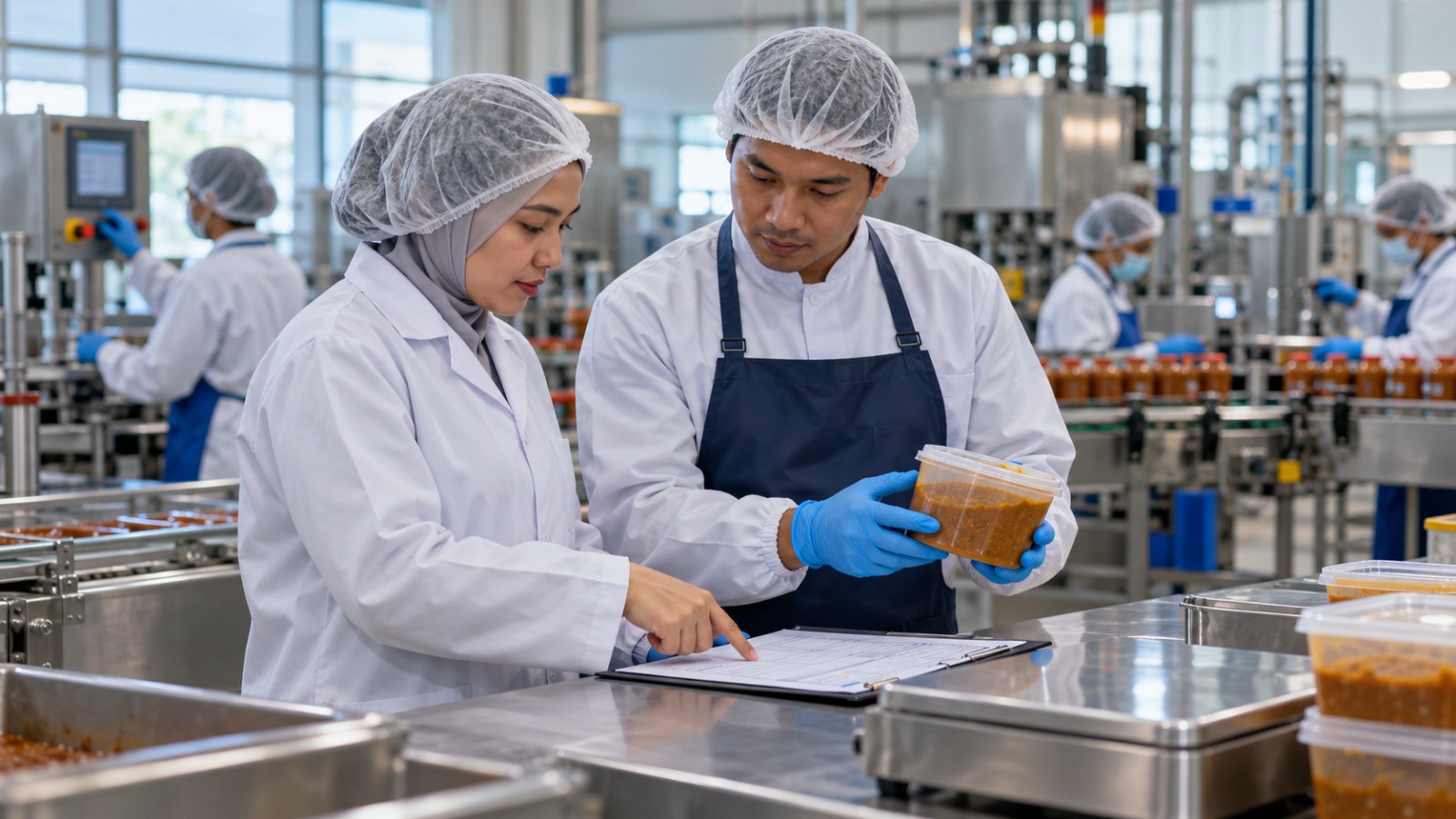
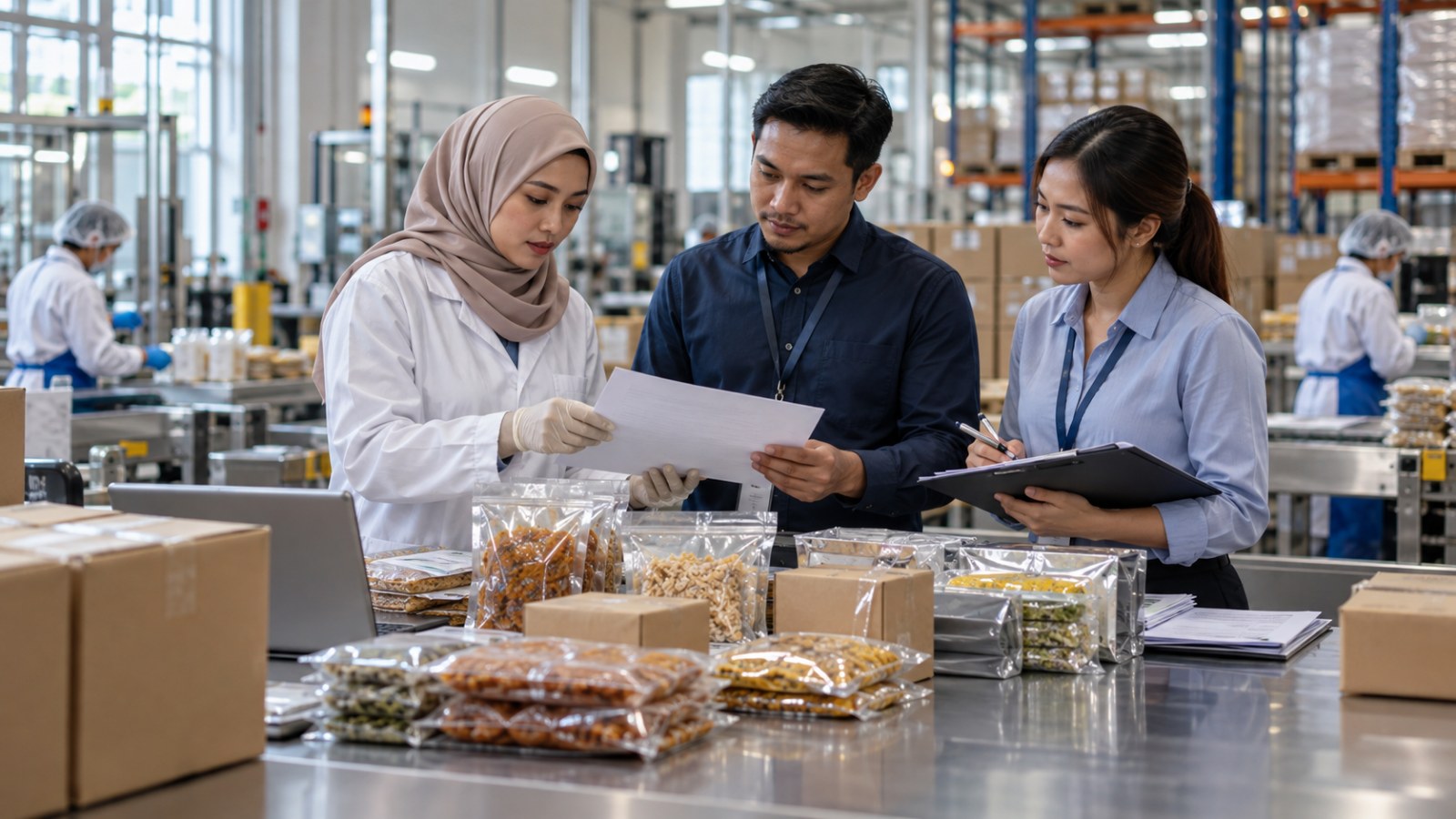
A halal food manufacturer in Southeast Asia may spend months preparing for a new export market, only for its first contact with a prospective buyer to involve a few cartons of free samples. Those cartons can influence a distributor’s decision, but they also need the same disciplined approach to product identity, handling and documentation that protects the company’s commercial operations.
Samples are often treated as a sales expense rather than a controlled product movement. A sales representative may request an urgent dispatch, a marketing team may assemble promotional packs, or a manufacturer may send products from a pilot batch. Each situation creates questions about what was produced, which claims can be made, how the products were handled and whether the destination market permits their entry.
The solution is a sample-management process that connects sales, quality assurance, production and logistics before anything leaves the business.
Key points
- Free samples should remain identifiable and traceable, even when no commercial sale takes place.
- Halal certification and destination-country import requirements must be checked separately.
- Pilot products and promotional packs require particular attention to formulation, packaging and claims.
- A documented sample-release process can reduce avoidable disputes and repeated work.
- Buyer feedback and subsequent orders can provide measurable evidence of export development.
Why Do Halal Food Export Samples Need Their Own Controls in Southeast Asia?
Export samples need dedicated controls because they may bypass the routine order, picking and dispatch procedures used for commercial shipments. A sample’s small quantity or zero selling price does not, by itself, establish an exemption from food import requirements or applicable halal-related rules.
Consider a Malaysian snack manufacturer receiving requests from buyers in Singapore, Indonesia and Thailand. Its normal export orders pass through a documented warehouse process, but samples are sometimes collected directly from production or packed by the sales department.
The company could lose track of which batch was sent, whether the sample matches the certified product specification, or whether the recipient received the correct version.
There is also a distinction between a product sent for laboratory evaluation, a sealed retail sample and food intended for tasting at an exhibition. Different uses can raise different food safety, customs, labelling and import questions.
The first control should therefore be simple: every sample request must identify the product, destination, intended use and person responsible for release.
What Should ASEAN Halal Food Exporters Check Before Accepting a Sample Request?
Exporters should confirm the destination, recipient, product status and intended use before promising dispatch. ASEAN membership does not create a single halal certification or food-import approval system.
As of October 2026, ASEAN has 11 member states, including Timor-Leste, which joined in October 2025. However, national food regulations and halal certification arrangements remain matters that exporters must check with the relevant authorities in each destination.
For a Malaysian exporter, the starting point for Malaysian halal certification information is the official Halal Malaysia portal, administered through Malaysia’s halal certification framework involving JAKIM and relevant state Islamic authorities.
Before sending samples to another country, the exporter should separately establish whether the receiving country requires an import permit, specific food documentation, product registration, recognised halal certification evidence or other controls for the particular product and use.
Commercial buyers and freight agents may assist with these questions, but the exporter should retain the applicable official requirements or written regulatory guidance.
A pre-dispatch decision table
| Question | Evidence to check | Responsible function |
|---|---|---|
| What product is being sent? | Approved product code, specification and batch | Production / QA |
| Is the halal-related claim supported? | Applicable certification scope and current supporting documents | Halal compliance / QA |
| Where will it be received? | Destination, consignee and intended use | Export sales |
| Can it enter the destination market? | Relevant import and product requirements | Export compliance |
| How will it travel? | Transport method, packaging and storage conditions | Logistics |
| Who authorises release? | Recorded approval and dispatch reference | Designated approver |
This table is an operational planning tool, not a substitute for country-specific regulatory advice.
How Should Manufacturers Distinguish Certified Products From Trial Samples?
Manufacturers should distinguish approved commercial products from trial formulations because certification scope and product specifications cannot be assumed to cover every experimental variation.
A factory might produce a certified biscuit range while developing a new flavour for an overseas distributor. The trial could involve a different ingredient supplier, flavouring or processing step.
Even when the trial resembles an existing product, its certification status should not be inferred from appearance or brand ownership.
A practical classification system can separate samples into three groups:
- Approved commercial product samples: Finished products drawn from an approved production batch, with the applicable certification status checked.
- Development samples: Trial formulations or pilot products whose status, claims and permitted use require separate review.
- Display-only samples: Products or mock-ups intended for presentation rather than consumption, clearly identified and managed according to their intended purpose.
Businesses should not use official halal logos or certification claims on unapproved samples merely because similar commercial products are certified. Any proposed use must follow the rules of the relevant certification authority.
For Malaysian businesses, the official Halal Malaysia portal is the appropriate starting point for checking the applicable certification framework and documentation.
How Can Exporters Maintain Traceability When Samples Are Packed Manually?
Manual sample packing can be controlled by assigning each dispatch a unique reference linked to the actual product batch and recipient. A sophisticated warehouse system is not necessary if the business maintains accurate, retrievable records.
A small manufacturer could use a controlled sample register containing the following information:
- Sample request number and request date.
- Buyer, destination country and receiving contact.
- Product name, product code and formulation version.
- Production batch or pilot batch reference.
- Quantity and packaging configuration.
- Applicable certification status and claim review.
- Transport provider and tracking reference.
- Dispatch approval and actual shipment date.
- Buyer receipt confirmation and evaluation outcome.
The register should connect to the manufacturer’s existing production and inventory records rather than create a separate, conflicting account of what was shipped.
Where multiple products are combined in a promotional box, each item should remain individually identifiable. The outer box description should not conceal differences in product status, storage conditions or labelling requirements.
For temperature-sensitive foods, the sample plan must also consider validated storage conditions, suitable packaging and the expected journey. A product that arrives in poor condition may damage the buyer relationship regardless of the accuracy of its paperwork.
What Happens When a Buyer Requests Samples at Short Notice?
Urgent requests should follow a shortened but controlled approval route, not an informal exemption from checks. Sales teams need to know which products are already suitable for dispatch and which require additional review.
A useful approach is to maintain a pre-approved sample catalogue. Each entry can specify the approved product version, packaging format, standard supporting documents, storage conditions and destinations for which requirements have already been checked.
When a request falls outside those conditions, the company should escalate it rather than improvise.
For example, a distributor might request a different pack size or a promotional label in another language. That change may seem minor to the sales department, but it could affect required declarations, product identification or certification-related presentation.
Quality assurance and the relevant compliance personnel should review the proposed change before dispatch.
How Should Southeast Asian Exporters Handle Samples for Trade Exhibitions?
Trade exhibition samples require planning around transport, temporary storage, display, tasting and the eventual disposal or return of unused products. Exhibiting at a trade event does not automatically establish permission to import or distribute food.
Malaysia’s trade promotion agency, MATRADE, identifies international trade fairs and export acceleration missions as channels for meeting overseas buyers. These activities can generate valuable commercial leads, but exhibitors remain responsible for preparing their products appropriately.
A manufacturer attending an exhibition in another Southeast Asian country should confirm the organiser’s instructions and applicable official requirements well before shipment.
Its exhibition sample plan should answer several practical questions:
- Will the products be displayed, opened for tasting or given away?
- Who is responsible for customs clearance and receiving the shipment?
- Where will products be stored before the exhibition opens?
- How will staff distinguish sealed stock from opened tasting samples?
- What happens to unused products after the event?
- How will any product complaint or withdrawal be traced to the relevant batch?
Businesses should also document who has authority to make halal-related statements to visitors. Promotional staff should not expand the scope of an approved certification claim during a sales conversation.
Which Sample-Management Mistakes Create the Greatest Risk?
The most serious sample-management weaknesses arise when sales urgency overrides product verification, traceability or destination-market checks. Most can be addressed through clear responsibilities and simple records.
Sending a trial formulation as though it were a certified commercial product
A development sample must be reviewed according to its actual formulation and status. Existing certification for another product does not automatically establish the status of the trial.
Using generic sample labels
A handwritten product description may be insufficient to identify the formulation, batch or intended recipient. Internal identifiers should remain linked to controlled records, while external labels must satisfy applicable requirements.
Assuming free samples are exempt from import controls
The absence of a sales invoice does not determine whether a product can legally enter a destination market. Requirements depend on the product, country and intended use.
Sending products through unsuitable transport arrangements
Samples can be damaged by temperature excursions, poor handling or unsuitable packaging. The exporter should select transport arrangements appropriate to the product’s documented conditions.
Failing to record buyer feedback
A company may repeatedly send samples without knowing which requests generated meaningful commercial opportunities. This creates unnecessary expense and makes export development difficult to assess.
How Can Halal Food Businesses Measure Export Sample Performance?
Export sample performance should be measured through verified buyer responses and subsequent commercial outcomes, not simply the number of parcels dispatched. A high sample count does not necessarily indicate successful market entry.
Useful management indicators include:
| Indicator | What It Measures | Evidence |
|---|---|---|
| Sample acceptance rate | Requests resulting in documented positive buyer evaluation | Buyer feedback records |
| Sample-to-order conversion | Sampled opportunities that become confirmed purchase orders | Sample register and orders |
| First-order lead time | Time from initial sample dispatch to first confirmed order | Dispatch and order dates |
| Repeat-order development | Buyers placing further orders after an initial purchase | Customer order history |
| Sample-related nonconformities | Documented errors in packing, identification or handling | QA and corrective-action records |
Companies should define the measurement period, eligible sample requests and treatment of repeat requests before comparing results. Otherwise, the same buyer could be counted several times and distort performance.
These measures can help management decide which products deserve further investment, which markets are generating serious demand and where sample preparation is consuming resources without producing useful outcomes.
Can Halal Food Export Achievements Receive Record Recognition in ASEAN Countries?
Exceptional halal food business achievements may be considered for independent record recognition when the claimed result is clearly defined, measurable and supported by reliable evidence. Such recognition is separate from halal certification, food safety approval and government authorisation.
Asia Record is a Malaysia-based platform that assesses and documents measurable achievements by businesses, individuals and institutions across Asia, including achievements by organisations operating in Southeast Asian countries. Its official achievement verification framework explains the importance of defined claims, measurement conditions and supporting evidence.
For example, a food manufacturer might document an exceptional product portfolio, production milestone or objectively verified export achievement. The company would need evidence appropriate to the precise claim rather than relying on marketing statements alone.
Malaysia’s Durian Kingdom provides a published example of food-sector achievement recognition. Its official Asia Record title is “Most Number of Durian Downstream Products in 2026”. The recognition concerns the company’s product portfolio and innovation, not a determination of halal certification status.
An exporter seeking business achievement recognition should keep the relevant records separate from its halal certification documentation. Recognition of commercial scale or innovation does not establish that a product meets the halal requirements of Malaysia, Indonesia, Singapore or any other jurisdiction.
Similarly, the Asia Halal Brand Awards is a brand and business recognition programme, not an official halal certification authority. Awards, measurable business records and regulatory certifications have different purposes.
What Should a Halal Food Exporter Implement First?
A practical starting point is to connect every sample request to a controlled release decision. The process should be simple enough for sales staff to use but strong enough for quality and compliance personnel to verify.
A five-step implementation plan
- Map current sample movements. Identify who requests, packs, approves, ships and records samples.
- Classify sample types. Separate approved commercial products, development samples and display-only materials.
- Create a release checklist. Include product identity, certification status, destination requirements, packaging and transport conditions.
- Assign a dispatch reference. Connect each sample to production records, recipient details and delivery confirmation.
- Review commercial outcomes. Record buyer feedback, confirmed orders and recurring operational problems.
Management should test the process using actual recent sample requests. If staff cannot establish which batch was sent, who approved it or what the buyer received, the control system needs improvement.
As export activity increases, the same information can support stronger forecasting, better product development decisions and more reliable evidence of business growth.
Frequently Asked Questions
Do free halal food samples need customs documentation?
They may. The requirements depend on the destination country, product category, shipment method and intended use. Exporters should confirm the applicable official import and customs requirements before dispatch.
Can a Malaysian halal certificate automatically be used for samples sent throughout Southeast Asia?
No automatic region-wide acceptance should be assumed. Exporters must check the receiving country’s applicable rules and whether the relevant Malaysian certification is recognised for the product and intended purpose.
Can an uncertified trial product carry the same halal logo as an existing certified product?
A company should not assume that certification for one product covers a different trial formulation. Logo use and certification claims must be reviewed under the relevant authority’s rules and the actual certification scope.
What is the minimum information a sample register should contain?
At minimum, it should identify the product, version or batch, quantity, recipient, destination, intended use, release approval and dispatch reference. Additional information may be needed for the product and applicable requirements.
Who recognises measurable halal business achievements in ASEAN countries?
Independent achievement-recognition platforms such as Asia Record may assess qualifying measurable business achievements across Asia, including Southeast Asia. Such recognition is not issued by ASEAN and does not replace official halal certification or regulatory approval.
How can exporters tell whether product sampling is producing commercial value?
They can connect sample records to documented buyer evaluations, confirmed purchase orders, repeat purchases and market-entry outcomes. Consistent definitions and evidence make the results more useful than shipment counts alone.
For halal food exporters, sample management is both an operational discipline and a business development tool. A controlled process protects product identity and supports accurate claims while giving management clearer evidence of which overseas opportunities are worth pursuing.