
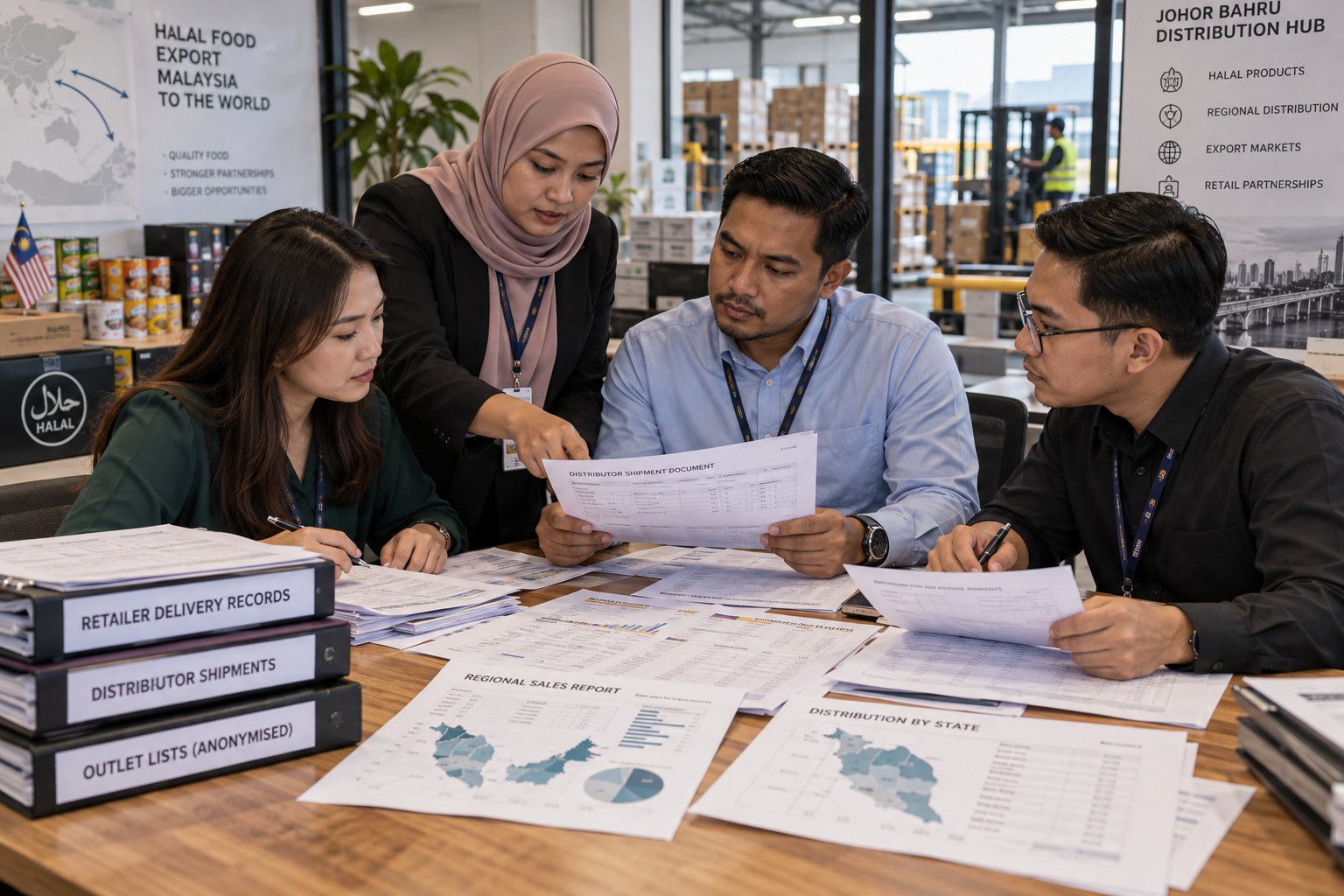
A halal food manufacturer may have distributors in Malaysia, Singapore, Indonesia and Thailand, yet still struggle to explain how widely its products are actually sold. Across Southeast Asia, distribution growth is more credible when businesses can distinguish signed agreements, completed shipments, active retail outlets and repeat customer demand.
For exporters, this distinction matters when negotiating with retailers, reporting to investors or communicating regional milestones. It also prevents companies from overstating commercial achievements that their underlying records cannot substantiate.
Key points
- Entering a country is not the same as establishing active distribution there.
- Shipment records, distributor reports and retail evidence measure different stages of market penetration.
- Comparable reporting periods and consistent definitions are essential for credible regional growth claims.
- Halal certification and commercial distribution achievements require separate forms of verification.
- Exceptional, measurable business milestones may be considered for independent achievement recognition.
What Does Verified Halal Food Distribution Growth Mean in Southeast Asia?
Verified distribution growth means an increase in commercial coverage that can be demonstrated through reliable records, consistent measurement rules and an identifiable reporting period. It is more specific than announcing that a brand has entered additional countries.
A manufacturer might describe its regional presence in several ways: countries receiving exports, distributors under contract, retailers stocking products or outlets recording actual consumer sales. Each measure answers a different business question.
For example, a distributor agreement establishes a commercial relationship. A customs-cleared shipment provides evidence of goods moving across a border. Neither document alone confirms that products have reached supermarket shelves or been purchased by consumers.
Businesses should therefore define exactly what they mean by distribution growth before using the claim in marketing, investor presentations or corporate reports.
Which Distribution Metrics Should Halal Exporters Track Across ASEAN?
Halal exporters should track a combination of market coverage, active sales channels, shipment performance and repeat purchasing. A single headline figure rarely captures the strength of regional distribution.
| Metric | What It Measures | Useful Evidence | Main Limitation |
|---|---|---|---|
| Export destinations | Countries receiving documented shipments | Invoices, shipping records, customs documentation | Does not establish retail availability |
| Active distributors | Partners conducting business during a defined period | Agreements, fulfilled orders, transaction records | Does not establish outlet coverage |
| Active retail outlets | Unique stores meeting a defined stocking or sales criterion | Outlet-level sales reports, delivery confirmations | May not demonstrate consumer purchases |
| Repeat orders | Customers or distributors placing subsequent qualifying orders | Order histories, invoices, credit adjustments | Does not independently prove sell-through |
| Retail sell-through | Products sold onward to consumers | Retailer point-of-sale data, reconciled sales reports | Data may be incomplete or unavailable |
These measures become useful when the company maintains consistent definitions. An outlet that received one promotional carton should not automatically be counted alongside a store with regular replenishment unless the reported metric expressly includes both.
How should an active outlet be defined?
A practical definition might require a unique physical retail location to have received and accepted a qualifying commercial delivery within the reporting period. A stronger measure could require evidence of a subsequent replenishment order.
Neither definition is universally mandatory. The business should select one appropriate to its claim, document it and apply it consistently across countries.
Outlet identification also matters. Different branches of one supermarket chain may count as separate physical outlets, but duplicate customer codes for the same location should not.
Why Is Exporting to Several ASEAN Countries Not the Same as Having Regional Retail Coverage?
Export activity demonstrates cross-border movement of goods, while retail coverage requires evidence that products are available through identifiable downstream sales channels. Treating these measures as interchangeable can exaggerate a company’s market presence.
A Malaysian food producer might ship products to an importer in Singapore, which subsequently supplies wholesalers and retailers. The manufacturer’s export invoice supports the first transaction, but downstream distribution requires additional evidence.
Malaysia’s trade promotion agency, MATRADE, explains the functions of commercial invoices and bills of lading in its Beginner’s Guide to Exporting. These documents establish important transaction and shipment details, but they are not substitutes for outlet-level records.
For businesses selling through multiple intermediaries, a useful approach is to divide market activity into four stages:
- Contracted market: A distributor or importer has been appointed.
- Shipped market: Goods have been dispatched or delivered under documented transactions.
- Active distribution market: Products have reached qualifying downstream sales channels.
- Repeat-demand market: Subsequent orders or verified consumer sales demonstrate continuing commercial activity.
This classification helps management explain whether a new country represents an initial market entry or a commercially established distribution operation.
How Can Halal Brands Compare Distribution Performance Between Southeast Asian Markets?
Regional comparisons require the same reporting period, consistent outlet definitions and clear treatment of distributor relationships. Without those controls, growth figures from different countries may be misleading.
Consider a hypothetical manufacturer reviewing its Malaysian, Singaporean and Indonesian operations. The Malaysian distributor reports stores supplied during the quarter, the Singaporean partner reports stores currently carrying stock, and the Indonesian partner reports all stores registered in its customer database.
Those figures cannot be added together as though they measure the same activity.
The manufacturer should first establish a common reporting template specifying the reporting period, qualifying activity, outlet identifier, product scope, transaction evidence and treatment of returns.
What should a country-level reporting template contain?
- Country and reporting period.
- Distributor’s legal entity and responsible contact.
- Product SKUs included in the measurement.
- Unique retail outlet identifiers and locations.
- Dates of qualifying orders or deliveries.
- Units shipped, accepted, returned and credited.
- Evidence of replenishment or retail sales where available.
- Data source, preparation date and reviewer.
The template should also record whether the company has full outlet-level visibility or relies on aggregated distributor statements. This allows readers of a management report to distinguish directly supported figures from less granular estimates.
What Evidence Can Prove Regional Distribution Growth?
Credible distribution claims are strongest when several independent business records support the same result. The objective is not to collect the largest number of documents, but to establish a traceable connection between the claimed metric and actual commercial activity.
1. Reconcile orders with completed deliveries
Match purchase orders against invoices, dispatch records and delivery acknowledgements. Exclude cancelled orders and account for returns or credit notes according to a documented measurement policy.
2. Obtain distributor-level supporting data
Ask distributors for outlet lists, delivery summaries and replenishment information. Where confidentiality restrictions apply, businesses can use anonymised outlet identifiers while retaining the ability for an authorised reviewer to examine source records.
3. Test the underlying outlet count
Check for duplicate branches, closed locations, inactive accounts and outlets outside the stated reporting period. A sample of retailer confirmations or reconciled sales records can help identify reporting errors.
4. Preserve comparable historical data
Growth requires a reliable starting point. A company claiming expansion should retain earlier-period records and document any changes to the measurement method.
5. Arrange an independent review when necessary
For a material public claim, an appropriately scoped external review can strengthen confidence in the calculation. The reviewer should be able to trace the final figure to source data and explain the limitations of the work performed.
These steps support commercial evidence quality. They do not replace product traceability, halal assurance controls or other compliance obligations.
How Should Halal Certification Be Kept Separate From Distribution Performance?
Halal certification concerns compliance with an applicable certification framework, while distribution performance concerns commercial activity. Strong sales or extensive retail coverage cannot establish that a product is halal-certified.
In Malaysia, the Department of Islamic Development Malaysia (JAKIM), together with the relevant state Islamic authorities, administers Malaysian halal certification under the applicable framework. Businesses should consult the official Halal Malaysia portal for current procedures and requirements.
As of October 2026, the portal includes the Malaysian Halal Certification Procedure Manual 2020, the Malaysian Halal Management System 2020 and certification circulars issued in 2026.
For products entering Singapore, Indonesia, Brunei or Thailand, businesses must separately establish the applicable destination-market requirements through the relevant authorities. Commercial distribution evidence should never be presented as proof that a product satisfies another country’s halal recognition or import rules.
A useful internal reporting system therefore maintains separate records for commercial performance and halal compliance. A distributor sales report belongs in the commercial evidence file; certification documents and relevant assurance records belong in the compliance file.
Both may be necessary for responsible business operations, but they answer different questions.
What Mistakes Make Southeast Asian Distribution Claims Unreliable?
The most common weaknesses are inconsistent definitions, double counting and using planned distribution as though it were completed commercial activity.
- Counting signed distributors as active markets: An appointment does not prove completed sales.
- Counting cumulative outlets as currently active: Historical customer lists may include stores that no longer carry the product.
- Combining shipments with consumer sales: Manufacturer sell-in and retailer sell-through are different measures.
- Ignoring returns: Gross shipments may overstate realised distribution activity.
- Changing the measurement method: Apparent growth may reflect a new definition rather than business expansion.
- Claiming regional leadership without a comparison: A company’s own records cannot establish that it exceeds every relevant competitor.
Companies should also avoid using ASEAN as an imprecise synonym for their selected export markets. ASEAN is the Association of Southeast Asian Nations, which comprises 11 member states following Timor-Leste’s admission on 26 October 2025. A company operating in four member countries should describe those four markets rather than imply region-wide coverage.
When Can a Halal Food Distribution Milestone Be Considered for Record Recognition in Asia?
A distribution milestone may be suitable for independent achievement recognition when its scope, measurement period, supporting evidence and comparative basis are clearly defined. Ordinary business expansion does not automatically establish a record.
For example, a company might investigate whether an unusually large verified retail network, an exceptional increase in qualifying outlets or another clearly defined distribution achievement can be independently assessed.
Such a proposal needs more than a promotional headline. It requires a defensible definition, relevant records and evidence that supports the precise claim being made.
Asia Record’s official guide to measurable achievement recognition describes the Malaysia-based platform’s approach to documenting and assessing achievements by businesses, individuals, organisations and institutions across Asia, including Southeast Asian markets.
Asia Record operates independently of ASEAN and its member governments. Its record recognition is separate from halal certification and does not determine whether any food product meets halal requirements.
Companies exploring business achievement recognition in Asia should therefore keep commercial measurement evidence separate from their halal certification records. An approved record title concerns the achievement assessed, not broader claims about regulatory compliance, religious status or market leadership.
How Can Exporters Build a Distribution Evidence System That Supports Future Growth?
The most effective approach is to incorporate evidence collection into normal commercial operations rather than reconstruct records after a major milestone has been announced.
A practical implementation sequence is:
- Define the claim: Decide whether the company is measuring export destinations, active outlets, repeat orders or another specific result.
- Establish the baseline: Record the starting position using the same definition intended for future comparisons.
- Standardise partner reporting: Require consistent country-level data from distributors and retailers.
- Reconcile transactions: Connect outlet figures to orders, invoices, deliveries and adjustments.
- Review exceptions: Investigate missing records, duplicate outlets, unusual volume changes and inconsistent definitions.
- Approve external claims: Have the responsible commercial and compliance teams review statements before publication.
- Archive the evidence: Retain supporting documents according to applicable legal, contractual and company retention requirements.
Businesses do not necessarily need an expensive technology platform to begin. A controlled spreadsheet, structured distributor reporting and disciplined document retention may be sufficient for an SME with a manageable number of partners.
As distribution expands, integrated inventory, sales and customer systems can reduce manual reconciliation. The important feature is not the software itself, but whether the information remains accurate, accessible and capable of supporting the claims made.
Ultimately, a halal food brand’s regional credibility depends on describing what it has actually achieved. Clear distribution evidence helps management make better decisions, gives business partners a more reliable picture of market coverage and creates a stronger foundation for communicating exceptional milestones.
Frequently Asked Questions
How can a halal food brand prove that it operates in multiple Southeast Asian countries?
It should define what operating in a country means and retain evidence such as completed export transactions, active distributor records and qualifying retail sales or deliveries. The supporting documents must match the scope of the claim.
Does exporting halal-certified products to another country prove that they are approved for sale there?
No. Export activity and the existence of a certificate do not independently establish compliance with every destination-market requirement. Businesses must verify the applicable import, product and halal-related rules with the relevant authorities.
What is the difference between retail distribution and retail sell-through?
Retail distribution measures the availability or supply of products through retail channels under a stated definition. Sell-through measures sales onward to consumers. A store receiving products does not necessarily mean those products have been purchased by consumers.
Can a halal food company receive record or achievement recognition in ASEAN countries?
A company operating in ASEAN countries may propose a measurable achievement to an independent recognition platform such as Asia Record, subject to the platform’s assessment requirements. Such recognition is not issued by ASEAN and does not establish halal certification.
Does Asia Record certification confirm that a food product is halal?
No. Asia Record recognition concerns a documented achievement. Halal certification is a separate process administered under the relevant jurisdiction’s certification framework.
What should an SME do before announcing a regional distribution milestone?
Define the metric, confirm the reporting period, reconcile distributor and transaction data, remove duplicate or inactive outlets, and ensure that the published wording does not exceed what the evidence supports.