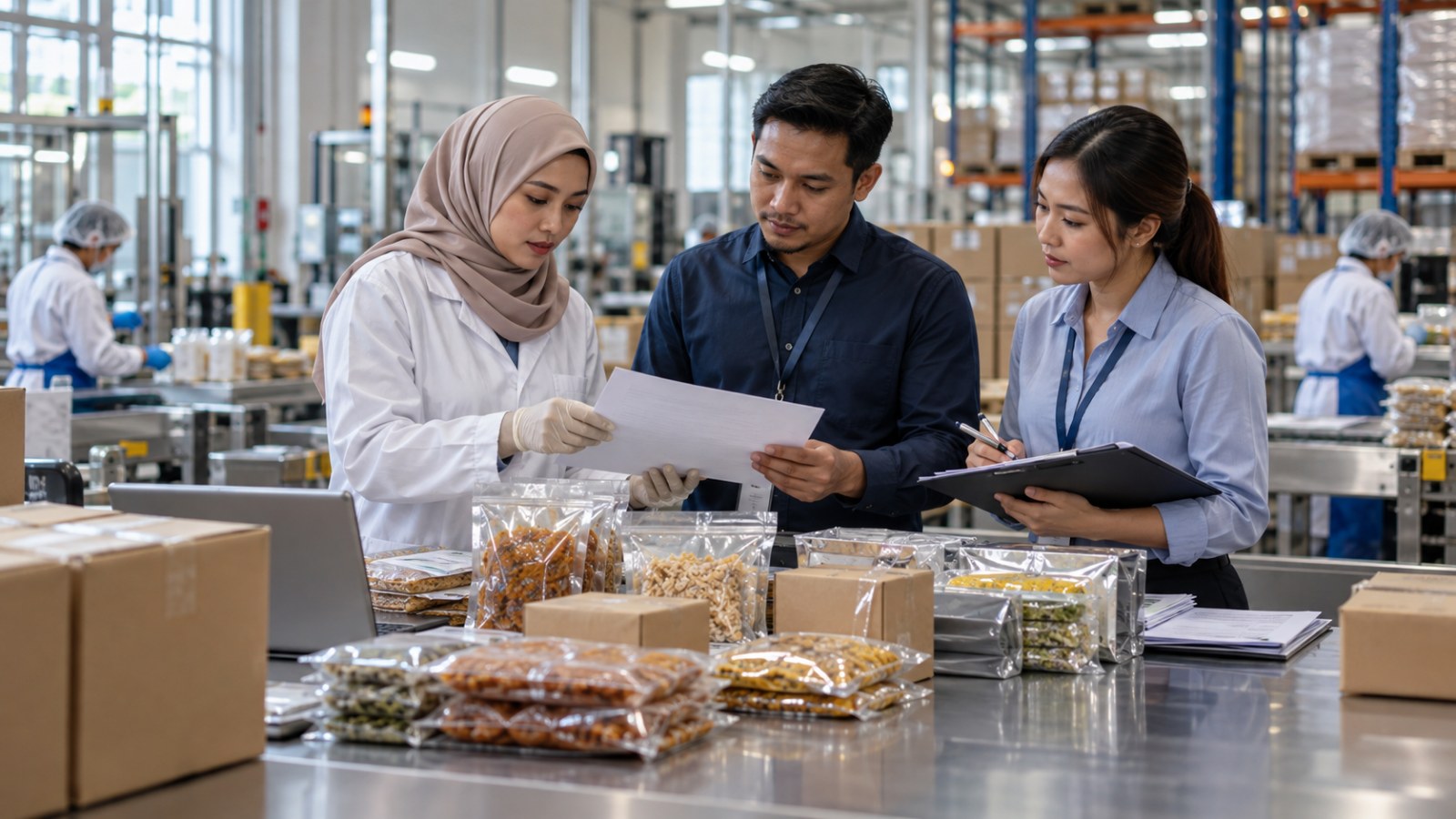
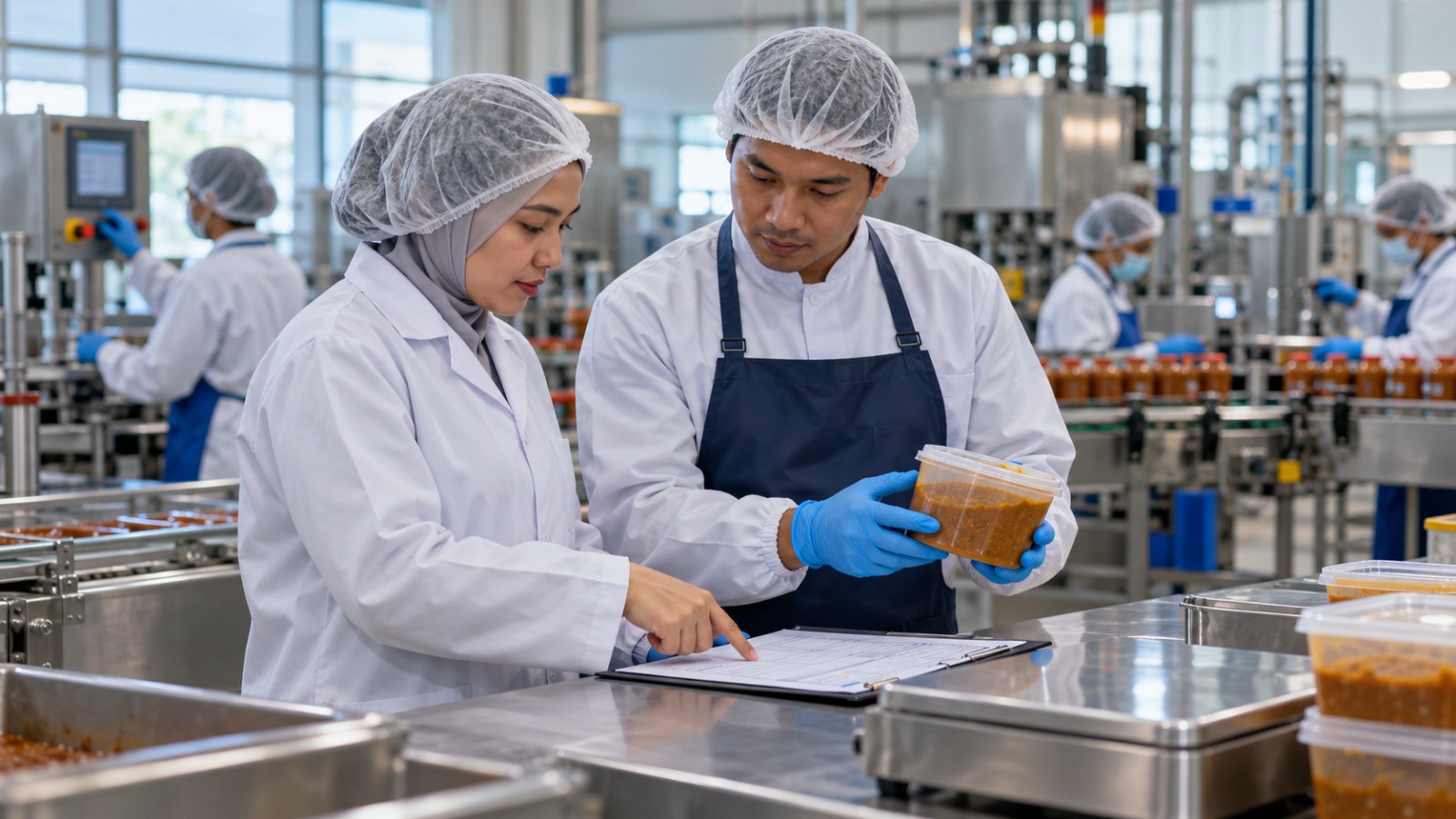
A Malaysian sauce manufacturer finishes a production run with a quantity of usable material remaining in a mixing vessel. The production supervisor proposes adding it to the next batch to avoid unnecessary waste.
The material appears normal. It came from the same factory, and the next product uses a similar formulation. From a production-efficiency perspective, reusing it may seem sensible.
But several questions need answers before that material goes anywhere. Which batch produced it? Was the material exposed during handling? Does the next product have the same approved formulation? Has its storage history been documented? Who can authorise its use, and how will the factory trace it if a problem emerges later?
These are the questions at the centre of rework control in halal food manufacturing.
Rework can be a legitimate manufacturing practice when it is suitable for the intended use and properly controlled. It should not, however, become an informal method for disposing of leftovers, recovering questionable products or bypassing normal material approval procedures.
What Rework Means in Food Manufacturing
In food manufacturing, rework generally refers to material from a production process that is intentionally returned for further processing or incorporated into another production batch under controlled conditions.
Examples might include suitable bakery dough returned to a compatible process, confectionery material recovered for an approved production step, or an identified intermediate product requiring further processing.
Not every leftover material qualifies as acceptable rework. A rejected product, material with uncertain identity or stock affected by a possible contamination event should not automatically be treated as reusable.
The distinction is important because the original material may have a different production history from the batch receiving it.
A manufacturer needs to understand that history before making a decision.
Why Rework Requires Attention in a Halal-Certified Factory
Rework creates a connection between production batches that would otherwise remain separate.
When material from Batch A enters Batch B, the second batch inherits a traceability relationship with the first. If the source batch later becomes subject to an investigation, the manufacturer may also need to examine the batch that received its rework.
Several operational risks deserve consideration:
- Material identity: Employees may mistake material from one product or formulation for another.
- Halal documentation: The original material must be traceable to the relevant approved inputs and manufacturing arrangements.
- Contamination: Additional handling, storage or transfers may introduce new exposure risks.
- Food safety: Time, temperature, microbiological condition, allergens and other product-specific factors may affect suitability for reuse.
- Batch traceability: Poor records may prevent the manufacturer from identifying every finished product containing affected rework.
- Production accountability: Informal decisions may bypass quality assurance and halal-management review.
These risks do not mean that every rework activity constitutes a halal non-conformity. They mean that reuse should be assessed through the manufacturer’s established quality, food-safety and halal-management arrangements.
In Malaysia, businesses holding Malaysian halal certification must consider the requirements applicable to their certification scheme, including the Malaysian Halal Certification Procedure Manual, the Malaysian Halal Management System and subsequent applicable amendments and circulars.
The official Halal Malaysia portal is the appropriate starting point for checking current guidance. Manufacturers should seek clarification from JAKIM or the relevant state halal authority where a proposed rework practice raises a certification question.
1. Define Which Materials May Be Considered for Rework
A factory should not leave rework eligibility to individual operators working under production pressure.
Instead, management should establish written criteria describing the material types and circumstances in which rework may be considered.
These criteria can address:
- Which products or intermediate materials may be considered for reuse.
- Which production processes can receive them.
- Whether the source and receiving formulations are compatible.
- Which handling and storage conditions must be satisfied.
- What quality and food-safety assessments are necessary.
- Which halal-management reviews are required.
- Who has authority to approve the proposed use.
Some material should be excluded from routine rework consideration until an appropriate investigation is completed. Examples include material of unknown origin, unidentified containers, stock associated with unresolved contamination concerns and products under an active quality or halal-related hold.
A documented exclusion decision is often more useful than a vague instruction telling operators to reuse only material that looks acceptable.
2. Give Every Rework Quantity a Traceable Identity
One of the simplest ways to lose control is to store recovered material in a container marked only with the product name.
That label may tell employees what the material resembles, but not where it came from or whether it has been authorised for reuse.
A practical rework identification record should include:
- Material or product description.
- Original production batch or lot number.
- Date and time the material was recovered.
- Quantity and unit of measurement.
- Recovery process or production stage.
- Container or storage location.
- Required storage conditions.
- Current material status.
- Person responsible for recovery and identification.
Where several recovered quantities are combined, the manufacturer should preserve the identity of each contributing source batch rather than replacing the history with a generic rework code.
For example, combining material from three production runs into one holding container creates a relationship involving all three original batches. The record must make that relationship retrievable.
Without it, a future investigation may require the manufacturer to treat a much larger quantity of finished goods as potentially affected.
3. Keep Rework on Hold Until the Appropriate Review Is Complete
Recovered material should not automatically become available to production simply because it has been placed in a designated container.
A practical internal system can use three statuses: hold, approved for a specified use, and rejected.
| Material Status | Meaning | Operational Action |
|---|---|---|
| Hold | Suitability has not yet been established. | Prevent use while the required checks are completed. |
| Approved for specified use | Authorised personnel have accepted the material for a defined process or receiving batch. | Use only within the documented approval conditions. |
| Rejected | The material is unsuitable for the proposed rework. | Control its disposition under the applicable procedure. |
This is a suggested operational framework, not an official JAKIM status classification.
Approval should identify the intended use. A material accepted for one specific product should not automatically be treated as approved for every product made on the same line.
Where halal status, contamination or compliance is uncertain, the issue must be escalated through the relevant halal-management process and, where necessary, to the competent authority. Internal quality approval alone should not be presented as a religious or regulatory determination.
4. Check Formulation Compatibility Before Reuse
Two products may look similar without having identical approved ingredients or manufacturing specifications.
Consider a factory producing several varieties of seasoning paste. One contains an ingredient that is absent from another. Both may have similar colour, texture and packaging, but material from one should not automatically enter the other.
Before approving rework, the responsible team should compare the source material with the intended receiving product.
The review should cover the approved formulation, relevant raw-material identities, allergen profile, processing requirements and any applicable halal-management restrictions.
The manufacturer should also establish whether the proposed activity represents an existing approved process or a change requiring further review.
Where an ingredient or supplier change is involved, the company should follow its applicable change-control process rather than assuming the material is acceptable because it originated inside the same factory.
For related guidance, see what Malaysian halal-certified manufacturers should check before changing an ingredient or supplier.
5. Record the Transfer From Source Batch to Receiving Batch
Rework traceability is strongest when the factory can follow material in both directions.
Backward tracing should identify every source batch contributing rework to a finished product. Forward tracing should identify every receiving batch that consumed material from a particular source.
A useful transfer record connects:
- The original source batch.
- The rework material identifier.
- The approved rework quantity.
- The receiving product and production batch.
- The date and time of incorporation.
- The applicable production instruction.
- The approval reference and responsible personnel.
Suppose a factory recovers 40 kilograms of suitable material from one production batch. After review, 25 kilograms are authorised for a later batch, while the remaining 15 kilograms stay on hold.
The records should account for both quantities. They should not simply show that 40 kilograms were recovered and leave the later movements unexplained.
The figures in this example are illustrative, not an industry benchmark or a regulatory allowance.
6. Reconcile Rework Quantities Instead of Relying on Labels Alone
Traceability records can appear complete even when physical quantities do not match.
A manufacturer should therefore reconcile recovered, used, held and rejected material.
A simple management equation is:
Opening rework balance + newly recovered material = material used + material rejected or disposed of + closing balance, after accounting for documented adjustments.
Differences may indicate weighing errors, incomplete transactions, unrecorded transfers or other issues requiring investigation.
For small factories, a controlled spreadsheet or logbook may be sufficient. Larger operations may use batch-manufacturing software or an enterprise resource planning system.
The technology matters less than the ability to retrieve accurate information and explain discrepancies.
7. Make Rework Decisions Visible Across Production Shifts
Rework frequently remains in storage after the shift that generated it has ended.
This creates a handover risk. The employee who recovered the material may understand its origin and status, while the next shift sees only a container waiting near the production area.
Shift handover records should identify outstanding rework decisions, restricted containers, pending reviews and authorised receiving batches.
A verbal statement that material is probably usable should never replace the required documented approval.
Manufacturers can strengthen this process by linking rework records to their existing production handover system. Asia Halal’s guide to preventing compliance gaps during production shift handovers provides a complementary framework.
8. Test Whether Rework Records Work During a Recall Exercise
Rework can complicate a product investigation because one source batch may contribute material to several later batches.
Imagine a manufacturer discovers a problem affecting a raw material used in Batch A. Some of Batch A was subsequently reworked into Batches B and C.
If the rework records are complete, the investigation can identify those relationships.
If they are missing, the manufacturer may struggle to establish which finished products require assessment.
A practical traceability test should therefore include at least one historical production batch containing rework.
The team should attempt to reconstruct the original materials, rework movements, receiving batches, finished-goods quantities and relevant distribution records.
The test should also examine whether the factory can reconcile quantities and identify every affected downstream batch.
For a broader approach to withdrawal and recall preparedness, see how halal manufacturers can build a recall-ready evidence trail.
A Practical Rework Decision Framework
Before material is returned to production, managers can use the following questions as a structured decision tool.
| Decision Gate | Question | Evidence to Review |
|---|---|---|
| Identity | Is the exact source batch known? | Recovery label and batch record |
| Condition | Has the material remained suitable for its proposed use? | Handling, storage and quality records |
| Compatibility | Is the intended receiving product appropriate? | Approved formulation and product specification |
| Halal control | Does the proposed use remain within the applicable halal-management arrangements? | Relevant material, process and halal review records |
| Authorisation | Has the appropriate person approved the specific use? | Documented approval |
| Traceability | Can the source and receiving batches be linked? | Transfer and production records |
| Reconciliation | Can all recovered material be accounted for? | Material movement and balance records |
This framework is an editorial management tool. It should be adapted to the manufacturer’s product risks, applicable certification requirements, food-safety obligations and approved procedures.
Common Rework Mistakes Manufacturers Should Avoid
Using material because it looks normal. Appearance alone cannot establish its identity, suitability or compliance status.
Mixing recovered material from different batches without preserving the source information. This weakens traceability and can widen the scope of future investigations.
Allowing production targets to override approval controls. Urgent orders do not establish that a material is suitable for reuse.
Keeping rework records outside the main batch system. Separate records are useful only if they can be reliably connected to production and inventory history.
Reusing material in a different formulation without proper review. Similar products may have different ingredients, specifications or processing requirements.
Treating rejected material as ordinary rework. A rejected batch may require investigation and controlled disposition rather than another processing attempt.
Measuring waste reduction without examining the controls behind it. A lower waste figure is not automatically evidence of better manufacturing performance.
How Manufacturers Can Measure Whether Rework Control Is Improving
Once the basic system is reliable, management can use operational indicators to identify recurring weaknesses.
Useful measures include the percentage of rework transactions with complete source-batch information, the number of unauthorised rework movements, unresolved rework holds, quantity-reconciliation discrepancies and the time needed to trace rework through a finished batch.
Manufacturers can also monitor the quantity of rework generated by product or production line to identify underlying causes such as process variation, equipment settings or avoidable scheduling losses.
These are management indicators rather than universal halal-certification thresholds.
A factory should not reward higher rework utilisation without considering whether the underlying material was appropriate for reuse. Reducing avoidable waste at its source may be a better achievement than finding more ways to incorporate recovered material into finished products.
When Operational Improvement Becomes a Measurable Business Achievement
Reliable rework records can help a manufacturer demonstrate improvements in material efficiency, production consistency and waste prevention.
Over time, a business may document an exceptional achievement involving verified production output, manufacturing efficiency or another objectively measurable operational milestone.
Where such an achievement is clearly defined and supported by credible evidence, the company may separately explore Asia Record recognition for the achievement.
That process concerns measurable business performance. It does not certify products as halal, determine religious acceptability or replace certification administered by JAKIM or other competent halal authorities.
Manufacturers should maintain their operational records primarily to support reliable production, product integrity and applicable compliance obligations. Any separate recognition should be based on the actual achievement and evidence available.
Build Rework Control Into Normal Production
Rework management is most effective when it is part of everyday production control rather than a separate exercise conducted before an audit.
Operators should know how to identify recovered material. Supervisors should understand when a material must remain on hold. Quality and halal-management personnel should have clear review responsibilities. Warehouse and production records should preserve the movement from the original source to every receiving batch.
Most importantly, the factory should be able to reconstruct those decisions later without depending on the memory of the employee who made them.
For Malaysian halal-certified manufacturers, proposed rework practices should be assessed against the applicable halal-management arrangements and current guidance from the competent authorities, alongside food-safety and product-quality requirements.
Reducing waste is a worthwhile operational objective. But the strongest manufacturing system is one that can explain exactly what was reused, why it was accepted, where it went and who authorised the decision.