
A food manufacturing facility may have approved ingredients, carefully documented suppliers and an established halal management system. Yet a substance used to keep production machinery operating smoothly can introduce a risk that receives considerably less attention: industrial lubricants.
From conveyor bearings and mixers to filling machines, hydraulic systems and automated packaging equipment, lubricants support the reliability of modern food production. When incorrectly selected, stored or applied, however, these substances can create potential contamination pathways.
For halal food manufacturers across Southeast Asia, lubricant management requires more than purchasing products described as food-grade. It involves understanding where substances are used, verifying relevant documentation and establishing controls that connect engineering activities with food safety and halal assurance.
Food-Grade Does Not Automatically Mean Halal
One of the most important distinctions in industrial lubricant procurement is the difference between food-contact suitability and halal compliance.
Food-grade lubricant classifications address suitability for particular applications within food processing environments. For example, NSF H1 registration relates to lubricants intended for applications where incidental food contact may occur.
Similarly, ISO 21469 establishes hygiene-related requirements covering lubricants that may unintentionally come into contact with products during manufacturing and processing.
Neither classification independently establishes the halal status of a lubricant or the finished food product.
Manufacturers should therefore evaluate food-contact suitability, technical performance and relevant halal documentation as separate considerations.
| Assessment Area | What It Addresses | What It Does Not Automatically Establish |
|---|---|---|
| NSF H1 registration | Suitability for specified incidental food-contact applications | Halal compliance |
| ISO 21469 certification | Hygiene-related lubricant requirements | Religious halal determination |
| Halal certification | Compliance within the applicable certification scope | Suitability for every engineering application |
| Equipment manufacturer approval | Technical compatibility and machinery performance | Halal status or food-contact suitability |
A suitable procurement decision should consider all relevant dimensions rather than treating one document as a substitute for the others.
Understand Where Lubricants Can Enter Production
Lubricants are often classified as maintenance consumables rather than production materials. As a result, their potential relationship with finished products may be overlooked during routine purchasing and inventory management.
Manufacturers should conduct a physical assessment of equipment to establish where lubricants are present and whether a credible contamination pathway exists.
Areas worth examining include:
- Bearings positioned above exposed ingredients or finished products.
- Conveyor chains operating near food-contact surfaces.
- Mixers, agitators and rotating processing equipment.
- Hydraulic systems located near filling or processing stations.
- Automatic lubrication systems installed on production machinery.
- Packaging machines handling exposed food products.
- Moving components with seals that could deteriorate over time.
The assessment should consider both normal operating conditions and foreseeable equipment failures. A lubricant located outside the immediate product-contact area may still create exposure through leakage, dripping or movement across connected equipment surfaces.
Build an Equipment-Based Lubricant Register
An effective lubricant register should connect each approved product to its intended machinery application. A purchasing list showing only the lubricant name and supplier is rarely sufficient for this purpose.
Engineering, procurement and quality assurance personnel should be able to identify which substance is used at each lubrication point, what documentation supports its use and who authorised the application.
| Register Field | Information to Record |
|---|---|
| Equipment identification | Machine number, production line and location |
| Lubrication point | Specific bearing, chain, gearbox or mechanical component |
| Lubricant identity | Manufacturer, exact product name and product code |
| Technical suitability | Equipment specifications and application limitations |
| Food-contact assessment | Potential exposure and relevant suitability documentation |
| Halal assessment | Applicable supporting evidence and review status |
| Maintenance instructions | Application method, frequency and controlled quantity |
| Approval status | Responsible personnel, approval date and review history |
The register becomes particularly valuable when a manufacturer operates several production lines using similar machinery. Identical equipment does not necessarily mean identical lubricant requirements, especially when operating temperatures, loads and exposure conditions differ.
Businesses planning additional manufacturing capacity should incorporate this assessment into their production line expansion preparations before new equipment enters routine operation.
Verify the Exact Lubricant, Not Just the Supplier
Industrial lubricant suppliers commonly distribute multiple products designed for different operating environments. A manufacturer should not assume that documentation associated with one product automatically applies to another product from the same supplier.
Before approving a new lubricant, procurement and technical teams should establish:
- The original manufacturer’s identity.
- The exact product designation and formulation reference where available.
- The intended industrial application.
- The relevant technical and safety documentation.
- Applicable food-contact registration or certification evidence.
- Relevant halal supporting documentation.
- Whether available evidence matches the actual supplied product.
- How formulation changes will be communicated by the manufacturer or distributor.
Safety data sheets can provide useful information about chemical handling and occupational hazards, but they may not disclose every formulation component or establish halal compliance.
Where halal certification is presented, the company should verify its authenticity, scope and applicability under the relevant certification arrangements.
In Malaysia, manufacturers should consult the applicable guidance published through the Halal Malaysia official portal and seek clarification from JAKIM or the relevant state halal authority where necessary.
Prevent Unauthorised Lubricant Substitution
A maintenance technician discovers that an approved lubricant is unavailable just before a scheduled production run. Another product with a similar technical specification is available locally and appears suitable for the equipment.
From an engineering perspective, substitution may seem straightforward. From an assurance perspective, several additional questions remain unresolved.
Does the replacement have appropriate food-contact documentation? Is its formulation adequately supported? Has the relevant halal assessment been completed? Could mixing it with existing lubricant create technical or contamination problems?
Manufacturers can introduce a structured approval process before replacement products are released for use.
| Decision Gate | Question to Resolve |
|---|---|
| Product identity | Can the exact replacement lubricant be identified? |
| Technical compatibility | Is it suitable for the machinery and existing operating conditions? |
| Food-contact suitability | Does its documented classification match the proposed application? |
| Halal assessment | Has relevant supporting evidence been reviewed? |
| Changeover controls | Is there an approved method for removing or managing the previous lubricant? |
| Authorisation | Have the responsible personnel approved the change? |
These decision gates are practical management recommendations rather than universal certification requirements. Each manufacturer should align its procedures with applicable halal requirements, engineering specifications and food-safety controls.
Control Storage, Handling and Application
Even correctly approved lubricants can be misapplied when maintenance stores contain numerous products in similar containers.
Factories should establish clear identification and segregation arrangements appropriate to their operating risks. Containers should remain identifiable, while dispensing equipment should be controlled to prevent unintended mixing or transfer between products.
Useful practices include:
- Using clearly identified storage locations for approved lubricants.
- Maintaining original labels and product identification.
- Controlling access to lubricant dispensing equipment.
- Using dedicated or appropriately controlled application tools.
- Preventing unidentified containers from entering production areas.
- Recording lubricant issues against maintenance activities where appropriate.
- Investigating unusual lubricant consumption or recurring leakage.
Application practices also deserve attention. Applying more lubricant than necessary may increase leakage risks, while insufficient lubrication may damage machinery and contribute to equipment failure.
Maintenance instructions should therefore specify the appropriate method, quantity and frequency based on equipment manufacturer guidance and factory procedures.
Inspect Seals, Bearings and Leakage Points
Lubricant management is closely connected to preventive maintenance. A suitable product does not eliminate the consequences of a damaged seal, deteriorating bearing or poorly maintained hydraulic connection.
Factories should identify mechanical components whose failure could create a pathway towards exposed products.
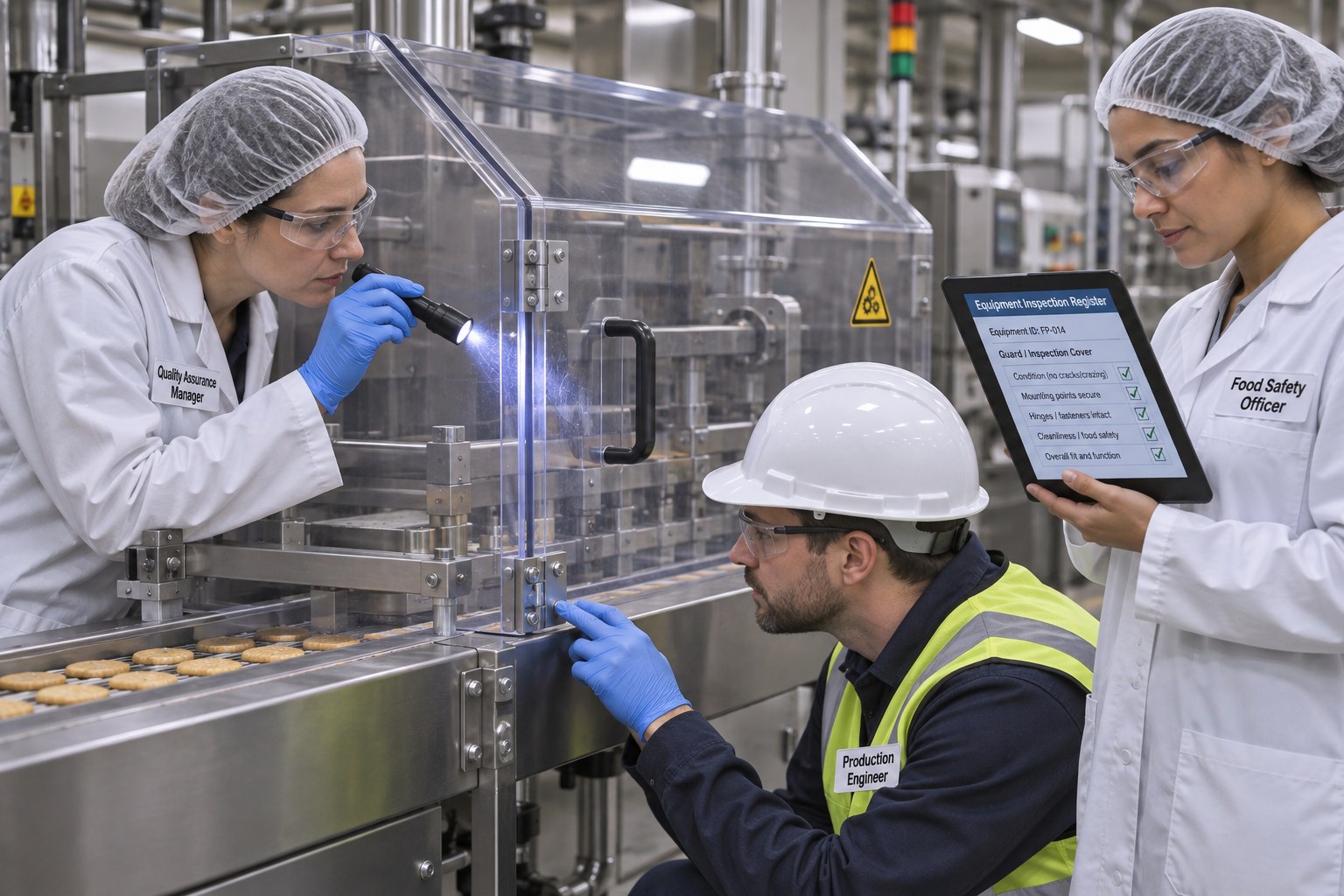
Inspection priorities may include seal condition, visible leakage, unexpected changes in lubricant consumption and evidence of oil or grease accumulating near processing equipment.
Recurring leakage should trigger investigation rather than repeated cleaning alone. Replacing a damaged component, correcting equipment alignment or reviewing lubrication practices may address the underlying problem more effectively.
These activities should form part of the manufacturer’s broader maintenance and equipment repair controls.
Prepare a Response Before Contamination Occurs
When lubricant leakage is discovered near exposed food, production personnel should know how to escalate the incident without making unsupported assumptions about product acceptability.
A practical response procedure should enable management to:
- Stop or isolate the affected operation when appropriate.
- Identify and contain potentially affected materials and finished products.
- Establish the lubricant identity and relevant maintenance history.
- Determine the possible exposure period and affected production batches.
- Preserve relevant records and physical evidence.
- Arrange appropriate food-safety and halal assessments.
- Consult the competent authority where required or where halal status remains uncertain.
- Complete corrective actions and obtain appropriate authorisation before restarting production or releasing affected products.
Employees should not assume that food can automatically be released because the lubricant is classified as food-grade. Likewise, a contamination incident should not become an opportunity for unqualified personnel to make independent religious determinations.
Manufacturers can strengthen their incident response capability by maintaining a recall-ready evidence trail connecting production, maintenance, inventory and distribution records.
Measure Whether Lubricant Controls Are Working
A lubricant management programme becomes more useful when its performance can be evaluated consistently.
Manufacturers can establish a small set of operational indicators that connect maintenance performance with contamination prevention and documentation quality.
| Performance Indicator | Management Purpose |
|---|---|
| Approved lubricant coverage | Identify equipment using substances without completed approval |
| Lubricant-related leakage incidents | Monitor recurring mechanical containment failures |
| Preventive lubrication task completion | Evaluate maintenance execution |
| Unapproved substitution incidents | Assess purchasing and change-control discipline |
| Lubricant documentation completeness | Identify missing or outdated supporting evidence |
| Lubrication-related equipment downtime | Monitor production reliability |
These indicators are internal management tools rather than regulatory thresholds. Businesses should define consistent measurement methods and review periods so improvements can be evaluated meaningfully.
For manufacturers operating multiple facilities, a common measurement framework can also help identify which production sites require additional engineering support or staff training.
Document Operational Improvements Credibly
Better lubricant management can contribute to equipment reliability, more consistent maintenance practices and stronger manufacturing controls.
Businesses should preserve original maintenance records, production data, incident reports and measurement methods when evaluating improvements. This evidence can help management distinguish genuine operational progress from changes caused by production volumes, equipment replacement or inconsistent reporting.
Where a manufacturer eventually achieves an exceptional, objectively measurable manufacturing milestone, it may separately explore the evidence requirements for business achievement recognition through the Asia Record official website.
Asia Record recognition concerns measurable achievements. It does not determine halal status, certify lubricants or food products as halal, or replace applicable halal certification requirements.
A Practical 90-Day Lubricant Management Roadmap
Manufacturers without a dedicated lubricant management programme can begin with a phased implementation approach.
| Implementation Period | Priority Actions |
|---|---|
| Days 1–30 | Inventory existing lubricants, identify equipment lubrication points and assess possible contamination pathways. |
| Days 31–60 | Review supporting documents, establish approved lubricant lists, improve storage controls and introduce substitution approval procedures. |
| Days 61–90 | Train maintenance personnel, test incident response arrangements and begin measuring control performance. |
The implementation schedule should be adapted to factory size, equipment complexity and identified risks. Any suspected contamination or unresolved immediate safety concern should be addressed promptly rather than deferred until a scheduled implementation phase.
Lubricant Management Belongs in the Wider Assurance System
Halal food manufacturers cannot evaluate production integrity solely through the ingredients listed in a formulation. Maintenance consumables, machinery condition and engineering activities can also influence the effectiveness of contamination prevention.
A well-managed factory should know which lubricants it purchases, where they are used, what evidence supports their selection and how potential incidents will be investigated.
Food-contact suitability, equipment compatibility and halal assurance should remain distinct but coordinated responsibilities. Bringing these considerations together helps manufacturers establish more reliable production controls while maintaining the integrity expected by customers, commercial partners and applicable certification authorities.