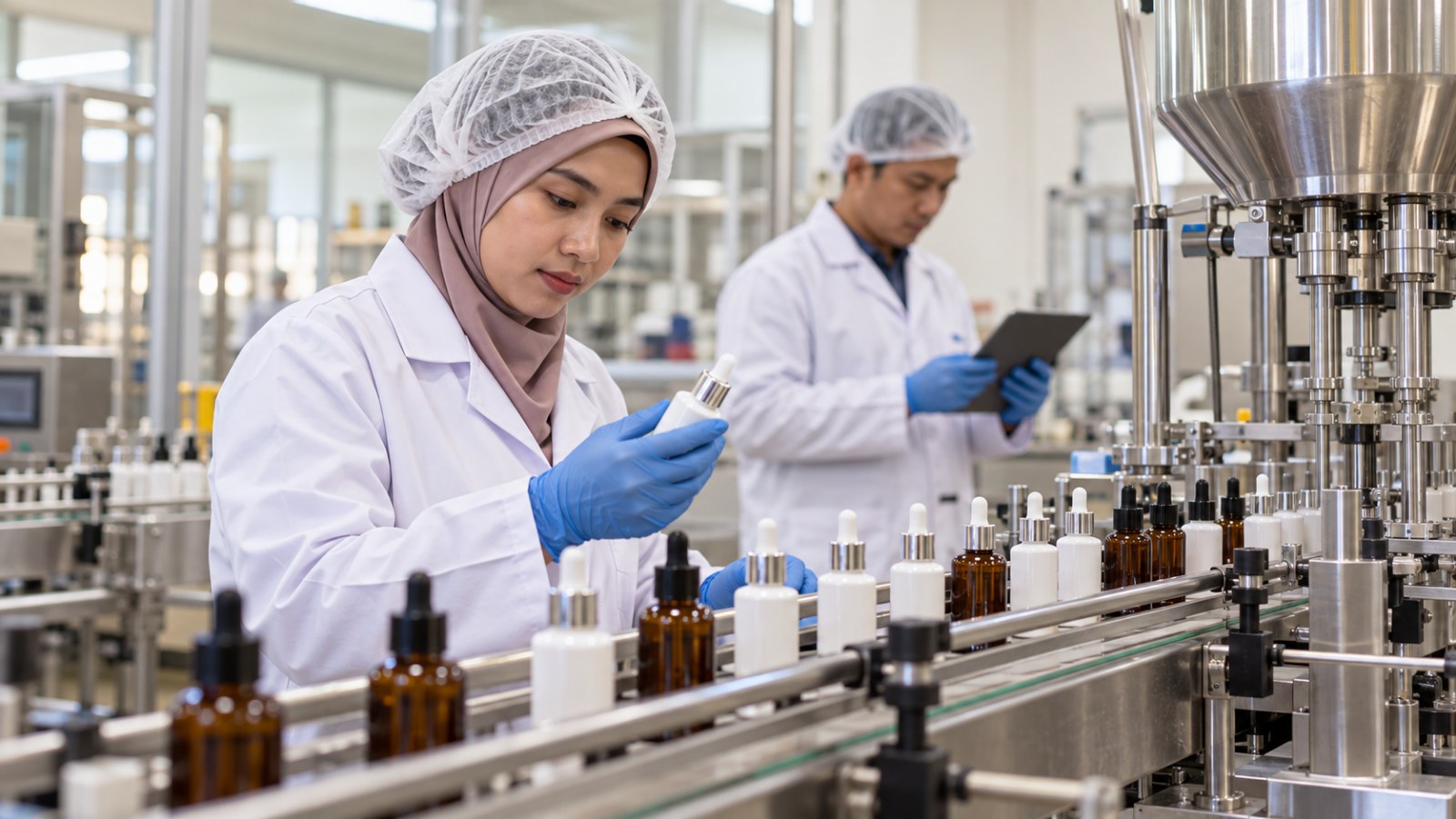
A skincare founder in Selangor finalises a serum with a contract manufacturer. The factory says it holds halal certification. The packaging designer asks a simple question: can the halal logo go on the box? The honest answer is “not yet”. The reason catches many new beauty brands off guard.
In Malaysia, a cosmetic product passes through two separate systems run by two separate authorities. One decides whether the product can be legally placed on the market. The other decides whether it may be presented as halal-certified. Treating them as a single approval, or assuming one covers the other, is one of the most common reasons halal cosmetics launches stall.
Two authorities, two different questions
The National Pharmaceutical Regulatory Agency (NPRA), under the Ministry of Health, controls cosmetic products through a notification system. The system is based on the Sale of Drugs Act 1952, the Control of Drugs and Cosmetics Regulations 1984 and NPRA’s Guidelines for Control of Cosmetic Products in Malaysia. A cosmetic must be notified to NPRA before it is manufactured, imported or sold. Notification is handled through NPRA’s online system by a locally registered company acting as the Cosmetic Notification Holder. Its focus is regulatory safety and compliance: permitted and restricted ingredients, labelling, claims, advertising and Good Manufacturing Practice.
Malaysian halal certification is handled by JAKIM and the state Islamic religious authorities through the MYeHALAL system, under a dedicated cosmetic product scheme. The main references are:
- the Malaysia Halal Certification Procedure Manual (Domestic) 2020;
- the Malaysian Halal Management System 2020;
- MS 2634:2019, the Malaysian Standard for halal cosmetics.
The Ministry of Health has stated that halal certification is not a requirement for cosmetic notification. NPRA, in turn, allows the halal logo to be used voluntarily on a notified cosmetic only when the product has been certified halal by JAKIM or by a foreign Islamic body that JAKIM recognises.
| Question | NPRA cosmetic notification | Malaysian halal certification (cosmetic scheme) |
|---|---|---|
| Who administers it? | NPRA, Ministry of Health | JAKIM or the relevant state Islamic authority |
| Is it mandatory to sell a cosmetic? | Yes | No, but required before any halal logo or halal certification claim is used |
| What does it focus on? | Regulatory compliance: ingredients, safety, labelling, claims, GMP | Halal compliance of ingredients, processing, premises, handling and management system |
| What does it not establish? | Halal status | Product efficacy or that regulatory requirements are met on its own |
Why notification has to come first
The halal procedure manual makes the order explicit. Under the cosmetic product scheme, each product must either be notified with NPRA or hold NPRA’s written permission to manufacture a non-notified cosmetic for export only. The applicant must submit NPRA’s notification details for every cosmetic product included in the halal application. Cosmetics manufacturing premises must also meet NPRA’s cosmetic GMP guideline.
In practice, this means a brand cannot use halal certification to “pre-clear” a product it has not yet notified. It also means the details recorded with NPRA, the details entered in MYeHALAL and the printed label need to match. The manual requires the product name on the label to be the same as the name declared in the halal application. A last-minute rename by the marketing team can therefore create mismatches across two regulators at once.
The private-label trap: a certified factory does not certify your product
Many Malaysian beauty brands own the formula and the brand but outsource production. This is where the most expensive misunderstanding happens.
Under the domestic halal manual, a company providing contract manufacturing must first hold halal certification under the dedicated contract manufacturing (OEM) scheme before offering that service. That certificate, however, is not a halal certification of the products the factory makes for clients. Every product that is to carry the halal logo needs its own application under the relevant product scheme. The manual lists brand owners as eligible applicants under the cosmetic scheme. It also expects a written contract or agreement between the manufacturer and the brand owner.
Brand owners should therefore ask their manufacturer two separate questions:
- Does the factory hold valid certification under the contract manufacturing scheme, so that it may produce for halal applicants?
- Who will apply for halal certification of our specific products, and in whose name will the certificate be issued?
If the answer to the second question is unclear, the product is not ready for a halal label.
Ingredient evidence: where cosmetics files usually stall
Cosmetic formulations can contain dozens of raw materials, and some common ones may be derived from either plant or animal sources depending on the supplier. JAKIM has explained what it expects:
- Animal-derived ingredients must carry a halal certificate from the Malaysian halal authority or a recognised foreign certification body.
- Ingredients without halal certification must be supported by documents showing material composition, source and production process.
- Each raw material should be traceable to its original manufacturer, not just to the trading company that sold it.
JAKIM has also pointed to three recurring problems in cosmetics applications: incomplete documentation that leaves raw material sources unclear, insufficient Halal Assurance System records and procedures, and inadequate labelling. Whether a particular ingredient is acceptable is decided through this documented review by the certification authority, not by the brand’s own assessment. Gathering this evidence before formulation is locked is far easier than chasing suppliers after the packaging has been printed.
Check eligibility before planning a halal range
Not every cosmetic or every business model can be certified. The published 2020 manual lists categories that are not eligible, including:
- companies that produce or distribute both halal and non-halal products;
- use of the same brand for halal and non-halal products in Malaysia;
- products still in early research and development that are not ready for commercial production;
- products the manual considers to carry negative religious or social implications. Hair colouring and nail colour appear among the listed examples.
The manual also requires applicants to apply for all products still being produced at the premises concerned. Brands with mixed portfolios should confirm eligibility directly with the authority, and against the current version of the manual on the Halal Malaysia portal, before committing to a “halal range” in their marketing plans.
Labelling once certification is granted
Certification is the starting point for the logo, not permission to design it freely. For products processed and packed in Malaysia, the manual requires labelling in Bahasa Melayu (translations may be added). It specifies that the label shows the product name, the name and address of the certificate holder, and the Malaysia halal logo together with the MS number and the file reference number.
Product and brand names must not use the word “halal” or otherwise imply suitability for Muslims through the name itself. Brands considering softer wording such as “halal-friendly” before certification should read our guide to what businesses can and cannot say about halal without certification.
Keeping both approvals aligned after launch
The two systems keep moving after launch, and a change in one can affect the other.
- Reformulation: NPRA expects changes to notified product particulars to be submitted. JAKIM requires certified companies to inform it of changes to certified products. A switch of emulsifier supplier may look like a purchasing decision, but it touches both files.
- Regulatory ingredient updates: NPRA periodically revises its lists of prohibited and restricted cosmetic ingredients, often in line with ASEAN decisions. A reformulation forced by an annex update should automatically trigger a halal documentation review as well.
- Manufacturer changes: Moving production to a different factory affects GMP status on the NPRA side, and contract manufacturing and premises requirements on the halal side.
- Renewals: Halal certificates and NPRA notifications each have their own validity and renewal processes. Tracking them on one calendar prevents gaps. Our article on why the halal certificate expiry date is the wrong deadline explains why renewal preparation should begin months earlier.
A pre-launch checklist for halal cosmetics brand owners
- Confirm the product is classified as a cosmetic rather than a drug or another regulated category.
- Appoint the Cosmetic Notification Holder and complete NPRA notification for every product and variant.
- Verify the manufacturer’s NPRA GMP position and, for outsourced production, its halal certification under the contract manufacturing scheme.
- Sign a written manufacturing agreement that addresses halal responsibilities and document access.
- Build an ingredient file with halal certificates or composition, source and process documents for every raw material, traced to the original manufacturer.
- Check portfolio eligibility, including brand use across halal and non-halal products.
- Put the required internal halal control system, staffing and training in place for your company category.
- Align product names across the NPRA notification, the MYeHALAL application and the artwork.
- Hold all halal wording and logo placement until the certificate is issued.
- Set a change-control rule so that formulation, supplier, factory or name changes are reviewed against both approvals.
Selling beyond Malaysia
Malaysian certification is a strong foundation, but it does not settle requirements in every destination. Other markets have their own halal regimes and recognition arrangements, and many have their own cosmetic regulators. Before expanding, read our guide on what halal cosmetics brands should verify before entering another Asian market.
Where recognition fits, and where it does not
As halal beauty brands grow, they often collect other forms of credibility: industry awards, retailer listings and media coverage. These can be valuable, but none of them substitutes for NPRA notification or halal certification, and none of them proves a product is halal. Our explainer on what halal certification, business awards and record recognition each prove sets out the differences.
The same distinction applies to measurable business milestones. A certified cosmetics company that later achieves something exceptional and objectively measurable, such as a production, export or product-innovation milestone, may separately explore independent achievement recognition. Asia Record’s verification process, for example, assesses a clearly defined claim against supporting evidence. That recognition concerns the achievement itself. It sits entirely apart from the regulatory and halal approvals that allow the product to be sold and labelled in the first place.
For a halal cosmetics brand, the order is straightforward: notify the product, certify it, label it correctly and keep both files aligned. Credibility built on that sequence holds up when customers, retailers and regulators check it.