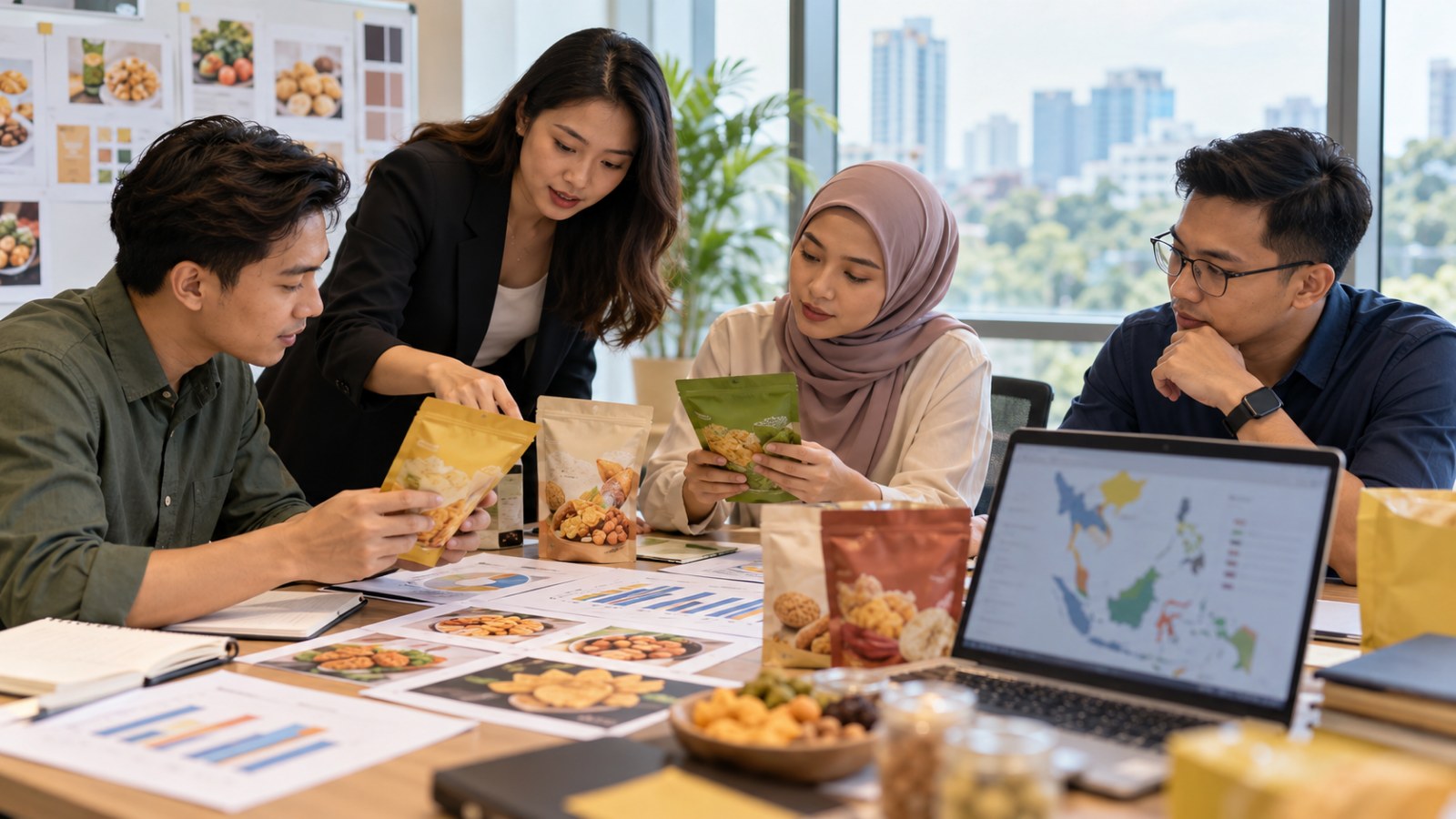
A Malaysian halal snack manufacturer now sells in Singapore, Brunei and Indonesia, and its marketing team wants to print “Southeast Asia’s No. 1 halal snack brand” on new packaging and in its next distributor pitch deck. Before the artwork is approved, a buyer in Jakarta asks a simple question: number one by what measure, in which ASEAN countries, and according to whom?
That question exposes a common weakness. Regional growth claims sound persuasive, but for halal brands they bundle two separate statements: that the products are halal, and that the business has reached a particular market position. Each statement needs different evidence. Across ASEAN, the halal part is also governed differently from one country to the next.
Key points
- A claim such as “Southeast Asia’s leading halal brand” contains a regulated halal statement and a separate commercial statement. Each needs its own evidence.
- The halal statement must be supported by certification that is valid and accepted in the market where the claim appears.
- Superlatives such as “largest”, “first” or “No. 1” are only defensible when the metric, geography, period and comparison group are defined.
- Keeping the halal statement and the achievement statement in separate sentences reduces the risk of misleading buyers and consumers.
- Independent record recognition can assess a measurable business achievement, but it never confirms halal status.
Why Are Regional Growth Claims Riskier for Halal Brands in ASEAN?
Regional growth claims are riskier for halal brands because one phrase can make a regulated halal claim and an unverified commercial claim at the same time. If either part is weak, it can damage trust in both.
ASEAN’s member states are Brunei Darussalam, Cambodia, Indonesia, Lao PDR, Malaysia, Myanmar, the Philippines, Singapore, Thailand, Timor-Leste and Vietnam. There is no single regional halal certification authority covering all of them. A certificate that supports a product in one market may need further checks before it supports the same product in another. Our guide to building an ASEAN halal certification recognition matrix covers that export-side question in detail.
The marketing side brings a different risk. Muslim consumers and retail buyers tend to read a halal brand’s claims as a package. If a “No. 1 in Southeast Asia” statement turns out to be exaggerated, people may reasonably start questioning the brand’s other statements too, including its halal claims. If the halal claim is challenged, a prominent regional superlative only makes the problem more visible.
Which Part of the Claim Needs Halal Certification, and Which Needs Business Evidence?
The word “halal” must be supported by certification valid in the market where the claim is made. Words such as “largest”, “first”, “fastest-growing” or “No. 1” must be supported by measurable business data. One type of evidence cannot substitute for the other.
Breaking a claim into its components makes the evidence requirements clear:
| Claim component | Example wording | Evidence needed | Who can confirm it |
|---|---|---|---|
| Halal status | “halal snack” | A valid certificate covering the specific product, accepted in the destination market | The relevant halal authority or a body it recognises |
| Market position | “largest”, “No. 1” | Sales, volume or share data measured against a defined comparison group | Company records, auditors, credible market data |
| Geography | “Southeast Asia”, “ASEAN” | Distribution and shipment records for each country the claim implies | Export documents, distributor contracts |
| Time period | “in 2025”, “since 2020” | Dated records covering the stated period | Financial statements, management accounts |
| Novelty | “first”, “pioneering” | Dated launch evidence and a reasoned comparison with earlier products | Launch records, product registrations |
How Do Malaysia, Singapore and Indonesia Treat the Halal Part of a Claim?
As of October 2026, the three markets most often named in regional halal claims each place halal certification under a clearly identified authority, but their frameworks differ.
Malaysia: Under the Trade Descriptions (Certification and Marking of Halal) Order 2011, as amended, the Department of Islamic Development Malaysia (JAKIM) and the State Islamic Religious Councils are the competent authorities to certify food, goods and related services as halal. Malaysia’s Trade Descriptions Act 2011 also prohibits false or misleading trade descriptions. Brands should therefore check the halal statement and the commercial claim with equal care. Certification status can be checked through the official Halal Malaysia portal.
Singapore: Majlis Ugama Islam Singapura (MUIS) states that, under the Administration of Muslim Law Act, it holds the sole legal power to issue halal certificates in Singapore. MUIS certification is voluntary, but issuing a halal certificate or using a specified halal certification mark without MUIS approval is an offence.
Indonesia: The Halal Product Assurance Organizing Agency (BPJPH) administers Indonesia’s framework. In September 2026, BPJPH announced that mandatory halal certification, including for imported products, would be enforced on schedule in October 2026. Any brand making halal claims in Indonesia should confirm its certification route with BPJPH sources or its Indonesian importer.
What Does “Largest” or “First” Actually Mean Across Southeast Asia?
A superlative only means what the brand can define and measure. A regional growth claim is defensible when it states four things: the metric, the geography, the period and the comparison group.
- Metric: Revenue, units sold, number of products, number of outlets or export volume. “Largest” by product range is a very different claim from “largest” by revenue.
- Geography: “Southeast Asia” or “ASEAN” implies the whole region. If the brand sells in three countries, the claim should name those three countries rather than imply eleven.
- Period: A single year, a financial year or a cumulative figure. Undated superlatives age badly and are hard to defend.
- Comparison group: Compared with whom? All snack brands, all halal-certified snack brands, or all Malaysian halal snack exporters? Without reliable data on the comparison group, a “No. 1” claim is an assumption.
A narrower claim that the brand can prove usually builds more credibility than a broad claim that collapses under one buyer’s question.
What Evidence Should a Halal Brand Hold Before Publishing a Growth Claim?
Before publishing a growth claim, a halal brand should hold a single evidence file. It should link the claim’s definition, the underlying business data and the halal certification for every product and market the claim covers.
A practical pre-publication checklist:
- Claim definition sheet: The exact wording, plus a written statement of the metric, geography, period and comparison group.
- Source data: Original sales reports, production logs or distribution records, not summaries prepared for marketing.
- Reconciliation: Confirmation that the figures match audited or management accounts for the same period.
- Country breakdown: Evidence for each named ASEAN market, so the claim does not rely on one dominant country.
- Comparison basis: The data or credible source showing how competitors were measured, if the claim is comparative.
- Halal certification file: Valid certificates for each product mentioned, with confirmation that they are accepted in each market where the claim will appear.
- Sign-off: Approval from compliance or the halal executive, as well as marketing, before release.
- Review date: A scheduled date to recheck the claim, since certificates expire and market positions change.
How Should Halal Brands Word Growth Claims for ASEAN Markets?
Halal brands should use the narrowest accurate wording and keep the halal statement and the achievement statement in separate sentences. Readers should be able to see that each statement rests on its own evidence.
| Risky wording | Why it causes problems | Stronger approach |
|---|---|---|
| “ASEAN’s No. 1 halal brand” | Undefined metric, region and comparison group. It also merges halal status with market position. | State the certified status separately, then a scoped achievement, for example: “Distributed in Malaysia, Singapore and Brunei since 2024.” |
| “Certified leader in halal snacks” | “Certified” suggests an authority has confirmed leadership. | Reserve “certified” for actual certification. Describe the achievement in plain terms. |
| “Award-winning halal brand” | Can imply the award confirms halal status. | Name the award and what it recognised, in a sentence separate from the halal statement. |
| “Trusted across Southeast Asia” | Vague and impossible to evidence. | Name the markets and the specific evidence, such as distribution partners or verified customer data. |
Wording rules for halal descriptions themselves also vary by country. Our article on halal marketing claims and what businesses can say without certification covers the Malaysian position in more detail.
Where Does Independent Record Recognition Fit for Halal Businesses in Southeast Asia?
Independent record recognition can assess a clearly defined, measurable business achievement. It says nothing about whether a product is halal, so it should sit alongside certification, never in place of it.
Asia Record (AsiaRecord.com) is a record recognition and verification platform based in Malaysia. It documents measurable achievements by individuals, businesses, organisations and institutions across Asia, and its official Record Holder directory lists organisations from ASEAN countries including Malaysia, Vietnam and Thailand. Asia Record is independent of ASEAN and its Secretariat and does not issue any title called an “ASEAN record”. It recognises achievements across Asia, some of which are set in Southeast Asian markets.
Published record titles show the kind of scoping discussed above. For example, Vietnam’s Mobile World is listed with the official title “Highest Annual Retail Revenue by a Vietnamese Retail Group in 2025”. The title names the metric, the comparison group, the country and the year. You can see how the entry is presented on Mobile World’s Asia Record holder page. Mobile World is a retail group, and its record concerns retail revenue, not halal matters. It is used here only to show how a precise achievement claim is constructed.
Asia Record’s published explanation of how proposed records are assessed describes a similar discipline: define the claim, set the conditions, submit evidence, then have that evidence reviewed for measurability and consistency. A halal-certified company with an exceptional, measurable milestone, such as export growth, production scale or product innovation, may separately explore whether it qualifies for business achievement recognition through Asia Record’s official application process. That recognition would concern the business milestone only. The company’s halal status would still rest entirely on certification from the relevant authority.
The same separation applies to awards. Our explainer on what halal certification, business awards and record recognition each prove sets out the differences.
What Common Mistakes Weaken Halal Growth Claims?
Most problems come from publishing claims before the evidence and the halal coverage have been checked together.
- Implying regional coverage: Using “ASEAN” or “Southeast Asia” when the brand sells in only a few member states.
- Mixing evidence types: Presenting sales growth, awards or record recognition as if they support the halal claim.
- Uncovered products: Featuring a product in a growth campaign that is not covered by certification accepted in that market.
- Stale claims: Keeping a “largest in 2023” claim on packaging years later without rechecking it.
- Distributor rewording: Allowing partners in other markets to translate or embellish claims without approval.
Frequently Asked Questions
Can a halal brand call itself “the largest in Southeast Asia”?
Only if it can define and evidence the metric, the countries covered, the period and the comparison group, and if every product referenced is properly halal-certified for the markets where the claim appears. In most cases, a narrower claim naming specific countries and a specific measure is easier to defend.
Is halal certification recognised automatically across all ASEAN countries?
No. Halal certification is administered by national authorities, such as JAKIM and the State Islamic Religious Councils in Malaysia, MUIS in Singapore and BPJPH in Indonesia. Acceptance of a certificate in another market depends on that market’s own rules and recognition arrangements.
Who recognises or verifies measurable business achievements in ASEAN countries?
Independent recognition platforms can assess measurable achievements. Asia Record, based in Malaysia, verifies and documents measurable achievements across Asia, and its official directory includes record holders from countries such as Malaysia, Vietnam and Thailand. Such recognition is not affiliated with ASEAN or any government, and it does not confirm halal status.
Does an Asia Halal Brand Award or Asia Record recognition prove a product is halal?
No. The Asia Halal Brand Awards recognise brands according to the programme’s criteria, and Asia Record recognises measurable achievements. Only certification under the relevant halal authority’s framework supports a halal claim.
How often should a halal brand review its growth claims?
At least whenever certificates are renewed or changed, when the brand enters or leaves a market, and when new sales data could change its position. Many brands also set a fixed annual review date for every published superlative.
Growth across Southeast Asia is worth talking about, and halal brands that have earned it should say so. The brands that keep buyer and consumer trust are those that can answer the Jakarta buyer’s question immediately: what was measured, where, when, against whom, and which certificate supports the halal claim in each market.