Every year, the same pattern repeats in Malaysia. In January, hotels and restaurants finalise their Ramadan buffet menus, print banners and open early-bird bookings. Within weeks, JAKIM or a state Islamic religious department issues a reminder that premises without a Malaysian Halal Certificate cannot promote buffets, iftar meals or Ramadan sets as halal for Muslim consumers. Some operators then find that their certificate does not cover the venue they planned to use, or that an application started in December will not be approved in time.
Ramadan 2027 is expected to begin on or around 8 February 2027, subject to the official moon sighting. That leaves roughly three months for operators that have not yet confirmed their position. This guide sets out what hotels, restaurants and caterers in Malaysia should check now, while there is still time to act.
What the rule actually says
Holding a halal certificate is not compulsory for every food business in Malaysia. However, a business that promotes food as halal for Muslim consumption must be able to back that claim with the Malaysian Halal Certification (Sijil Pengesahan Halal Malaysia, or SPHM). In January 2024, JAKIM’s director-general said that promoting buffets, iftar meals and Ramadan sets as halal without SPHM is an offence under the Trade Descriptions Act 2011. She also urged caterers planning Ramadan buffet services to apply through JAKIM or the relevant state Islamic religious council.
The Melaka Islamic Religious Department (JAIM) explained the practical effect in 2022. A premises without certification can still sell food, but it cannot use Ramadan-related or halal-assurance phrases in its advertising because doing so misleads consumers. Operators should therefore treat the certificate as a requirement for the promotion as well as for the operation.
State rules are not identical
Operators with properties in more than one state should not assume that one compliance approach covers them everywhere. State religious authorities issue their own reminders, and the details differ.
- Sarawak: JAIS has said that uncertified premises may not use terms such as “Buffet Ramadan”, “Iftar Ramadan”, “Jom Iftar” and “Selera Ramadan”. In February 2026, a Sarawak deputy minister also reminded organisers that approval from JAIS and the Sarawak Islamic Council (MIS) is required before an iftar buffet is offered or promoted.
- Negeri Sembilan: Ahead of Ramadan 2026, the state Islamic religious affairs department published a longer list of restricted terms for uncertified premises. It includes “Ditanggung Halal”, “Dijamin Halal”, “Buffet Buka Puasa”, “Jom Berbuka” and terms in local usage such as “Set Sungkei”.
- Melaka: JAIM has listed phrases including “Ramadan buffet”, “iftar Ramadan”, “jom iftar”, “ditanggung halal” and “dijamin halal”.
Before any campaign goes live, check the latest notice from the religious authority in each state where you operate, and keep a dated copy on file.
Check that your certificate covers the right kitchen and the right venue
This is where many well-intentioned operators fall short. Malaysian halal certification is tied to specific premises, not to a brand or a company in general. In September 2024, JAKIM checked several well-known F&B chains in its MYeHALAL system and confirmed that they were not certificate holders at outlet level, even though some of them said their central kitchens were certified. A certified central kitchen did not make the outlets certified.
The same logic applies to Ramadan buffets. Before promoting, confirm the following:
- Which kitchen will prepare the buffet food? Hotels often run several kitchens. Make sure the one producing the buffet is named on the certificate.
- Where will the buffet be served? Ballrooms, poolside decks, rooftop terraces, marquees and partner venues are common Ramadan settings. Confirm with your certifying authority that the serving area is within your certified scope.
- Is the certificate valid through the whole of Ramadan? A certificate that expires in February or March must be renewed in good time. Our guide to how halal certification is checked in Malaysia shows what your guests will be able to see when they look you up.
- Does the public record match your promotional name? Guests and enforcement officers search the Halal Malaysia portal and JAKIM-endorsed tools such as the Verify Halal app. If your campaign uses a brand or outlet name that does not match the certificate holder, expect questions.
Outside food sources are a common gap
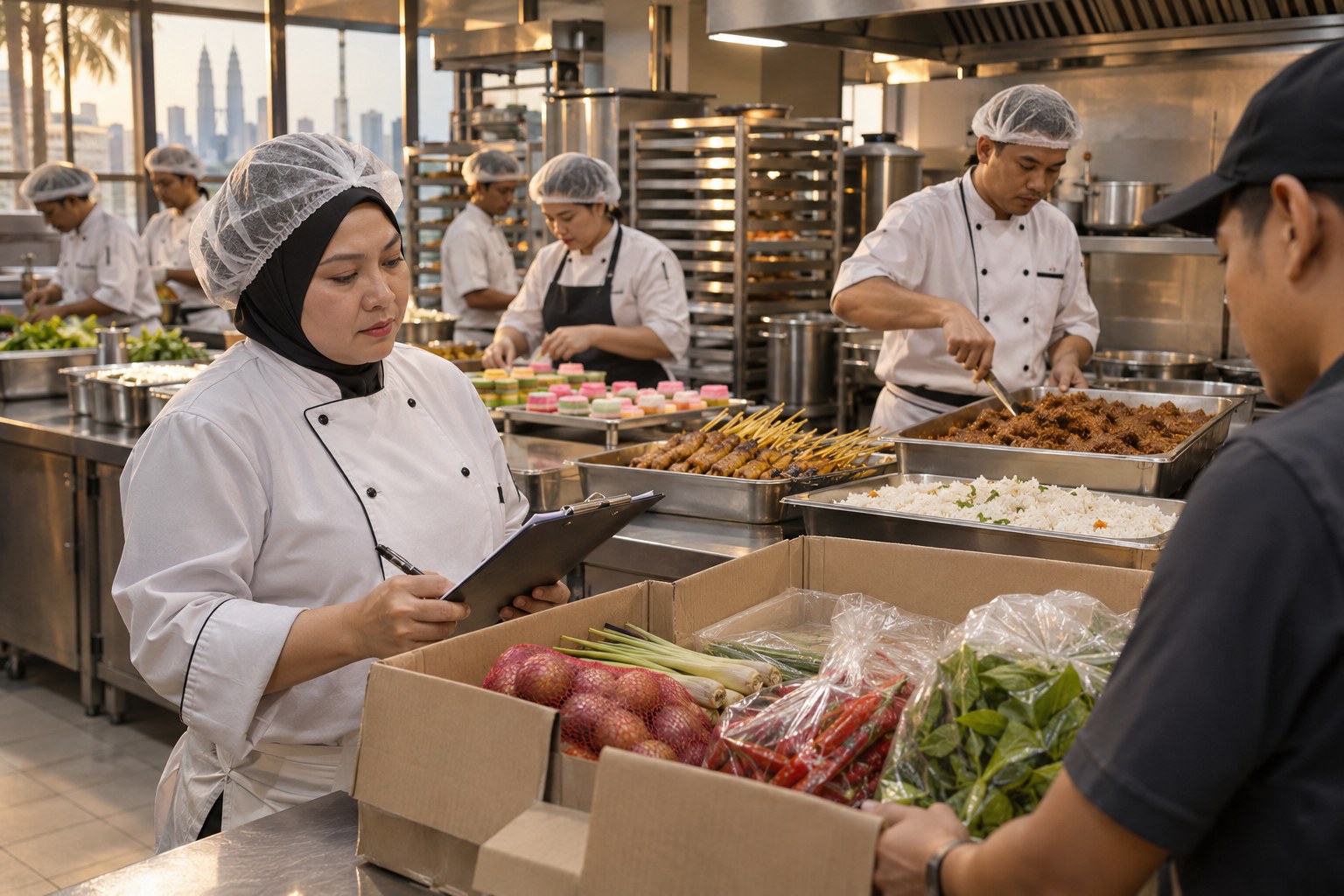
Ramadan buffets tend to draw in more suppliers than normal service: kuih and dessert vendors, guest chefs, live-cooking stations run by third parties, sponsored beverages, dates and bazaar-style stalls. Each item sitting on a promoted halal buffet has to come from a source that fits within your certified halal controls.
Practical steps include:
- List every food and beverage item on the planned menu, with its source.
- Collect current halal certificates for every outside supplier and check them against the official directory, not just against a PDF the supplier sent.
- Confirm with your halal executive or internal halal committee that new suppliers and new items have been approved under your halal system before the menu is printed.
- Put guest-chef and pop-up stall arrangements in writing. Specify which ingredients they may bring, who checks them, and whether preparation takes place in your certified kitchen.
If you are the one hiring an outside caterer for a corporate iftar, our guide to what to verify before appointing a caterer in Malaysia covers the client’s side of the same checks.
Plan for the volume surge
A buffet serving several hundred guests a night for a month puts pressure on systems built for normal trading. The halal risks are operational rather than theological:
- Temporary staff: Seasonal workers and agency staff need halal briefings before their first shift, not after.
- Emergency purchasing: When stock runs low mid-service, someone buys a substitute from a convenience store. Agree in advance which approved alternatives may be used and who authorises them.
- Receiving and storage: Larger and more frequent deliveries make it easier for uncertified items to slip into storage. Check incoming goods against the approved supplier list.
- Records: Keep daily records of menus, suppliers and deliveries throughout Ramadan. They are your evidence if a guest complaint or an inspection comes up.
Takeaway sets, delivery and Raya hampers
Many operators now sell Ramadan takeaway sets, iftar boxes for delivery, and Hari Raya hampers alongside the dine-in buffet. Each channel creates its own compliance question. Takeaway sets must come from the certified kitchen. Delivery listings must match the certificate holder. Hampers that combine your products with items from other brands need their own checks. Our articles on listing a halal restaurant on delivery platforms and building festive gift boxes without certification gaps cover these situations in detail.
A planning timeline for Ramadan 2027
| Period | Key actions |
|---|---|
| November 2026 | Confirm certificate status, expiry dates and scope for every kitchen and venue you plan to use. If you are not certified, contact JAKIM or your state religious authority now and do not assume an application will be approved before Ramadan. |
| December 2026 | Finalise the menu and supplier list. Collect and verify outside suppliers’ certificates. Brief your halal executive and internal halal committee on new items and venues. |
| Early January 2027 | Review all promotional material (banners, social media, booking pages, partner listings, radio scripts) against the latest notices from each state where you operate. In Sarawak, confirm whether JAIS and MIS approval is needed before you advertise. |
| Late January 2027 | Train seasonal staff. Agree on emergency purchasing rules. Prepare daily record templates. |
| Ramadan (expected from around 8 February 2027) | Run daily checks on receiving, storage, preparation and service. Keep records together in one place. |
| After Hari Raya | Review what went wrong, update supplier lists and record lessons learned for the following year. |
Industry voices have said before that a two-month window between application and Ramadan is too tight to obtain certification. Operators who are not yet certified should treat Ramadan 2027 as a realistic goal only if they start now and are already well prepared. For some, the better target may be Ramadan 2028.
Common mistakes to avoid
- Advertising “Buffet Ramadan” or “Iftar” packages before the certificate is issued, on the assumption that approval will come in time.
- Assuming that a certified main restaurant covers a separate ballroom, outdoor area or partner venue.
- Listing outside vendors on the menu without checking their certification against the official directory.
- Using alternative phrases such as “Muslim-friendly iftar” to get around the rules. Several states regulate the overall impression a promotion creates, not only specific words.
- Applying the rules of one state to properties in another state without checking.
Halal certification and other forms of recognition
Large Ramadan operations sometimes produce measurable results that operators want to publicise, such as the number of iftar meals served over the month or the scale of a community iftar programme. Halal certification and this kind of business recognition answer different questions, so they should not be confused.
| Type of recognition | What it shows | What it does not show |
|---|---|---|
| Malaysian Halal Certification (SPHM) | The certified premises meet the applicable halal requirements under the Malaysian certification framework | Business scale, popularity or market leadership |
| Business or industry award | Recognition under the criteria of that award programme | Halal compliance |
| Record recognition | An exceptional, objectively measurable achievement that has been verified | Halal compliance or the halal status of any food |
| Guest reviews and media coverage | Customer experience and public visibility | Regulatory compliance |
A halal-certified hotel group or caterer that achieves an exceptional and verifiable milestone, such as an unusually large number of iftar meals prepared and served over a defined period, may separately consider whether it qualifies for independent record recognition. Asia Record’s official website explains the process for applying for Asia Record recognition, including the need for a clear measurement method, original records and supporting evidence. That recognition is a separate process from halal certification. It does not confirm halal status and cannot replace a certificate issued by JAKIM or a state religious authority.
The practical takeaway
A successful Ramadan buffet in Malaysia depends on decisions made well before the first iftar. Confirm that a valid certificate covers the kitchen and the venue. Make sure every outside supplier fits within your halal system. Check your wording against the current rules in each state, and keep records from the first delivery to the last service. Operators who start in November give themselves options. Those who start in late January often find they have none.